More decorated books from the Netherlands

netherlands1.jpg

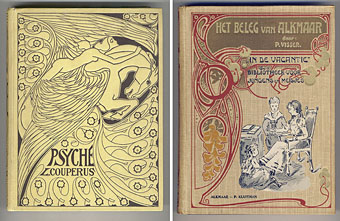
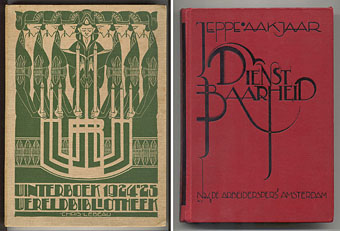
left: Jan Toorop (1898); right: no designer credited (1904).

A search this week for work by Dutch designer Chris Lebeau (1878–1945) turned up another collection of fantastic decorated covers and prints from the Netherlands, running from the Art Nouveau period through Art Deco up to the 1940s. I found some Lebeau pieces but the big surprise was also discovering a number of cover designs by the Symbolist artist Jan Toorop (1858–1928). Toorop’s highly-stylised draughtsmanship easily lends itself to graphic design but I’ve never seen cover illustration mentioned in any discussion of his work. The site doesn’t have any text in English but the pictures are well worth a browse.

Update: Well…the pictures were worth a browse but the site is currently offline, all the links now go to a domain holding-page.

netherlands2.jpg

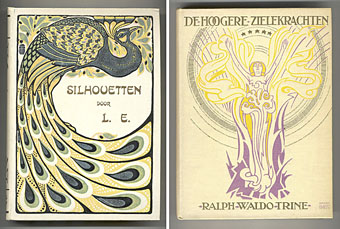
left: Albert Angus Turbayne (1913); right: CA Vlaanderen (1919).

The peacock cover is a variation on an earlier design by Albert Angus Turbayne.

netherlands3.jpg

left: Chris Lebeau (1924); right: AP Hahn Jr. (1931).

Elsewhere on { feuilleton }
The book covers archive

Previously on { feuilleton }
Netherlands decorated books

Repin and Ljuba

repin.jpg

Sadko in the Underwater Kingdom (1876).

This painting by Russian artist Ilya Yefimovich Repin (1844–1930) is included in one of my Symbolist art books despite its pre-dating the Symbolist period and there being little else in the artist’s career which might suit the label. It’s a curious picture, however, illustrating a medieval folk tale and depicting the moment when the Sadko of the title is forced by the Sea Tsar to choose a wife from a line of aquatic maidens. It was art historian Philippe Jullian who had me returning to Repin, and the reminder gives me an excuse to post something by Serbian Surrealist Ljuba (aka Ljuba Popovic) whose colours, fauna and metamorphic female figures are a match for Repin’s sirens. Last time I looked for Ljuba pictures there were few available, a situation which has now been remedied by blogs such as this one.

ljuba.jpg

Lot and Lotus (1972).

Previously on { feuilleton }
The art of Ivan Bilibin, 1876–1942
Magic carpet ride
Short films by Walerian Borowczyk
The art of Ljuba Popovic

Jugend, 1899

jugend-99-01.jpg

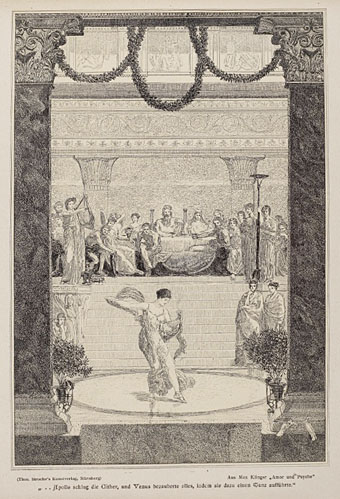
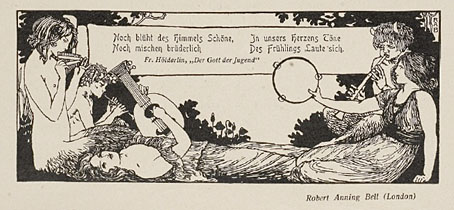
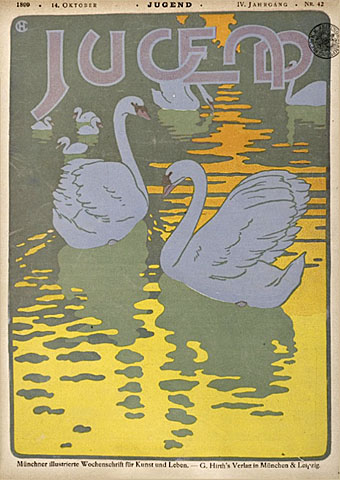
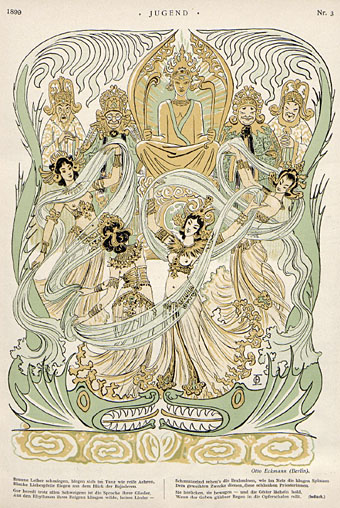
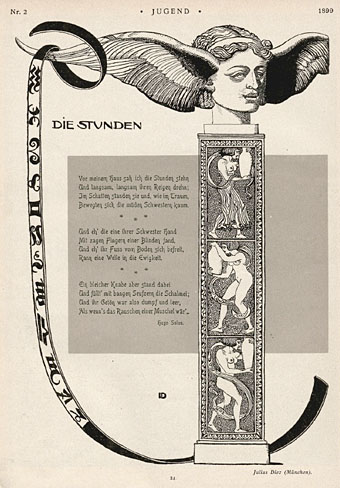
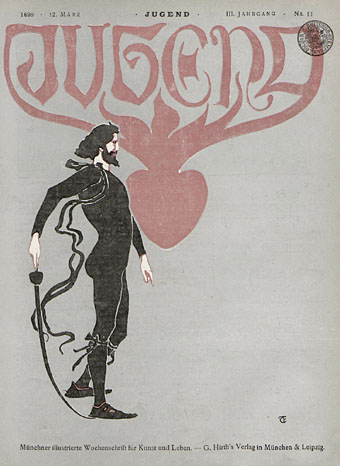
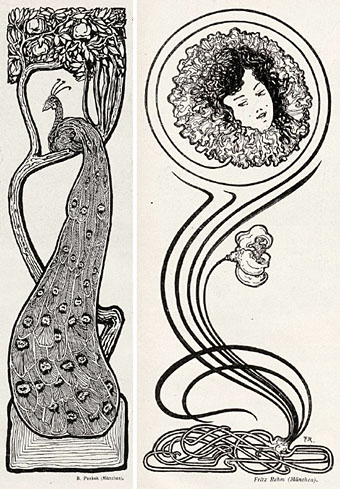
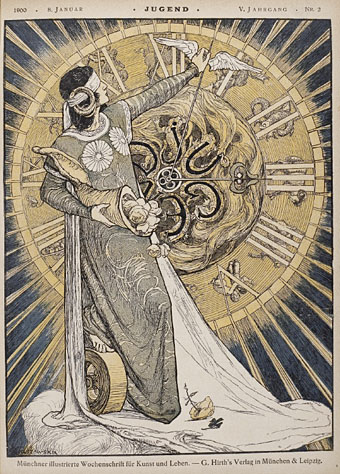
Continuing the delve into back issues of Jugend magazine, the German fin de siècle periodical of “art and life”, this post covers the year 1899. The earlier years of the magazine are replete with a variety of elegant and often bizarre graphics, as well as some classic examples of Art Nouveau graphic design. 1899 is the point in the magazine’s history that the variety (and, for me, the interest) begins to diminish. The covers lose their earlier inventiveness while the Art Nouveau stylings within are being replaced by drab illustrations of the German middle classes and patriotic depictions of country folk. There are still gems to be found, however, some of which follow below. As before, anyone wanting to see more of these graphics is advised to explore the bound volumes at the Heidelberg University archive. The two books for 1899 can be found here and here.

jugend-99-02.jpg

Otto Eckman (above) and Julius Diez (below) were heavily featured in the earlier years of the magazine and Diez in particular produces some of the best work in this year’s run.

jugend-99-03.jpg

Continue reading “Jugend, 1899”

Jugend, 1898

jugend-98-01.jpg

Continuing the delve into back issues of Jugend magazine, the German fin de siècle periodical of “art and life”, this post covers the year 1898. As before, Jugend was so copiously illustrated that the selection here can only scratch the surface. Anyone wanting to see more of these graphics is advised to explore the bound volumes at the Heidelberg University archive. The two books for 1898 can be found here and here.

jugend-98-02.jpg

Continue reading “Jugend, 1898”

The art of Jim Leon, 1938–2002

leon1.jpg

Psychopathia Sexualis (1967).

This, dear friends, is what the art of the fantastic could give us but rarely does, something which combines the metaphysical intensity of the Symbolists with a post-Freudian sensibility to create what Philip José Farmer once called “the pornography of the weird”. Jim Leon was a British artist whose work gained prominence via the underground magazines of the 1960s, especially Oz, although he was never really a psychedelic artist as such. Many of his earliest paintings show the influence of the Pop artists, it was only later in the decade that a distinctly original and surreal imagination came to the fore. Oz was always pretty scurrilous and had no qualms about challenging the authorities with bizarre sexual imagery which other magazines would never dare to print. Leon and other artists were fortunate to have such a public forum for outré work, a few years earlier or later and they might not have found an outlet at all.

leon2.jpg

Untitled (1979).

His early work blended influences from Francis Bacon, surrealism and the baroque. Lurking there is also the English visionary William Blake, together with the obsessive Romanticism of the pre-Raphaelites. A number of his early paintings and drawings refer to William Burroughs’s Naked Lunch (first published in Paris in 1959). These were just some of the ingredients of an amazing, semi-abstract, spatially complex, ritualistic, orgiastic flesh-painting, expressing highly wrought morbidity, eroticism, transcendence and ecstasy; astonishing explorations of the murkier depths of the human mind. (More.)

A Very English Visionary by Simon Wilson.

I first encountered Leon’s work thanks to David Britton’s curating of a portfolio feature in Wordworks magazine which was republished in the Savoy Books anthology, The Savoy Book in 1980. Having seen a Leon painting in a back issue of Oz I was surprised that an artist with such a powerful imagination was so little-known. It turns out that he’d been working all along, albeit far from the public gaze, having moved to Lyons in France where he spent the 1970s and 80s painting many canvases of mystical scenes similar to those produced by the California artists featured in the Visions book. None of his later work explores the darker realms of his earlier Psychopathia Sexualis drawings, and since it’s the early work that I prefer, that’s what’s featured here. These drawings and paintings bear comparison with the art of Raymond Bertrand but where Bertrand has had his work published in lavish book collections, we have to rake through back issues of magazines for Leon’s endeavours. Leon’s later paintings at least have a website which is maintained by his family.

Continue reading “The art of Jim Leon, 1938–2002”