Jewel beetle

beetle.jpg

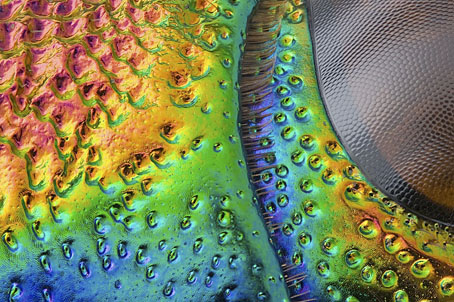
A 40X close-up of Chrysochroa fulgens, the iridescent Jewel Beetle, showing part of the insect’s eye. A stereomicroscopy photo by Charles Krebs, and one of the winners in the 2008 Olympus Bioscapes Digital Imaging Competition. Scientific American has larger images.

Previously on { feuilleton }
How many leaf beetles can dance on the head of a pin?
The art of Jo Whaley
Endangered insects postage stamps

Welcome to Mars

welcometomars.jpg

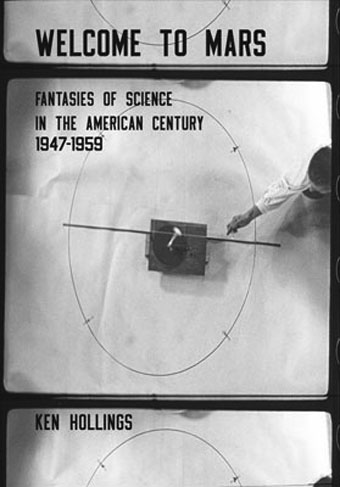
Arriving today—and barely surviving the postman’s attempts to cram it through the letterbox—is the latest volume from Strange Attractor, Welcome to Mars by Ken Hollings. I’m really looking forward to reading this since it touches on areas of interest which span the development of Cold War technologies to pulp science fiction, examining the interconnections between these disparate zones; most histories of the period prefer to stay in one area or the other. A glance at the chapter titles immediately pushes my buttons: “1947 Rebuilding Lemuria”, “1951 Absolute Elsewhere”. If all that wasn’t enough there’s an intro by Erik Davis and the first 250 copies come with a CD of “classy analogue Outer Space exotica” by Simon James. Order from the SA Shoppe and get a free postcard!

Welcome to Mars is a map of the post-war Zone, a non-fiction Gravity’s Rainbow that follows the arc of Germany’s V2 rocket to the end of the rainbow – to America.’ Erik Davis

Welcome to Mars is an iconoclastic, penetrating and darkly humorous history of America from 1947-1959, the decade in which the nation defined its image and created the blueprint for the world we live in today.

Welcome To Mars draws upon newspaper accounts, advertising campaigns, declassified government archives, old movies and newsreels from this unique period when the future first took on a tangible presence. Ken Hollings depicts an unsettled time in which the layout of Suburbia reflected atomic bombing strategies, bankers and movie stars experimented with hallucinogens, brainwashing was just another form of interior decoration and strange lights in the sky were taken very seriously indeed.

Seamlessly interweaving developments in technology, popular culture, politics, changes in home life, the development of the self, collective fantasy and overwhelming paranoia, Hollings has produced an alarming and often hysterically funny vision of the past that would ultimately govern all of our futures.

“Ken Hollings shows brilliantly how the extraordinary web of technologies that drove the Cold War have shaped not just our culture but the very way we think of ourselves as human beings. Welcome to Mars offers a rare and fascinating glimpse of the roots of the strange humanoid culture we live in today.” Adam Curtis

‘Ken Hollings has placed his critical focus at the precise point where the high technologies of information control and social manipulation intersect the passionate search for scientific ways to probe the human mind. Welcome to Mars is a searingly accurate and deeply disturbing exposé of the fantasies of American modernism that have inspired the many nightmares and the few hopeful visions of our new Millennium.’ Dr Jacques Vallée

Previously on { feuilleton }
SAJ again
Strange Attractor Journal Three
How to make crop circles

The Central Molecular Zone

galaxy.jpg

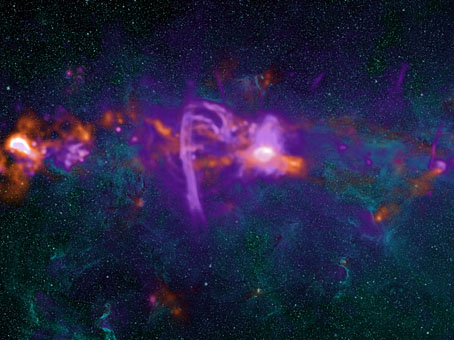
Our Galaxy’s Central Molecular Zone by A. Ginsburg (U. Colorado – Boulder) et al., BGPS Team, GLIMPSE II Team.

NASA explains:

The central region of our Milky Way Galaxy is a mysterious and complex place. Pictured here in radio and infrared light, the galaxy’s central square degree is highlighted in fine detail. The region is known as the Central Molecular Zone. While much of the extended emission is due to dense gas laced with molecules, also seen are emission nebulas lit up by massive young stars, glowing supernova remnants, and the curving Galactic Center Radio Arc in purple. The identity and root cause for many other features remains unknown. Besides a massive black hole named Sgr A*, the Galactic Center houses the galaxy’s most active star forming region. This image is not just interesting scientifically. It’s esthetic beauty won first prize this year in the AUI/NRAO Image Contest.

The art of Josiah McElheny

mcelheny1.jpg

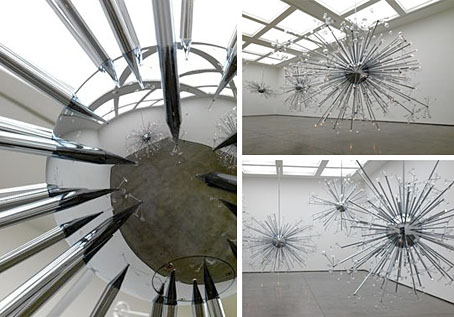
Island Universe (2008).

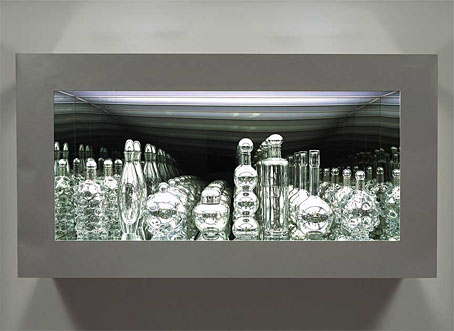
Island Universe is a new work by American artist Josiah McElheny at London’s White Cube gallery. McElheny’s recurrent use of glass and mirrors would be enough to capture my attention anyway—I particularly like the Modernity piece below—but Island Universe also features a specially-commissioned sound accompaniment by one of my favourite musicians, Paul Schütze.
mcelheny2.jpg

Modernity circa 1952, Mirrored and Reflected Infinitely (2004).

McElheny collaborated with cosmologist David Weinberg for Island Universe to create abstract sculptures that are scientifically accurate models of Big Bang theory as well as illustrations of the ideas that followed the general acceptance of the theory. The varying lengths of the rods are based on measurements of time, the clusters of glass discs and spheres accurately represent the clustering of galaxies in the universe, and the light bulbs mimic the brightest objects that exist, quasars. Island Universe proposes a set of possibilities that could have burst into existence depending on the amount of energy or matter present at the universe’s origin.

I can’t help but compare that description of McElheny’s new work with another exhibition that opened this week, TH.2058 by Dominique Gonzales-Foerster which will be filling Tate Modern’s vast Turbine Hall for the next few months. Josiah McElheny extrapolates from documentary fact and creates something beautiful at the same time. Ms Gonzales-Foerster borrows from pre-existing works of written and filmed science fiction and has to rely on those works to sustain much of the interest:

It rains incessantly in London – not a day, not an hour without rain, a deluge that has now lasted for years and changed the way people travel, their clothes, leisure activities, imagination and desires. They dream about infinitely dry deserts.

This continual watering has had a strange effect on urban sculptures. As well as erosion and rust, they have started to grow like giant, thirsty tropical plants, to become even more monumental. In order to hold this organic growth in check, it has been decided to store them in the Turbine Hall, surrounded by hundreds of bunks that shelter – day and night – refugees from the rain.

A giant screen shows a strange film, which seems to be as much experimental cinema as science fiction. Fragments of Solaris, Fahrenheit 451 and Planet of the Apes are mixed with more abstract sequences such as Johanna Vaude’s L’Oeil Sauvage but also images from Chris Marker’s La Jetée. Could this possibly be the last film?

On the beds are books saved from the damp and treated to prevent the pages going mouldy and disintegrating. On every bunk there is at least one book, such as JG Ballard’s The Drowned World, Jeff Noon’s Vurt, Philip K Dick’s The Man in the High Castle, but also Jorge Luis Borges’s Ficciones and Roberto Bolaño’s 2666.

On one of the beds, hidden among the giant sculptures, a lonely radio plays what sounds like distressed 1958 bossa nova. The mass bedding, the books, images, works of art and music produce a strange effect reminiscent of a Jean-Luc Godard film, a culture of quotation in a context of catastrophe.

There’s a list of works used in the Tate installation, nearly all of which are far more stimulating artworks in their own right than the one which is hijacking them into its “culture of quotation”. I’m sure I can’t be the only person to think that the Tate would have been better served asking McElheny and Schütze to expand their work to fill the Turbine Hall instead. Those Island Universes could only get better if they were bigger.
mcelheny3.jpg

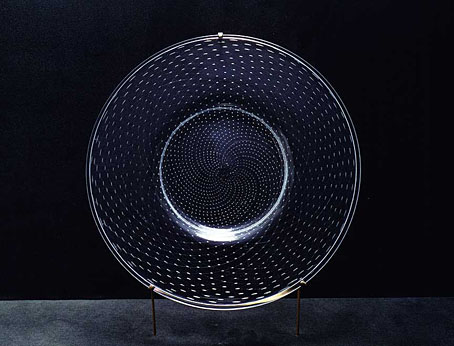
Studies in the Search for Infinity (detail, 1997-1998).

A PBS feature on Josiah McElheny

Update: Writer M John Harrison reviews TH.2058 for the Guardian and fails to be impressed:

It occurred to me that the biggest disaster in that room is the disaster for art. TH.2058 seems to finalise the hollowing-out of everything into the shallowest of semiotics. Foerster’s reading list is more powerful and important than her installation. Every one of the books on those bunk beds will give you a frisson that you don’t get from the show, so you would be as well just reading them for yourself.

Previously on { feuilleton }
Doris Salcedo’s Shibboleth
The Garden of Instruments