From LSD to OSX

itunes_jelly.jpg

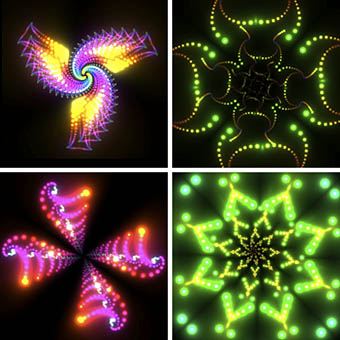
A few servings of iTunes jelly.

I’ve spent the past week or so enjoying the delights of Leopard, the 10.5 iteration of Apple’s OS X operating system, but have only just noticed the new Visualizer patterns in the latest version of iTunes. I don’t use the Visualizer much, especially since the introduction of Front Row, Apple’s home media management system, but it’s always nice to know it’s there. The original Visualizer isn’t so far removed from the graphic tricks I used to laboriously program into my old Spectrum computer in the 1980s, simple repeated shapes with coloured lines, albeit a lot faster and with far more detail and animation than a 48k Spectrum could ever manage. The latest Visualizer has been significantly supercharged, however, and the new “Jelly” setting creates some really beautiful (and it should be noted, trippy) patterns, reminiscent of Steven Spielberg’s Close Encounters UFOs or James Cameron’s Abyss inhabitants.

I can’t help but see a direct line of continuity here from Apple’s origin in the head culture of Sixties and Seventies’ California to the present. Writer John Markoff examined some of the connections between psychedelic culture and the nascent computer scene in What the Dormouse Said: How the Sixties Counterculture Shaped the Personal Computer Industry where we find Apple CEO Steve Jobs saying that “taking LSD was one of the two or three most important things he had done in his life.” Given this, the glowing, pulsating mandalas in the new iTunes can be seen as a vestigial remnant of that era, and it seems fitting that those patterns are integrated into a music player; it was upon the Sixties’ music scene, after all, that LSD originally had its greatest cultural impact.

Update: For anyone wanting to play with iTunes Jelly, there’s a couple of undisclosed features (this is for Macs but I imagine they’d be the same in the PC version). Pressing M tells you the name of the pattern currently being displayed, pressing 1 shrinks part of the pattern, 2 zooms it out and 8, 9 and 0 cause different colours to over-saturate. It’s a full-on psychedelic light-show, in other words.

Update 2: If you press M so it shows the pattern name then press the Up or Down arrow, you can flick through the various pattern settings.

Watch Jelly in action
Steve Jobs drops acid in Pirates of Silicon Valley

Previously on { feuilleton }
iTunes 7

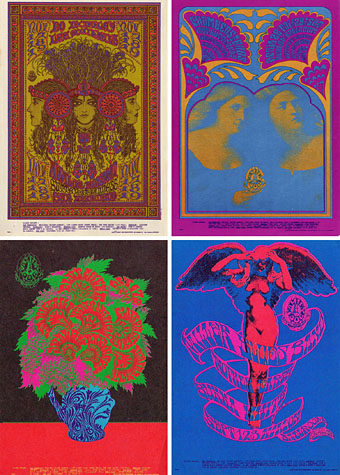
Family Dog postcards

psych_postcards.jpg

top: William Henry (1967); Victor Moscoso (1967).
bottom: Victor Moscoso (1967); Kelley/Mouse (1967).

Marvellous. Oldhandbills.com has a lot of this stuff, loads of designs I’ve never seen before. Via Arthur.

Elsewhere on { feuilleton }
The illustrators archive

Previously on { feuilleton }
The poster art of Marian Zazeela

Boredoms in Manchester

boredoms2.jpg

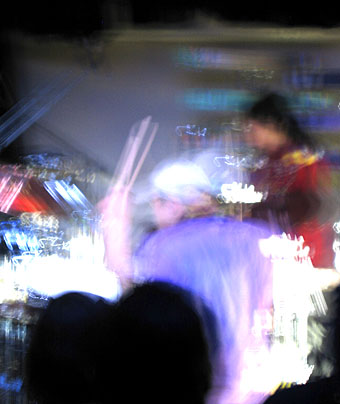
Anyone who subscribes to the stereotype about Japanese people always being quiet and unassuming has never seen a Japanese rock band. Last time I returned from a gig with my ears ringing the way they are now was after seeing Acid Mothers Temple a few years ago. Tonight it was the turn of Boredoms who drummed up an absolute storm in a sweaty, airless dungeon under the Student’s Union. Boredoms have been active since the mid-Eighties in various shapes and sizes, more recently working under variations on their name. Early albums were always experimental but tended to be nastily noisy with it. They really caught my attention at the end of the Nineties with Super Ae (1998) and Vision Creation Newsun (2000), a pair of drum-powered albums that owe a great deal to the “kosmische” atmosphere of the best Krautrock, especially Amon Düül II circa Yeti.

boredoms1.jpg

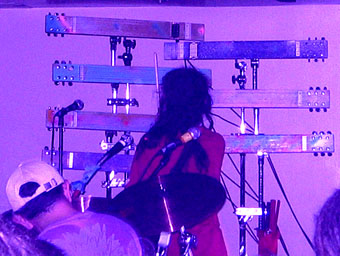
Tonight we had a great deal of the thundering cross-patterns of drum rhythms amended by some of the piercing extended crescendos found on VCN. Very loud and very powerful. There was some unusual instrumentation involved as well, including what appeared to be hand-held lightbulbs triggering samples and harmonised feedback, and also a rack of guitar necks (above) with what I assume must be open tunings given the way these were used as percussion devices. It was difficult to tell who was doing what (or using what) for much of the time due to the density of the crowd. But such details are beside the point, this was a tremendous performance that was overwhelmingly intense at times. It’s rare indeed to find a band still working at this peak after 21 years. Along with the very different performance by Machinefabriek in May, best gig of the year so far.

AVAF at Mao Mag

avaf.jpg

New York-based Mao Mag seems to have a predilection for a particular brand of psychedelic imagery if recent issues are anything to go by. Peter Max was on the cover of #8 earlier this year and appeared inside together with a feature on the equally eye-popping work of Kenny Scharf.

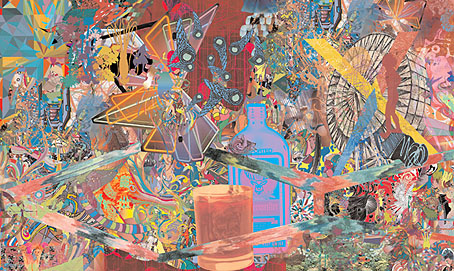
For #9 it’s the turn of AVAF aka Assume Vivid Astro Focus, a Brazilian artist also based in NYC whose paintings and installations combine a psychedelic vibrancy with frequent gay themes. The work in the magazine looks considerably more interesting than the show I saw at Tate Liverpool in 2005 which seemed to suffer from bad lighting and being separated from the Summer of Love exhibition it was intended to complement.

Elsewhere on { feuilleton }
The gay artists archive

Previously on { feuilleton }
Heinz Edelmann
Verner Panton’s Visiona II

Relighting the Magick Lantern

anger2.jpg

The first part of Kenneth Anger’s Magick Lantern Cycle appeared on DVD in a splendid edition from Fantoma earlier this year. The second and final part is due for release on October 2nd and you can see the mouthwatering trailer here.

This new set includes the Cocteau-esque Harlequinade, Rabbit’s Moon (1950); homoerotica, bikers and rock’n’roll in Scorpio Rising (1964); a hot rod, a blond boy in tight pants and the Paris Sisters crooning Dream Lover in Kustom Kar Kommandos (1965); magick ceremonies and Mick Jagger playing with a Moog synth in Invocation of My Demon Brother (1969); and Donald Cammell, Marianne Faithfull, Egypt, volcanoes, Aleister Crowley, an orange UFO and a great score from Bobby Beausoleil in the miniature epic, Lucifer Rising (1982).

The Magick Lantern Cycle is a great work of cinema that’s suffered from shoddy presentation on previous video releases; Fantoma have given these films the care and attention they deserve. If you haven’t seen them yet, you’re in for a treat.

Previously on { feuilleton }
James Bidgood
Kenneth Anger on DVD…finally
Un Chant d’Amour by Jean Genet