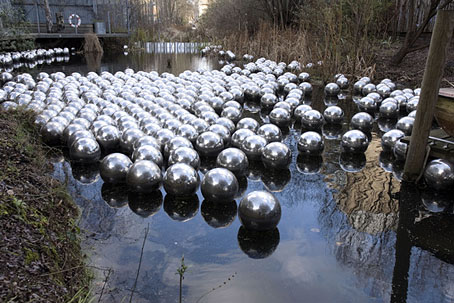
Yoshitaka Amano in Berlin

amano1.jpg

Deva-loka (2007).

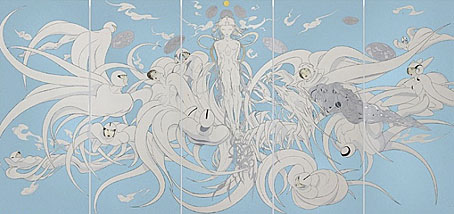
Big new paintings by one of my favourite Japanese artists at Galerie Michael Janssen, Berlin, until February 29, 2008. The wild details in Deva-loka are completely lost at this size but there’s a larger version on Amano’s site.

amano2.jpg

Creation (2007).

These works are being sold as fine art but Amano’s reputation rests upon his commercial art which embraces anime, manga and book cover illustration. As is often the case, the art world has a problem with this, regarding work for hire as lower than work for galleries, the latter being no less commercial in the sense that the works are sold to collectors who frequently demand more of the same; Andy Warhol’s studio was named The Factory with good reason. A comment at Creative Europe acknowledges the dilemma:

“There are two reasons why it is necessary to bring Yoshitaka Amano’s immensely successful professional biography into the equation here: on the one hand, the work he has done as a creator of mangas and animes (animations) provides an undisputed frame of reference for his pictures; on the other, it has become difficult where Amano’s oeuvre is concerned to uphold the differentiation popular in German speaking quarters between a more commercial applied visual art and the personally expressive variety.” (My italics.)

Amano’s non-commercial work at Galerie Michael Janssen is for sale, prices on request.

Previously on { feuilleton }
The art of Takato Yamamoto

Happy birthday, Mr Hofmann

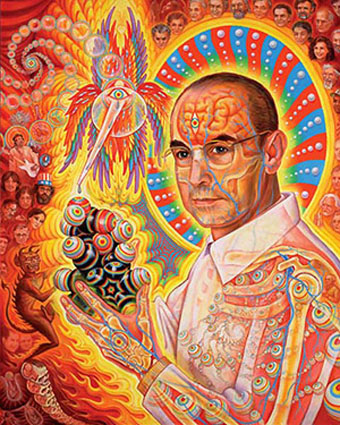
hofmann.jpg

Albert Hofmann by Alex Grey.

Albert Hofmann, discoverer of LSD, 102 years old today. Last month Scientific American reported that hallucinogenic drugs are once again being considered as a way to treat psychiatric disorders.

Previously on { feuilleton }
The art of LSD
The trip goes on
Albert Hofmann
Hep cats

The art of Sadao Hasegawa, 1945–1999

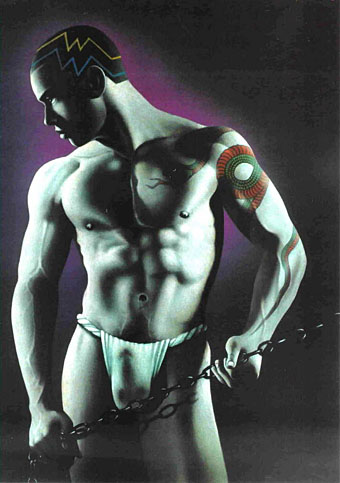
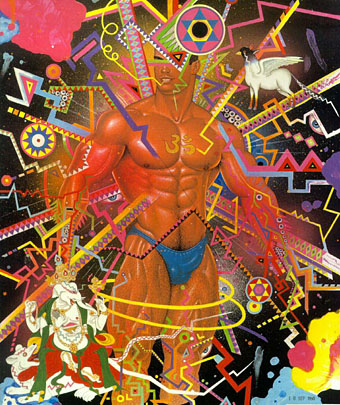
hasegawa5.jpg

(No title) from Sadao Hasegawa 01 (1990).

It’s good to be able to finish the year with another artistic discovery. I’d not come across Sadao Hasegawa’s work before but this page has an extensive (complete?) selection of his paintings and drawings. This is gay erotica with a twist, being Japanese in origin yet incorporating figures and symbolism derived from Indian or Thai mythology, detailed psychotropic invention and the kind of angular motifs common in much illustration and design of the 1980s. A heady brew, in other words, and quite unique as a result, which makes it all the more tragic that he committed suicide in 1999. At least one of his books, Paradise Visions, is still available in Japan but a decent collection of his work for a western audience is obviously long overdue.

hasegawa7.jpg

Paradise Visions (1996).

Continue reading “The art of Sadao Hasegawa, 1945–1999”

Paisley patterns

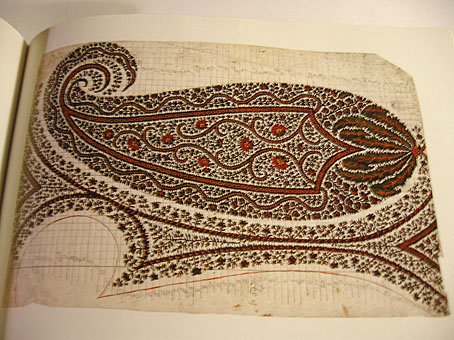
paisley1.jpg

Kirking shawl design (1850).

December is a month when I normally shun the secondhand shops so as to avoid being taken for a cheapskate trying to save money while Christmas shopping. Sometimes it pays to break your own rules, however, as with this discovery, Paisley Patterns: A Design Source Book (Studio Editions, 1989) by Valerie Reilly. This falls into the class of those books you didn’t know you’d wanted for years until you hold it in your hands, being a marvellous history of the evolution of the Paisley pattern from its origin in Kashmiri shawls to its development among the shawl weavers in the Scottish town of Paisley (and elsewhere) during the 19th century. With 100 colour plates it’s impossible to give a fair representation of the book’s contents but many of the examples are astonishingly abstract and worlds away from what we normally consider Victorian design.

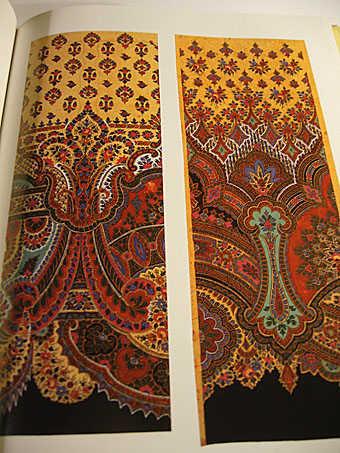
paisley2.jpg

Silk shawl design (1860).

The pre-psychedelic splendour of Paisley (and its “Oriental” character) was what led to its popularity during the 1960s. There was plenty of Paisley clothing around in the 1970s as a result, I had a particularly garish turquoise tie when I was about 11-years old and I think it was this which first set me wondering what the design was and who invented it. As Valerie Reilly notes, the boteh teardrop shape is a motif that’s as old as civilisation and its original use in patterns can’t be pinned to a single location. One of the nice things about this book is the quantity of shawl designs taken from the Paisley Museum that have sufficient detail for you to see how the pattern makers went about creating a design. The book is out of print but a swift search on Amazon reveals a couple of similar titles. The article below is a good overview of the evolution of the shawls and their designs.

Kashmir and Shawls of Paisley Design at Victoriana.com

Previously on { feuilleton }
Flowers of Love

Visions and the art of Nick Hyde

visions.jpg

Cover painting: Holy Grove by Gage Taylor (1975).

Book purchase of the week was this American collection of what we have to call “hippy art” (or “California Visionary Art”, as its creators preferred) published by Pomegranate Publications in 1977. I’d seen this circa 1979 and many of the pictures inside were used by Omni Magazine to decorate the science fiction stories in their early issues. After that it vanished from view completely which leads me to believe that UK distributors Big O didn’t sell as many as they would have liked. The white cover design made me remember it for a long time as being part of the David Larkin series which I discussed in May but it isn’t, although the Larkin books were quite probably the model for the book’s presentation.

Finally acquiring a copy was something of a disappointment since it transpires I remembered the decent painters and forgot the terrible ones who comprise at least half the book. Cliff McReynolds is one of the better artists (Omni thought so too) and by coincidence I posted one of his Visions paintings, Landscape with Grenade, almost a year ago to the day.

hyde.jpg

BethAnn (1970).

Best of the bunch for me is Nick Hyde whose fantastically detailed works blend the fractal filigree of psychedelic art with the kind of dreamscapes and tableaux one sees in Surrealism. The print reproductions do little justice to his detail and the web degrades his work even further (see Abraxas for a good example). Happily there are posters available.

Elsewhere on { feuilleton }
The fantastic art archive