Stevenson and the dynamiters

dynamiter.jpg

The Dynamiter: More New Arabian Nights (Longmans, London; 1914).

I’ve mentioned before that I’m a sporadic collector of the Tusitala Edition of Robert Louis Stevenson’s works, 35 small blue volumes published by Heinemann, London in 1924. I’ve found 15 of them so far and today turned up another one, volume 25, Virginibus Pueresque and Other Essays in Belles Lettres. Most of the ones I’ve collected are later reprints and this is no exception, being a sixth edition from 1928. The popularity of the series and the many reprint editions is the main reason they still appear with such frequency. Another reason is that these small pocket books, which were very common before and after the First World War, were well-made and have easily outlasted the first generation of paperbacks that eventually replaced them. I’d have no trouble ordering a complete set of the Stevensons from a book dealer but prefer to let chance find new additions. Given the dearth of good secondhand shops this is becoming increasingly difficult.
dynamiter2.jpg

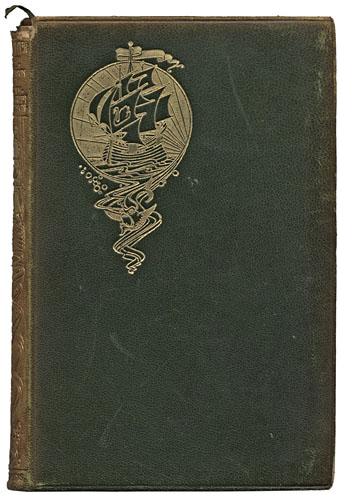
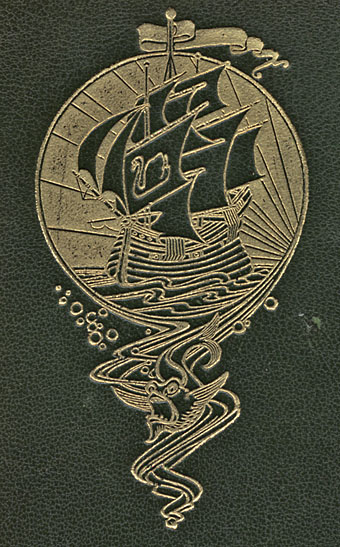
Also in today’s book haul was an earlier Stevenson, The Dynamiter: More New Arabian Nights, in a rather battered leather binding from 1914. I bought it almost solely for the Art Nouveau motif on the cover whose ship suits the author of Treasure Island but doesn’t really fit with the London setting of this particular book. I seem to recall having seen this design before which means it’s probably part of a uniform set like the Tusitala Edition, each volume of which bears a palm tree design on the spine and the signature of RLS blocked on the front board.

The only number of the Tusitala Edition I have in a leather binding is this book’s precursor, volume 1, New Arabian Nights. The Dynamiters is a collection of linked stories that Stevenson wrote with his wife, the Arabian Nights conceit being an attempt to transplant the telling of tall tales from medieval Baghdad to Victorian London. The dynamiters are a group of inept terrorists whose comic exploits were based on the real Fenian bombings that took place in London in the 1880s. A later attempted bomb attack on the Greenwich Observatory inspired the unsuccessful anarchists in Joseph Conrad’s The Secret Agent. Whatever some contemporary commentators might have us believe, terrorist attacks in cities are nothing new at all, only in Stevenson’s day they were labelled “dynamite outrages”. Stevenson dedicates his stories to the police officers charged with protecting the capital and apologises for making light of a serious matter. I have to wonder what he would have made of modern Baghdad being plagued by dynamite outrages on such a regular basis. And I also wonder how much real dynamite many of these Longmans’ books might have encountered, having been published just in time to be packed in the kit of soldiers going to the Western Front.

Elsewhere on { feuilleton }
The book covers archive

Previously on { feuilleton }
The Chronicles of Clovis and other sarcastic delights
William Burroughs gives thanks again

wsb.jpg

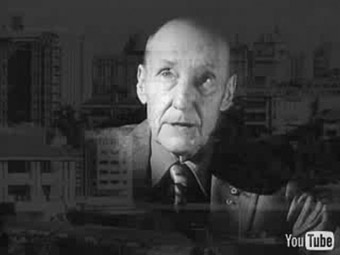
I posted the text of William Burroughs’ Thanksgiving Prayer last year as there wasn’t a copy of Gus Van Sant’s film version available anywhere. YouTube has now filled that gap.

Previously on { feuilleton }
William Burroughs gives thanks
The Final Academy
William Burroughs book covers
Towers Open Fire

Forty years of freedom after centuries of injustice

oscar.jpg

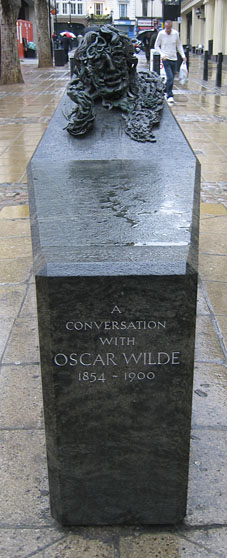
left: Maggi Hambling’s Oscar Wilde monument near Covent Garden, London.

“Yes, we shall win in the end; but the road will be long and red with monstrous martyrdoms.” Oscar Wilde, after his release from Reading Gaol in 1897.

“Forty years ago in Britain, loving the wrong person could make you a criminal. Smiling in the park could lead to arrest and being in the wrong address book could cost you a prison sentence. Homosexuality was illegal and hundreds of thousands of men feared being picked up by zealous police wanting easy convictions, often for doing nothing more than looking a bit gay.

“At 5.50am on 5 July 1967, a bill to legalise homosexuality limped through its final stages in the House of Commons. It was a battered old thing and, in many respects, shabby. It didn’t come close to equalising the legal status of heterosexuals and homosexuals (that would take another 38 years). It didn’t stop the arrests: between 1967 and 2003, 30,000 gay and bisexual men were convicted for behaviour that would not have been a crime had their partner been a woman. But it did transform the lives of men like Antony Grey, who had fought so hard for it, meaning that he and his lifelong partner no longer felt that every moment of every day they were at risk.”

From “Coming out of the dark ages” by Geraldine Bedell, The Observer.

The Sexual Offences Act of 1967, passed forty years ago today, was a compromised victory, as the quote above notes. The age of consent was set higher for gay men at 21 (these laws and restrictions applied to men only?lesbian sex had never been forbidden), you couldn’t be a member of the armed forces, you had to conduct your business with one other person only and in private (ie: at home; no hotel liaisons). The new act also only applied to England and Wales; Scotland had to wait until 1980 while in Northern Ireland (often a backwater where gay rights are concerned) the law wasn’t changed until 1982.

Yet it was a start, and it’s surprising and heartening to see how far things have travelled since 1967, especially when we seemed to be moving in reverse with the iniquities of the Thatcher years. Tony Blair’s government can be accused of many sins but it was never homophobic, and gave us an equalised age of consent, civil unions and finally scrapped Thatcher’s Section 28 law forbidding “the promotion of homosexuality”. Yes, gay-bashing still occurs, gay teens are bullied at school and we still have people like this idiot spouting nonsensical drivel. But Britain finally feels like a civilised place these days, more than it ever did.

It took over a century Oscar, and the road was long and red, but we made it.

Previously on { feuilleton }
Joe Orton
The Poet and the Pope
Queer Noises

London Pride

london_pride.jpg

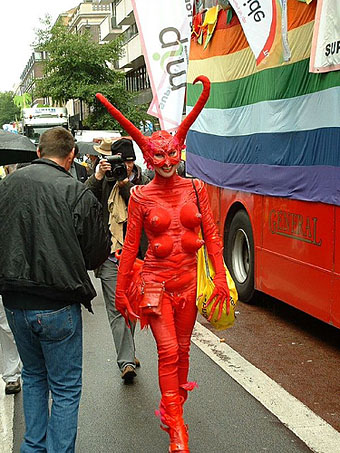
One of the exotic creatures at today’s London Pride march. More pictures at this Flickr pool. Marchers braved wet weather and renewed terrorist threats after two unexploded car bombs were found on Friday. (And where that matter is concerned, The Register has a rebuke to the inevitable hysterics.)

nc-17.jpg

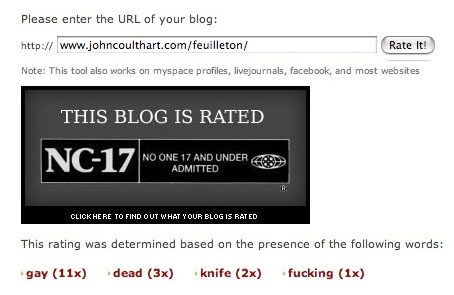
On a related note, this site has a feature that allows you to see how your blog (or page) would be rated by the MPAA. As Queerty notes, overuse of the word “gay” pushes up the supposed offensiveness quotient, something which results in this page receiving an NC-17 rating when it scans the past month of postings. Yes, it’s only a bit of web silliness but when the real Motion Picture Ass. of America has been shown to treat gay themes or stories with greater restriction than straight ones then it’s probably more accurate than its creators suspect.

Update: also in The Register, an ex-armed forces bomb-disposal operator explains why the London “terror clowns” shouldn’t be dignified with the hysteria they’ve been receiving.