Terror and Magnificence

spitalfields.jpg

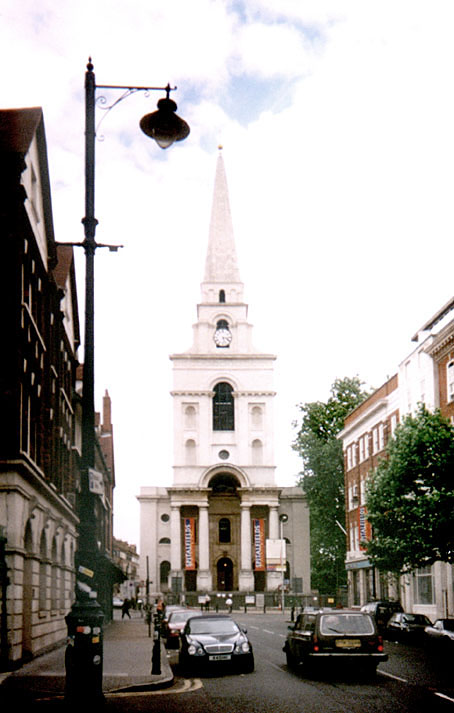
Christ Church, Spitalfields, London, in 2001. A photo I took with a disposable film camera.

And so let us beginne; and, as the Fabrick takes its Shape in front of you, alwaies keep the Structure intirely in Mind as you inscribe it. First, you must measure out or cast the Area in as exact a Manner as can be, and then you must draw the Plot and make the Scale. I have imparted to you the Principles of Terrour and Magnificence, for these you must represent in the due placing of Parts and Ornaments as well as in the Proportion of the several Orders: you see, Walter, how I take my Pen?

Hawksmoor (1985) by Peter Ackroyd

*

Bentley had laid down tracks for a shot that would feature the saxophonist and composer John Harle tooting away at his Terror and Magnificence in the setting of Hawksmoor’s church, which was now established, post-Ackroyd, as a cathedral of baroque speculation. Harle, in the notes published with the CD, writes that “darkness beneath the architecture and the very fabric of the stones pushed the idea towards a text.” The language here harks back to Ackroyd, towards privileged notions of place. The church was, in its proportions, a score to be unravelled; an overweening Pythagorean geometry to be tapped and sounded.

Iain Sinclair in Rodinsky’s Room (1999) by Rachel Lichtenstein & Iain Sinclair

Iain Sinclair first drew the world’s attention (or the minuscule portion of the world that was reading his books) to the strange character of Hawksmoor’s London churches in 1975 with Lud Heat, a book-length poem. Peter Ackroyd a decade later turned Sinclair’s esoteric excavation into a bestselling architectural murder mystery with his novel Hawksmoor, since when Sinclair’s psychogeography (if that term still has any valid currency) has found its way into From Hell by Alan Moore & Eddie Campbell, where Christ Church dominates the proceedings, and a musical work, Terror and Magnificence, by composer John Harle which takes its title from Ackroyd’s novel.

tandm.jpg

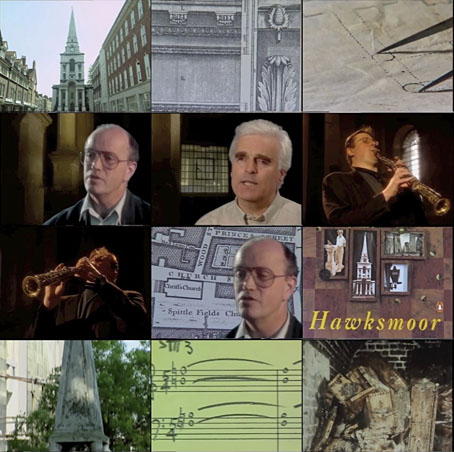
The short BBC film to which Sinclair refers can be seen on Harle’s YouTube channel. In addition to running through the Hawksmoor mythology we receive some glimpses of David Rodinsky’s abandoned room in the Princelet Street synagogue, a location (and a life) explored in detail in Sinclair’s book with artist Rachel Lichtenstein.

Bob Bentley’s film of Harle, Sinclair and Keith Critchlow was broadcast in 1995. In the same year Harle was commissioned by the BBC Proms to write an opera. The resulting work, Angel Magick, with libretto by David Pountney, advertises itself as “the first Dr Dee Opera”, a subject equally of interest to both Sinclair and Alan Moore, who in Sinclair’s Liquid City (1999) take a walk to John Dee’s home at Mortlake. (“We were a thrift-shop Dee and Kelley cupping our ears for whispers from tired stone.”) In that piece Sinclair mentions having been in on the early discussions for the opera but doesn’t go into any detail. I haven’t heard Angel Magick but you can hear a complete performance of Terror and Magnificence by the John Harle Band, the Balanescu Quartet, and the London Voices, here.

Previously on { feuilleton }
Mister Jarman, Mister Moore and Doctor Dee
Compass Road by Iain Sinclair

Weekend links 151

yongliang.jpg

Untitled art by Yang Yongliang. There’s more at But Does It Float.

• “Newly unearthed ITV play could be first ever gay television drama“. Writer Gerald Savory, incidentally, also adapted Dracula for the BBC in 1977, still the version that’s closest to the novel.

Craig Redman and Karl Maier‘s poster designs for the Bavarian State Opera.

Lustmord: ambient’s dark star, and The Strange World of Scanner.

The cats are tapping the old man for psychic sap, milking him, stalking through rubbled dreams of the coming Land of the Dead. On subsequent US visits – to Bastrop in Texas and Phoenix, Arizona – I learned about the fellowship of those internal exiles, the hardcore writers: Michael Moorcock, Jim Sallis. Like Burroughs, they kept cats and guns (Mike’s was a replica). Cats infiltrate mystery fiction: men with coffee habits, ex-drinkers, post-traumatic spooks solving crimes the hard way. Moorcock uses cats like a scarf, like Peter Sellers in The Wrong Box; their claws scratch runes into his easy chair.

Iain Sinclair remembers visiting William Burroughs. I remember meeting those Moorcock moggies; not as interesting to reminisce about, however.

The Ghosts of Antarctica: Abandoned Stations and Huts.

• A Masterpiece of the Ridiculous by Jocelyn Brooke.

• “Chance is a good librarian,” says Alberto Manguel.

• Mix of the week: dub from Bristol duo Zhou.

The Aleph: Infinite Wonder / Infinite Pity.

Sarah Lee‘s underwater photography.

Arthur #34 is out!

Underwater (1979) by Harry Thumann | Underwater Church (1992) by Conrad Schnitzler | Underwater Flowers (2003) by John Foxx & Harold Budd

Out of season

fisher1.jpg

Photographer Andrew G Fisher sent a link to his web galleries recently, among which there’s a great series of shots from various seaside towns. If I respond to these more than the others it’s because I grew up by the sea. Views like this are an indelible feature of my childhood memories, they often recur in dreams. The peculiar melancholy of an out-of-season holiday resort isn’t exactly an unknown quantity, but if you’ve grown up in one of these places it becomes an ingrained feature of your life. Resort towns have no industry other than catering to holidaymakers; for half the year they lie fallow and appear semi-deserted when their population has been so drastically reduced. Add to this the disparity between the sunny days for which all the facilities cater, and the winter when many of those facilities have been closed down and the weather brings gales howling off the sea, and you have a curious parallel existence which the inhabitants of other towns and cities never experience.

Andrew Fisher’s photographs capture some of this parallel life: the abandoned shelter under a grey sky, empty promenades with iron bollards corroded by the salt air, a line of unused seats made even more cheerless by the presence of a floral tribute. That last shot fixes the nature of the seaside resort as an absolute boundary; the built environment can extend no further than this. Yes, I miss the sea.

fisher2.jpg

fisher3.jpg

fisher4.jpg

fisher5.jpg

Previously on { feuilleton }
Old lighthouses

Le Panorama Exposition Universelle

exposition01.jpg

One day I really will have exhausted this subject but for the moment here’s another look at the Paris Exposition Universelle of 1900. I’d downloaded this photo album months ago from the excellent resources at the University of Heidelberg then promptly forgot all about it. The book is of interest for the variety of views it gives of the exposition; despite this being a world event that attracted a host of photographers and even (as we’ve seen) early filmmakers, the views you see are often the same remote shots of the major buildings.

Ludovic Baschet’s book compensates for this with photos by the Neurdein brothers, Étienne and Antonin (assisted by Maurice Baschet) which show many close views of the pavilions, including a couple I hadn’t seen before in any detail. The oddest thing about these views is that many seem to be composites, with figures from other shots dropped into the scenes; this may be more obvious to eyes schooled in the disparities of Photoshop. Baschet’s book also has the best views I’ve seen of the Swiss exhibit, a miniature village built in the 7th arrondissement complete with livestock, authentic milkmaids and a fake mountain. And is that a joke at Britain’s expense in the view of Edwin Lutyens’ surprisingly dull British pavilion? Philippe Jullian tells us that Paris endured a heatwave in the summer of 1900—there are many parasols in evidence—yet the British pavilion is shown with a rain-soaked pavement, and set against a mass of impending storm clouds.

exposition02.jpg

exposition03.jpg

Continue reading “Le Panorama Exposition Universelle”

London zoom

london01.jpg

I’m generally indifferent to panoramic views of cities, especially London where the sprawl lacks the distinct contours of Manhattan or the Napoléonic severity of Hausmann’s Paris. This view is different, however, being a 320 gigapixel panorama of the capital seen from the top of the BT Tower. This view is currently the world’s largest panoramic photo, and while the wide view is of the usual grey cloudscape and undifferentiated vista of 19th-century roofs and 20th-century ducting, the ability to zoom down into the streets (and, in some cases, into windows) is unprecedented at this resolution.

london02.jpg

These screengrabs show a zoom towards the river from the widest angle down to the painted sign of the Duke of York pub on the corner of Rathbone Street and Charlotte Place in Fitzrovia. At the end of the zoom there’s a reverse view from Google Maps showing the pub itself, and the tower, the one landmark you won’t otherwise see. MetaFilter’s members have bookmarked various points of interest. I’m surprised there are so many roof gardens in this area of London although I think Paris still has the edge in that department.

london03.jpg

london04.jpg

Continue reading “London zoom”