Angels 3: A diversion

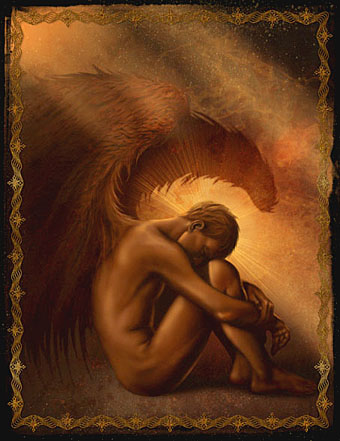
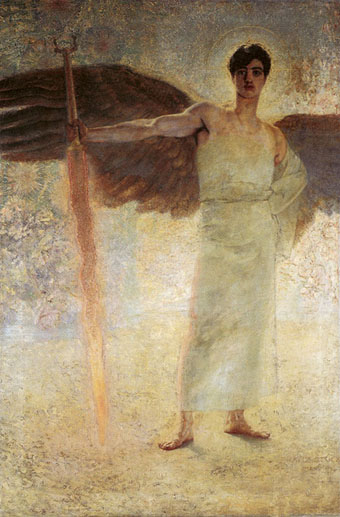
On Monday Eroom Nala mentioned my Fallen Angel picture in one of the comments for the first angel posting. Here’s the picture in question (from 2004).

fallen_angel.jpg

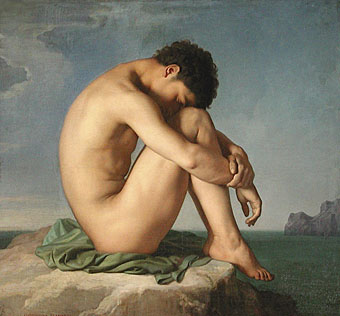
As I mentioned earlier, this was based on Jeune homme assis au bord de la mer (Young Man Sitting by the Seashore, 1836), the most well-known painting by Jean Hippolyte Flandrin (1809–1864). In a posting back in February I wrote about how this painting has become something of a gay icon over 170 years, with increasing numbers of artists and photographers working their own variations on the pose. As far as I was aware, I was the only person to have tried adding wings to the figure.

flandrin.jpg

Now today I run across a great gallery of photographs by Jose Manchado who has his rather gorgeous model, Reuben, adopt the same pose then gives him a set of abstract wings.

manchado.jpg

Manchado’s other photographs are well worth a look. He also adds more realistic wings to a female model but since we’re concerning ourselves with male angels this week I’ll leave you to look for her.

Elsewhere on { feuilleton }
The gay artists archive
The recurrent pose archive

Angels 2: The angels of Paris

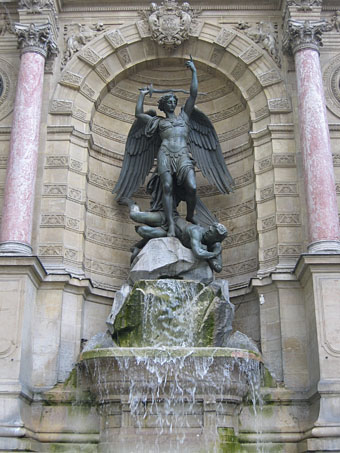
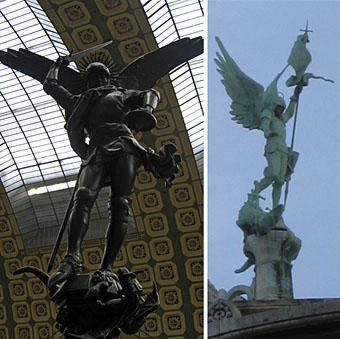
Los Angeles, despite being the City of Angels, has few angels on display outside its cemeteries, whereas European cities are full of them. These are some of the ones that caught my attention in Paris this year.

paris1.jpg

Saint Michael (1860) by Francisque-Joseph Duret in the Place Saint-Michel.

paris2.jpg

More statues of Saint Michael. The one on the left is by Emmanuel Frémiet (1897), in the Musée D’Orsay. On the right is a detail from the roof of the Sacre Coeur.

Continue reading “Angels 2: The angels of Paris”

The Jantar Mantar

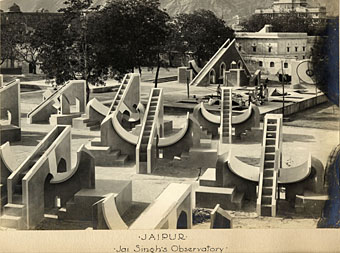
jaipur1.jpg

Fran Pritchett’s site has a wealth of photos of Indian architecture, including many old views of temples and a substantial section devoted to Jaipur’s fascinating Jantar Mantar.

The Jantar Mantar is a collection of architectural astronomical instruments, built by Maharaja Jai Singh II at his then new capital of Jaipur between 1727 and 1733. It is modelled after the one that he had built for him at the then Mughal capital of Delhi. He had constructed a total of five such observatories at different locations, including the ones at Delhi and Jaipur. The Jaipur observatory is the largest of these.

The name is derived from yantra, instrument, and mantra, for chanting; hence the ‘the chanting instrument’. It is sometimes said to have been originally yantra mantra, mantra being translated as formula, although there is limited justification for this since in traditional spoken Jaipur language, the locals obfuscate the written Y syllable as J.

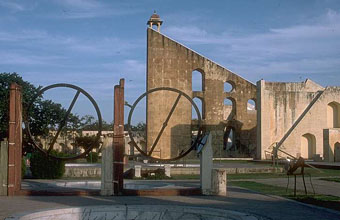
The observatory consists of fourteen major geometric devices for measuring time, predicting eclipses, tracking stars in their orbits, ascertaining the declinations of planets, and determining the celestial altitudes and related ephemerides. Each is a fixed and ‘focused’ tool. The Samrat Jantar, the largest instrument, is 90 feet high, its shadow carefully plotted to tell the time of day. Its face is angled at 27 degrees, the latitude of Jaipur. The Hindu chhatri (small domed cupola) on top is used as a platform for announcing eclipses and the arrival of monsoons.

jaipur2.jpg

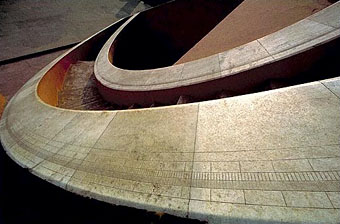
Built of local stone and marble, each instrument carries an astronomical scale, generally marked on the marble inner lining; bronze tablets, all extraordinarily accurate, were also employed. Thoroughly restored in 1901, the Jantar Mantar was declared a national monument in 1948.

An excursion through Jai Singh’s Jantar is the singular one of walking through solid geometry and encountering a collective weapons system designed to probe the heavens.

The instruments are in most cases huge structures. They are built on a large scale so that accuracy of readings can be obtained. The samrat yantra, for instance, which is a sundial, can be used to tell the time to an accuracy of about a minute. Today the main purpose of the observatory is to function as a tourist attraction.

jaipur3.jpg

Previously on { feuilleton }
The Garden of Instruments

The Door in the Wall

Photographer Alvin Langdon Coburn (1882–1966) illustrates HG Wells’ wonderful short stories in a rare edition of The Door in the Wall and Other Stories, from 1911. More pictures here.

The Door in the Wall was a true three-way collaboration between the author, the photographer and the typographer, Frederic W. Goudy, who specifically produced his Kennerley Old Style typeface for this book. Designed in the elegant Arts-and-Crafts style, it was printed on French hand-made paper at Goudy’s Village Press in an edition of 600 copies. In fact, only 300 copies contain the full compliment of Coburn’s rich photogravures, due to some being damaged in shipment and being replaced by aquatones. The photographer personally prepared the gravure plates, pulled proofs and oversaw the printing of the edition.

coburn1.jpg

The Door in the Wall.

coburn2.jpg

The Lord of the Dynamos.

Previously on { feuilleton }
War of the Worlds book covers