HPL in France

hpl-fr1.jpg

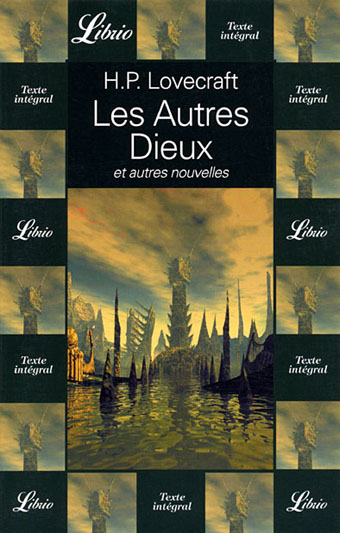
Les Autres Dieux et autres nouvelles (2002).

In 2002, French publisher J’ai Lu used my perennially popular view of R’lyeh on the cover of a small collection of HP Lovecraft’s fiction. This replaced a Michael Whelan painting on an earlier edition which looks fine but which happens to be a detail from one of his old Elric covers.

hpl-fr7.jpg

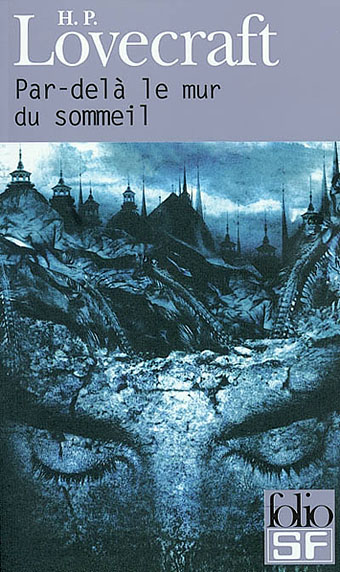
Par-delà le mur du sommeil (2002). Cover art by Eikasia.

Looking through the Lovecraft pages at Noosfere this week turned up some recent French covers I’d not seen before. One of the striking things about cover art for French genre titles is the amount of artists who also work in comics. This isn’t so surprising given the scale of the French comics world but in the UK the tendency is for people to work in one area alone. Artists such as myself who move freely from comics to cover art to graphic design are a very small minority.

hpl-fr8.jpg

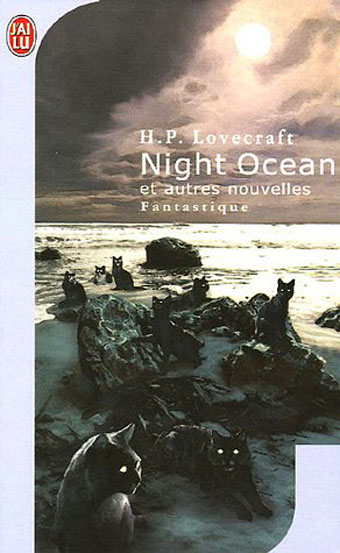
Night ocean et autres nouvelles (2005). Cover art by Richard Guérineau.

Continue reading “HPL in France”

The King in Green

hastur.jpg

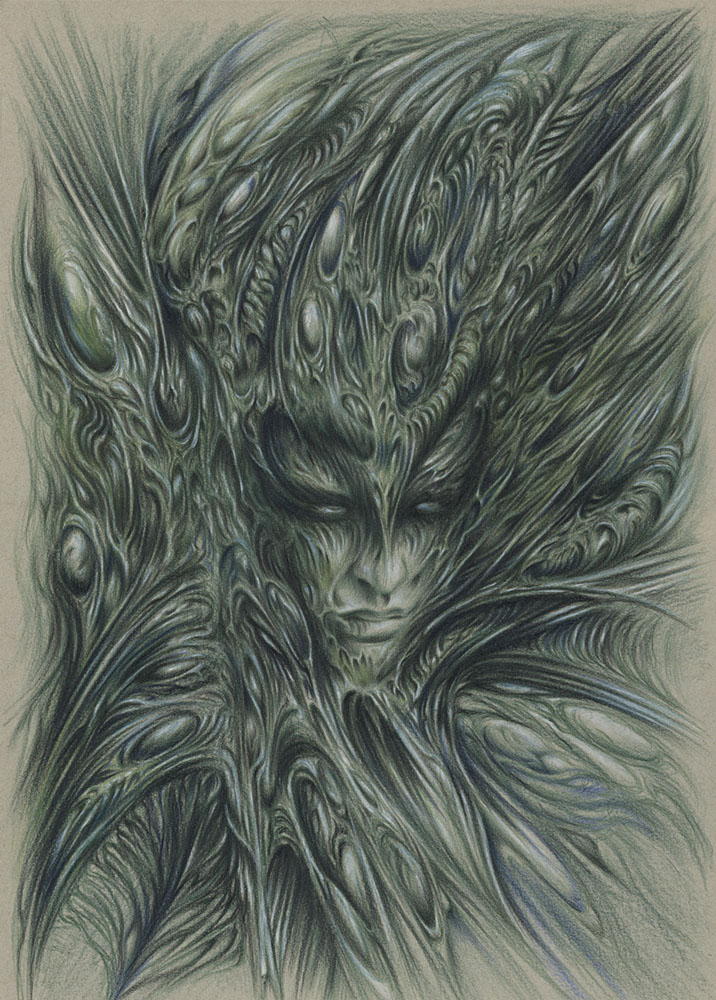
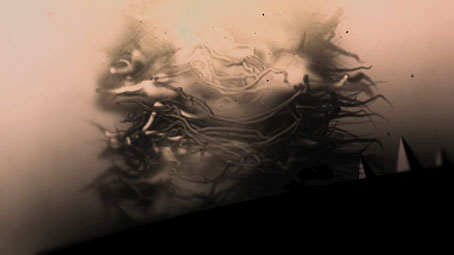
Hastur (1999) by John Coulthart.

Going through some of my old Lovecraft art this week it occurred to me that this drawing hadn’t been made public in its original colour form. Hastur appears as a murkier black-and-white illustration in the Great Old Ones series I produced in collaboration with Alan Moore for The Haunter of the Dark. The drawing was one of several improvised pieces made using coloured pencils on tinted paper. Some people may regard this and similar works as “Gigeresque” but I only apply that label to close imitations of HR Giger’s biomechanical style. This type of improvised drawing or painting predates Giger—Max Ernst’s decalcomania paintings being familiar examples—and you see similar fields of organic or mineral forms in the work of other Surrealist or Fantastic artists. If you have some ability with a pencil or paintbrush it’s relatively easy to produce a lot of this kind of work; the challenge is to do something more than create a mass of writhing abstraction.

Elsewhere on { feuilleton }
The Lovecraft archive

Weekend links 271

flyhead.jpg

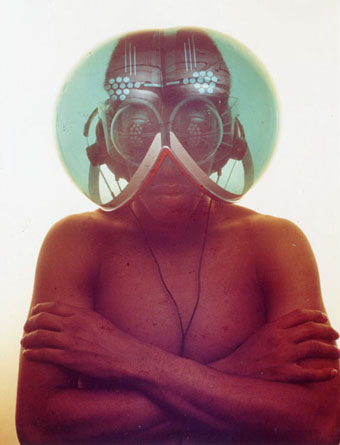
Environment Transformer/Flyhead Helmet by Haus-Rucker-Co (1968). From Hippie Modernism at the Walker Art Center, Minneapolis.

• From 2006: Weird Tales: The Strange Life of HP Lovecraft. Geoff Ward examines Lovecraft’s life and work for BBC Radio 3 with contributions from Neil Gaiman, ST Joshi, Kelly Link, China Miéville and Peter Straub. Meanwhile, Ned Beauman wonders whether Ford Madox Ford is “as scary as Lovecraft”.

• Alexei German’s years-in-the-making feature film, Hard to be a God (previously), receives a UK release this week. Paul Duane reports on an overwhelming viewing experience, while Nigel Andrews says it “may be the greatest film since the millennium began”.

• Mixes of the week: Adventures In Sound And Music, 30 July 2015, hosted by Joseph Stannard, and RCMIX9 by worriedaboutsatan.

As Nabokov insisted, “Literature is invention. Fiction is fiction. To call a story a true story is an insult to both art and truth.” The genre thrives because its deceptions are liberating. For Wood, the thrill of reading fiction is intimately connected with the awareness that fiction constitutes “an utterly free space, where anything might be thought, anything uttered.” The excitement comes when, as readers, we’re allowed to participate in this freedom and experience the fiction imaginatively, without being required to believe that it is true.

Joanna Scott on The Virtues of Difficult Fiction

• “Writing used to be a solitary profession. How did it become so interminably social?” asks Meghan Tifft.

• The original, real-life dystopian cityscape of Kowloon Walled City, and the artwork it inspired.

• The Long, Lonely Walk: Nick Ripatrazone on hallways in horror films.

New cover designs for the Essentials range from Penguin Books.

Lemi Ghariokwu: “How I designed Fela Kuti’s album covers”.

• “Do CDs sound better than vinyl?” asks Chris Kornelis.

• Magic Fly (1977) by Space | Human Fly (1978) by The Cramps | I Am The Fly (1978) by Wire

Howard’s creatures

yith.jpg

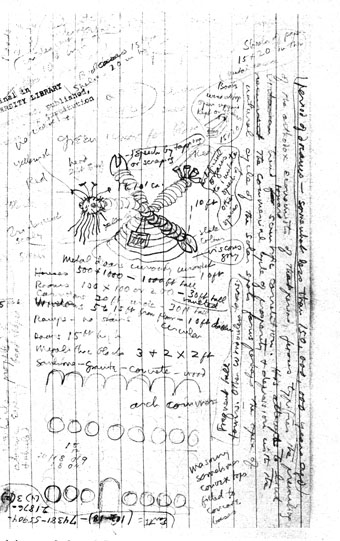
One of the tasks this week has been sketching out a member of the Great Race of Yith, the consciousness-hopping alien scholars whose exploits are detailed in HP Lovecraft’s The Shadow Out of Time. Their appearance isn’t at all mysterious: Lovecraft describes them in some detail (and sketched them in his notes above) and they were illustrated by Howard V. Brown for their first publication in Astounding Stories in June 1936. But I’ve only ever drawn any of Lovecraft’s creatures when there’s been a good reason (or a commission) so this was the first time I’d had to think seriously about how I wanted to depict a Yithian.

cthulhu.jpg

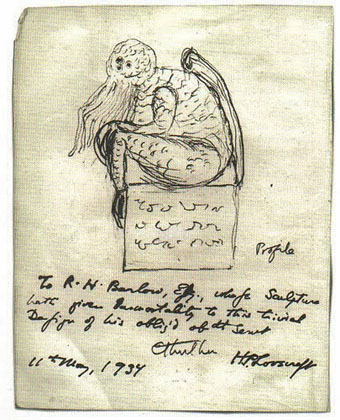
The results will be posted here in due course but in the meantime here’s a couple more of Lovecraft’s own sketches of his creations. The Cthulhu sketch is one of two showing the statue from the story. The most interesting detail for me is the multiple eyes which aren’t described in the text.

atmom.jpg

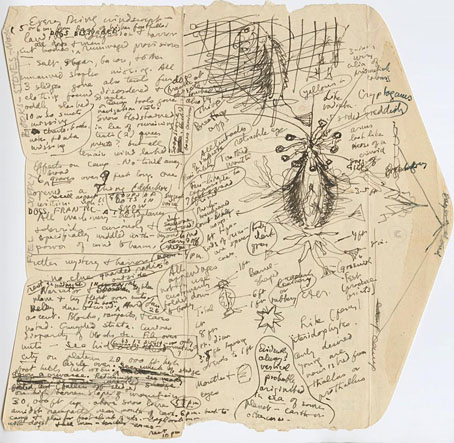
The Great Race of Yith have always struck me as somewhat improbable even if you take into account alien evolutionary paths. Similar creatures populate the early science fiction magazines (Frank R. Paul painted many of them), and this is one place where I feel slightly let down by Lovecraft’s imagination. In the recent batch of drawings I’ve also been depicting one of the Mi-go and some of the Elder Things from At the Mountains of Madness. The latter are at the opposite end of the scale to the Great Race, sufficiently alien without seeming absurd.

Elsewhere on { feuilleton }
The Lovecraft archive