Four short films by Lejf Marcussen

marcussen1.jpg

There’s more Surrealism inside this 34-minute collection of films by Lejf Marcussen (1936–2013), a Danish film-maker and animator whose filmography has never been easy to explore on the internet. Marcussen made an impression on a number of Britons in the late 1980s when The Public Voice was shown on TV, one of many such films broadcast during a time when British television channels still dared to screen unusual animations. I’ve written about The Public Voice before so there’s no need to repeat myself, it was a search for a better copy that led me to this compilation of four Marcussen films—The Conductor (1978), Tone Traces (1983), The Public Voice (1988), and Angeli (2002)—all of which differ so much from each other they could easily be taken for the works of four different directors.

marcussen2.jpg

The Conductor is the one closest to traditional animation, being a comic portrait of an orchestral conductor’s wildy exaggerated actions and facial reactions during the performance of a piece of music. It’s music that turns out to be the dominant theme in this collection, and the sole consistent element.

marcussen3.jpg

Where The Conductor is overtly comedic and grotesque, Tone Traces is completely abstract, an illustration of Carl Nielsen’s Symphony No. 5 whose unfolding is depicted by coloured lines on a black background. Marcussen’s approach differs from earlier musical illustrators like Oskar Fischinger in restricting his shapes to lines that follow the instrumentation and composition in great detail.

marcussen4.jpg

This version of The Public Voice is another one taped from a TV broadcast, it’s not necessarily better than any of the others but it does at least keep Marcussen’s remarkable film circulating. The music this time is a chaotic amalgam of pieces by Luciano Berio, Henry Cow and Gustav Mahler.

marcussen5.jpg

Angeli was Marcussen’s final film, another remarkable piece of work although it’s not one I like very much. Watching computerised shapes jump around in a jaunty manner isn’t how I prefer to spend my time, and the score for this one is chaos of a different kind, a collision of digital keyboard pieces with the superior music of Handel, Dvorak and Beethoven. Watch the second and third films in this set if you do nothing else.

Previously on { feuilleton }
A Picture, a film by Lejf Marcussen
The Public Voice by Lejf Marcussen

Antediluvian, a film by Mario Lanzas

antediluvian1.jpg

This short animated film differs from many other dinosaur films in using outmoded representations of the creatures for its source rather than the more accurate depictions we have today. The first modellings of dinosaurs were crude and often very inaccurate, to a degree that the earliest renderings now have a naive charm of their own, like the hearsay depictions of African animals or Egyptian monuments.

antediluvian2.jpg

Antediluvian has an additional attraction in its unintended resemblance to Roland Topor’s designs for René Laloux’s Fantastic Planet. Topor’s snapping, shrieking fauna are just as vicious as the outmoded saurians while being rendered in an equally naive style. All that Antediluvian requires is some suitably alien flora to push it into Topor-land, or at least the planet next door.

Previously on { feuilleton }
Les Temps Morts by René Laloux

Weekend links 771

druillet.jpg

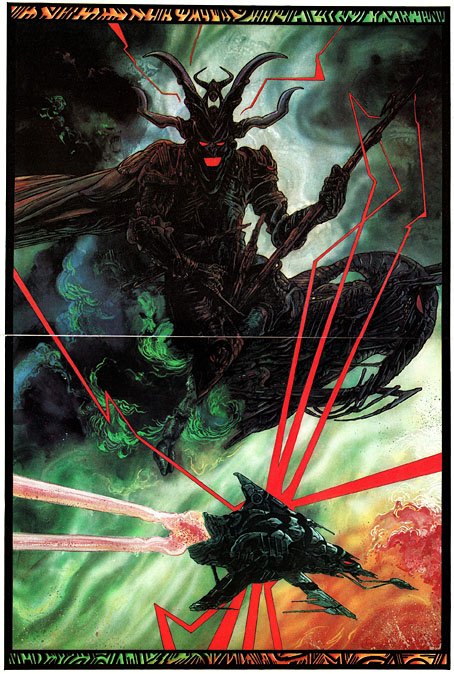
A page by Philippe Druillet from Salammbo (1980).

• At the BFI: Alex Ramon suggests 10 great British films of 1975 (the Britishness of Barry Lyndon seems a little debatable), while Jonathan Romney talks to the Quay Brothers about their latest exhibition and Sanatorium Under the Sign of the Hourglass.

• At Public Domain Review: The Cameraman’s Revenge (1912), an early animated film by Wladyslaw Starewicz concerning the domestic affairs of a pair of beetles.

Saga de Xam (previously), the science-fictional bande dessinée by Nicolas Devil and Jean Rollin, will be published in English for the first time in June.

When I first came across Ernest Berk, I assumed he was somebody’s Ursula Bogner style joke. An anti-Nazi exile turned fearless electronic pioneer, who had been a dancer in the Weimar Republic and worked both with Max Reinhardt and with Peter Zinovieff? Who nobody had ever heard of? I smelled a rat, but was wrong: Berk was very real. He was one of many dancers who fled Nazism and ended up at Dartington Hall, a school founded by wealthy hobbyists in Devon which has been slightly fancifully described as the ‘English Bauhaus’; he danced and choreographed at Glyndebourne and Covent Garden, and in the 1950s, became interested in the electronic music that was emerging out of his native Cologne. Berk gradually built a studio in Camden where he would be able to compose music for his own ballets…

Owen Hatherley on the legacy of the emigré composers who found refuge in Britain from the 1930s on

• “…distant and unrelated juxtapositions are at the very heart of Surrealism—both in France and in Japan.” Leanne Ogasawara on Surrealism in Japan.

• “What’s happening? Where are we? What about the investigation?” Mark Harris on Alan Sharp and Arthur Penn’s Night Moves.

• At Bandcamp: Dark Dreams and Bright Nightmares: Jim Allen‘s artist guide to Coil.

• At Colossal: Winners of the 2025 British Wildlife Photography Awards.

• DJ Food found more psychedelic posters from the web.

Wildlife (1987) by Penguin Cafe Orchestra | Night Moves/Fear (1988) by Jon Hassell/Farafina | Dark Dreams (1989) by Brian Eno

Dormitorium: The Film Décors of the Quay Brothers

crocodiles.jpg

The Tailor’s Shop from Street of Crocodiles.

I’m back home after a whirlwind visit to London, having earlier received an invitation from the Quay Brothers to the opening night of their Dormitorium exhibition at the Swedenborg Hall in Bloomsbury. The show is the London debut of a display of sets and puppets from all the Quays’ major films. This is also a slightly expanded exhibition, previous outings such as the one at the Museum of Modern Art in New York having been staged before they made their more recent films. New additions include several cases devoted to characters from The Doll’s Breath, and one that features characters and tiny set elements from their new feature film, Sanatorium Under the Sign of the Hourglass.

dolls.jpg

Characters from The Doll’s Breath.

One of the curious things about looking at art in our mediated age is that you can become very familiar with certain paintings or drawings yet only have a vague idea as to the actual size of the originals, even when dimensions are printed along with reproductions in books. So too with the Quays’ puppets and décors. All the details are very familiar yet I wasn’t prepared to see those familiar details differing so much in size. The box that contains the puppets from This Unnamable Little Broom, for example, is very large, yet the boxes you see shortly after this, containing sets from Street of Crocodiles, are much smaller, a factor which makes everything inside those boxes seem dizzyingly concentrated. Choice of materials has obviously determined some of this. In the films where the Quays have used ceramic doll’s heads the sets have had to be constructed to the scale of the found artefacts. All of the more recent puppets have been constructed at a larger size.

calligrapher.jpg

The Calligrapher.

The other surprise of the exhibition was the cabinets themselves. A few of these have been built to take advantage of the exhibition setting: the box featuring ‘The Calligrapher’ has a large distorting lens set into its front glass panel, while the cabinet next to it, showing the rippled landscape from The Comb, has glass sides which allow the viewer to more easily read the anamorphic lettering stretched over the hills. Several other cabinets present their contents like peepshow exhibits, their portholes being filled with yet more distorting lenses which offer mutable views of the illuminated exhibits within.

rehearsals.jpg

Rehearsals for Extinct Anatomies.

All these wonders will be on display at the Swedenborg Hall until 4th April. Entry is free if you’d like to disturb the sleep of the inhabitants. In return they’ll do their best to disturb your dreams.

dormitorium-plan.jpg

Elsewhere on { feuilleton }
The Quay Brothers archive

Mazes, a film by István Orosz

mazes1.jpg

Until last week I didn’t know Hungarian artist István Orosz had been making short animated films since the 1970s. I’ve known about Orosz’s Escher-like drawings for some time but missed the mention of the films in this interview with Steven Heller. Útvesztök (Mazes) from 2008 is one of the few Orosz films that you can see on YouTube, a short piece that seems to be a self-portrait going by the drawing tools littering one of the shots.

mazes2.jpg

The film is divided into nine sections, each one of which opens with a view of a maze where a hand (or pencil) traces a route matching the number of the section. The sequences that follow are all of the animated type wherein familiar things (animals, people, objects) mutate in some way, the mutations eventually revealing a face which ages slightly from one sequence to the next. I was hoping we might also see some of Orosz’s architectural illusions but if he has animated any of these they must be in his other films.

Previously on { feuilleton }
False perspective