Stille Nacht V: Dog Door

dogdoor.jpg

A short animation by the Brothers Quay which I evidently missed last year when I was searching for their uncollected works. As far as I’m aware this is the most recent addition to the Stille Nacht series, all of which were made to serve some function external to the films themselves: so Stille Nacht I was an MTV ident, II was a music video for His Name Is Alive, III was an extended trailer/preview for Institute Benjamenta, and IV was another music video for His Name Is Alive.

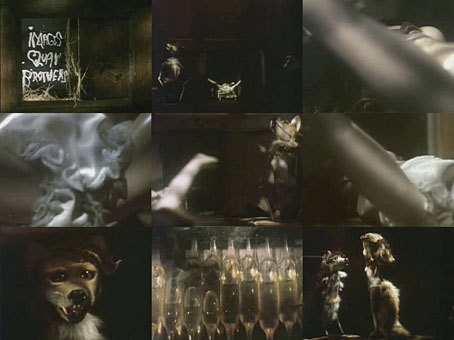
Number V in the series is another music video, this time for Sparklehorse’s Dog Door, a song from the group’s 2001 album It’s A Wonderful Life. Tom Waits is the guest vocalist providing his usual enigmatic wailing. The video was one of several commissioned to illustrate the album’s songs but the Quays still manage to make something that’s very much their own. As with the His Name Is Alive films there’s an atmosphere of polymorphous perversity via the two characters of a masturbating dog (or is it a fox?) and a recumbent doll, also masturbating. A slogan at the end states in French “You’re never too young for debauchery”. (In the earlier videos there was another doll and a toy rabbit.) Copies on YouTube are rough but for the moment it’s the only way you’ll see this one.

Elsewhere on { feuilleton }
The Quay Brothers archive

Tadanori Yokoo animations

yokoo13.jpg

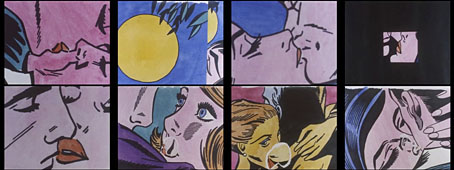
Kiss Kiss Kiss (1964).

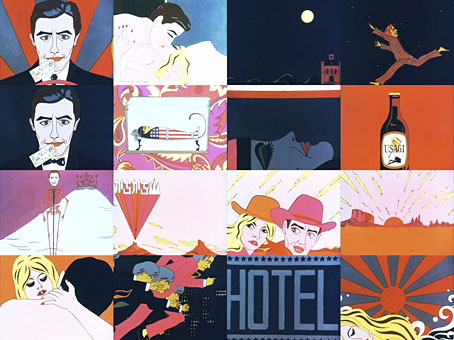
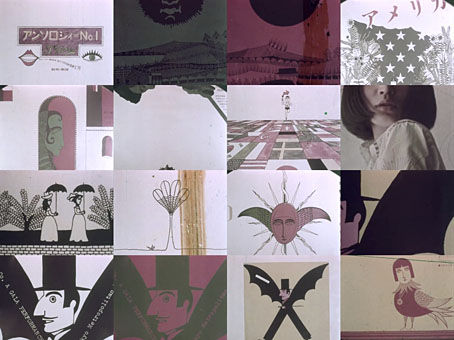
A follow-up to yesterday’s post, and three short films by the artist from the 1960s. As animations go these are fairly crude but they do have the benefit of showing Yokoo’s sense of humour, something which isn’t necessarily so obvious in his poster art. Kiss Kiss Kiss is a short sequence of juxtaposed couples from the same American romance comics that Roy Lichtenstein spent much of his time plundering. Kachi Kachi Yama, the longest of the three, opens with the unlikely claim that it features Alain Delon, Elizabeth Taylor, Richard Burton, Marilyn Monroe and The Beatles, then makes good by showing drawings of all of these in a witty melodrama which is like Yokoo’s poster art brought to life. Tokuten Eizou Anthology No. 1 is a lot less explicable being a display of the artist’s drawings together with the occasional photograph. All three films can be seen together at Ubuweb.

yokoo14.jpg

Kachi Kachi Yama (1965).

yokoo15.jpg

Tokuten Eizou Anthology No. 1 (1964).

Previously on { feuilleton }
Tadanori Yokoo album covers

La femme qui se poudre

bokanowski1.jpg

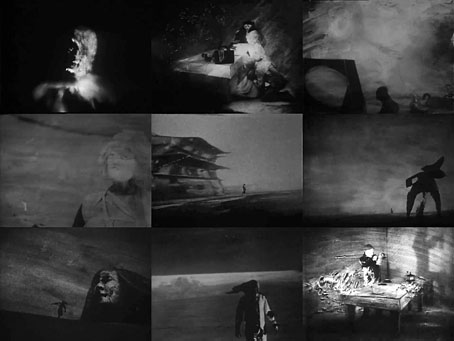
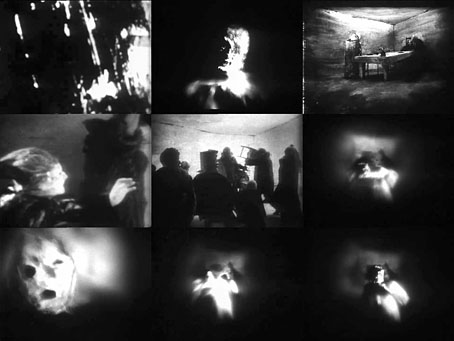
The DVD collection of films by Piotr Kamler turned up last week so I’ve been alternating viewing of that with shorts by Patrick Bokanowski. The latter is less an animator than a filmmaker who uses animation or film effects to achieve his aims, together with masks and very stylised performances. Bokanowski’s early film La femme qui se poudre (The Woman Who Powders Herself, 1972) runs for 15 minutes, and is as remarkable in its own way as his feature-length L’Ange (1982). La femme qui se poudre has the same masked figures engaged in activities which often lack easy interpretation; in both films the atmosphere can shift from absurdity to the edge of horror and back again. For me what’s most remarkable about this particular short is the way it anticipates both Eraserhead and the early films of the Brothers Quay yet still seems little known. The Quays are on record as admiring L’Ange but I’ve yet to see any sign that David Lynch knew of this film in the 1970s. I’d be wary of assuming that Lynch was imitating Bokanowski, artists are quite capable of finding themselves working in similar areas independently.

bokanowski2.jpg

Films of this nature always benefit from well-matched soundtracks: Piotr Kamler uses recordings by different electronic composers; Eraserhead had Fats Waller and the rumblings and hissings of Alan Splet; the Quays have unique compositions by Lech Jankowski. La femme qui se poudre and L’Ange have outstanding soundtracks by Michèle Bokanowski, the director’s wife and an accomplished avant-garde composer. Her work is as deserving of further attention as that of her husband. DVDs of L’Ange and a collection of Patrick Bokanowski’s short films may be purchased here.

Previously on { feuilleton }
Le labyrinthe and Coeur de secours
Chronopolis by Piotr Kamler
Brothers Quay scarcities
Patrick Bokanowski again
L’Ange by Patrick Bokanowski

Weekend links 159

francov2.jpg

El Banquete Magnético (2011) by Cristina Francov.

Did Vertigo Introduce Computer Graphics to Cinema? asks Tom McCormack. He means Saul Bass’s title sequence which mostly uses still harmonographs but also features some animated moments by John Whitney.

•  Temple of the Vanities by Thomas Jorion. “Pictured here are political monuments and munitions depots, hulking concrete forms that marked the edges of empires.” Related: Paintings by Minoru Nomata.

• Musical reminiscences: Matt Domino on the Small Faces’ psychedelic magnum opus Ogden’s Nut Gone Flake, and Richard Metzger on the sombre splendours of Tuxedomoon.

Harrison is best known as one of the restless fathers of modern SF, but to my mind he is among the most brilliant novelists writing today, with regard to whom the question of genre is an irrelevance. To read his work is to encounter fiction doing what fiction must: carrying out the kinds of thinking and expression that would be possible in no other form. I pass through his novels feeling a mixture of wonder, calmness and disturbance; I end them brain-jarred and unsettled. Metaphysical echoes persist for days afterwards. It feels as if I have had a strabismus induced, causing illusions that slowly resolve into insights.

Robert Macfarlane on M. John Harrison and the reissue of Climbers.

• Divine Machinery: An Interview with Paul Jebanasam. Arvo Pärt, Cormac McCarthy and Algernon Blackwood are folded into his new album, Rites.

Autostraddle shows the evolution of twelve queer book cover designs. As is often the case in cover design, latest isn’t always best.

• “My Definition Of Hell? It’s Other People, At The Cinema!” Anne Billson on the very thing that finished me as a cinema-goer.

• “London in the 1830s was a truly weird and terrifying place.” Spring-Heeled Jack, The Terror of London.

• At Scientific American: The Reading Brain in the Digital Age: The Science of Paper versus Screens.

Van Dyke Parks: “I was victimised by Brian Wilson’s buffoonery.”

Colour film of London in 1927.

Abandonedography

Social Dead Zone

• Tuxedomoon: Tritone (Musica Diablo) (1980) | Desire (1981) | Incubus (Blue Suit) (1981)

Ray Harryhausen, 1920–2013

harryhausen.jpg

Concept art for Jason and the Argonauts (1963).

He could also draw, something the obituaries won’t necessarily mention. I wasn’t aware of Ray Harryhausen’s many detailed preliminary drawings until I had the good fortune to see him give a talk at the Preston SF Group in the early 1990s. I recall mention being made of Gustave Doré as an influence, something that wasn’t so surprising given that Harryhausen’s animation career began with Willis O’Brien, animator of the original Kong. The Skull Island sets for King Kong owed much to Doré’s illustrations, and the film also made use of equally detailed preliminary drawings by O’Brien, Byron Crabbe and Mario Larrinaga.

I was going to link to Jason and company’s celebrated fight with the skeletons but the only clips on YouTube at the moment lack Bernard Herrmann’s superb score. The Harryhausen/Schneer films always had low budgets but the producers understood the importance of music, and employed Herrmann on four of their films: The 7th Voyage of Sinbad (1958), The Three Worlds of Gulliver (1960), Mysterious Island (1961) and Jason and the Argonauts (1963). Miklós Rózsa provided the score for The Golden Voyage of Sinbad (1974) so here’s a favourite moment from that film with John Philip Law and Martin Shaw tackling Tom Baker’s sword-wielding Kali statue.

Ray Harryhausen’s production drawings can be seen in The Art of Ray Harryhausen (2005).

Previously on { feuilleton }
Swords against death