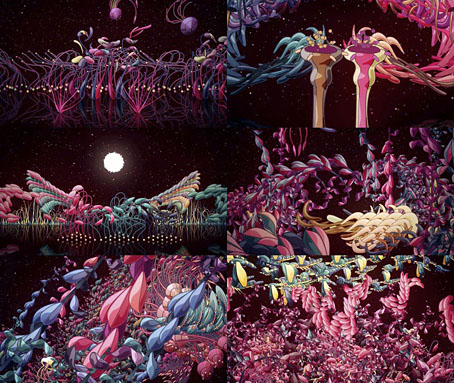
Burgeoning plant life, fungal forms and flights of insects fill the screen in this vivid animation by Hideki Inaba. The music is by Beatsofreen. (Via Full Fathom Five)
A journal by artist and designer John Coulthart.

Animated films
Burgeoning plant life, fungal forms and flights of insects fill the screen in this vivid animation by Hideki Inaba. The music is by Beatsofreen. (Via Full Fathom Five)
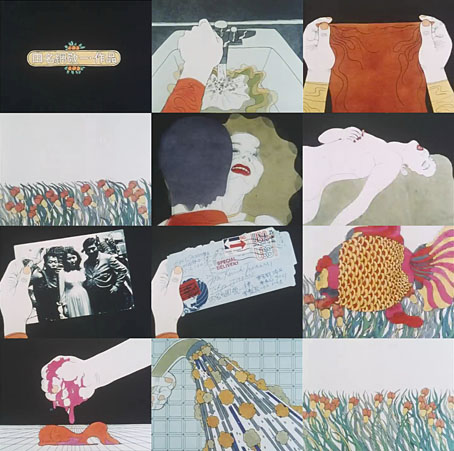
One of a number of strange, short animations made by Tanaami in the 1970s with the assistance of professional animators. IMDB lists 13 of these films but biographical notes for Tanaami refer to others before and after. This one is on YouTube together with a handful of others, or you can see the same films in better quality at Ubuweb.
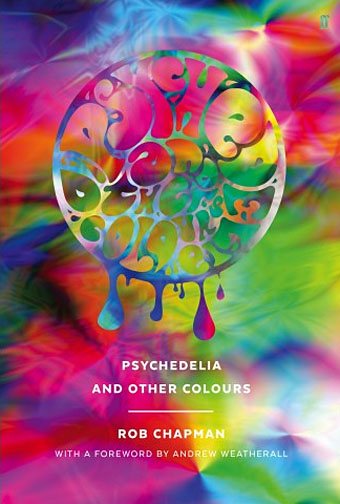
My mother thought well enough of The Beatles in the 1960s to buy two of their albums—Beatles For Sale and Help!—and she continued to enjoy the Fab Four’s songs up to the point when (in her words) “they went funny”, by which she meant the period after Rubber Soul when they dropped the beat stylings, picked up sitars and took to recording drums and guitars in reverse. They were also taking drugs, of course, hence the funniness, and this rapid evolution—from loveable moptops to freaked-out weirdos in a matter of months—is the subject of Rob Chapman’s huge study of psychedelia as a cultural phenomenon, the period from around mid-1965 to late 1969 when Western youth “went funny” en masse.
This isn’t an undocumented era but Chapman’s book provides an overdue counterweight to the American focus of earlier studies such as Jay Stevens’ Storming Heaven: LSD and the American Dream (1987). Psychedelic art evolved in San Francisco but it’s an irony of the form that many of the wildest, most typically psychedelic concert posters were promoting acts that were only marginally psychedelic in their sound or, in the case of the older jazz, soul and blues acts, weren’t psychedelic at all. Chapman is more interested in the multi-media light shows than the poster art, and he reaches back in his early chapters to the origin of the San Francisco light shows in the avant-garde art of the Modernist era (especially László Moholy-Nagy’s Light-Space Modulator of the 1920s) and the art schools of the 1950s; he also traces the familiar journey of LSD from the Sandoz laboratories in Switzerland and the clinics of America to the front pages of newspapers and magazines. One of the most remarkable and unlikely aspects of psychedelia was the way in which a short-lived poly-cultural phenomenon maintained an aura of danger and illegality late into the 1960s even while psychedelic aesthetics were filtering into every facet of mainstream life: films, fashion, decor, advertising, even children’s television—all bloomed briefly with vivid colours and melting typography.
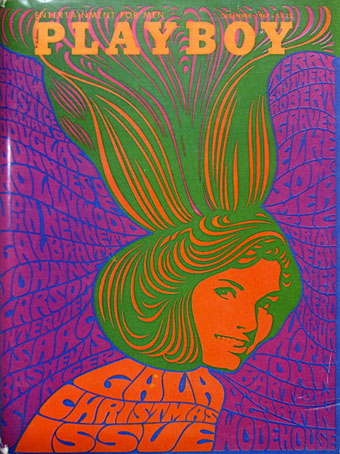
Playboy gets hip to the trip, December 1967. Art by Wes Wilson.
Chapman touches on all of this but the bulk of his study is concerned with the music which was always the core of psychedelic culture, even if many of the artists involved were only following a trend (or, to be less charitable, jumping on a bandwagon). American groups are given their due, and Chapman has some smart things to say about the often neglected surf boom of the early 60s; as noted here last month, the first piece of popular music to use “LSD” in its title was LSD-25 (1960), a surf instrumental by The Gamblers. Surf bands and garage bands mutated into psychedelic groups but there was often little change in the overall sound beyond adding an effect or two to the instrumentation. Adulterated or processed sound is what I usually look for in psychedelic music, the psychedelic experience being one of distorted or exaggerated perception. Adulteration (or lack of it) is the most obvious factor that differentiates American psych from its British equivalent: White Rabbit by Jefferson Airplane is a great song (its final line is fixed to every page of this blog) but is psychedelic only as a result of its lyrical context. Musically, the song is a simple rock bolero next to which Strawberry Fields Forever sounds like a broadcast from another planet.
Continue reading “Psychedelia and Other Colours by Rob Chapman”

Behind by Lisa Wassmann.
• “Without space art, nobody would know what Mars would look like.” Artist David A. Hardy talking to Nadja Sayej about a life spent painting the cosmos and—briefly—working for Hawkwind. Visions of Space, an exhibition of astronomical art, is at the Wells & Mendip Museum throughout November.
• Mixes of the week: Something Beautiful Happened by Cafe Kaput; Autumn Vybes: Mist, Mystery and Motion by Abigail Ward; and Secret Thirteen Mix 166 by Ron Morelli.
• More Ghost Box: Two new singles in the Other Voices series will be released next month. And the label is profiled in the latest issue of Electronic Sound magazine.
It breaks my heart when one writer tells another what she can or cannot do. I once knew a woman, a professor of literature, who said that Flaubert had no right to write Madame Bovary because he was a man. Such dangerous foolishness! This is just another form that dogmatic thinking takes. And it seems to me that the imagining mind—which is also a profoundly human mind—must be unfettered, boundless. To write from the perspective of another’s world demands a generous and a rigorous leap of the spirit; it demands empathy and mindfulness. Writing is so much about subverting dogmatisms of all kinds, above all the ones that insist you cannot go there! You must not say that! Writers need to go anywhere, to take anything on. And the only rule is to do it well.
Rikki Ducornet in a retrospective feature at Dennis Cooper’s blog
• “Horror at its best has always existed outside the mainstream,” says Brian Ennis in another celebratory piece about Thomas Ligotti.
• Alan Clarke & David Rudkin’s Penda’s Fen receives another cinema screening next week at the Sallis Benney Theatre, Brighton.
• “[David] Lynch’s films abound with gnomic pronouncements and incantations,” says Dennis Lim.
• Stars of the Lid play a tremendous hour-long set at St. Agnes Church in Brooklyn.
• Drawn in Stereo: a book of music-related art and illustration by Michael Gillette.
• At Dangerous Minds: Only the coolest people get to sit in the wicker peacock chair.
• Everything Is Erotic Therefore Everything Is Exhausting by Johanna Hedva.
• Moon Mist (1961) by The Out-Islanders | River Mist (1989) by Brian Eno | Black Mist (Long Version) (2013) by Pye Corner Audio
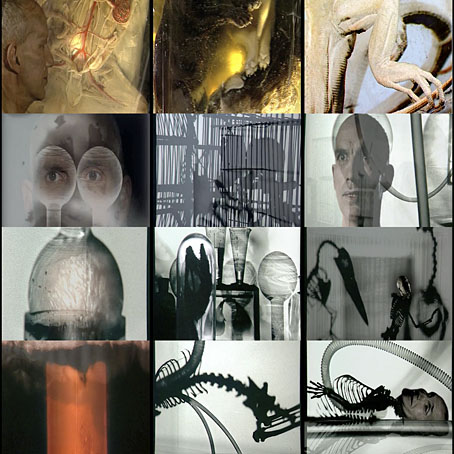
“Butcher’s hook” is Cockney rhyming slang for “look”, something alluded to in this short and wordless blend of live action and animation. But it also has a more sinister connotation when the fate of the taxidermist becomes apparent. As with Pummell’s earlier Secret Joy of Falling Angels, animal skeletons and silhouettes predominate. The film was co-written by novelist Simon Ings while the sound is by regular Quay Brothers collaborator Larry Sider.
Previously on { feuilleton }
• Secret Joy of Falling Angels, a film by Simon Pummell