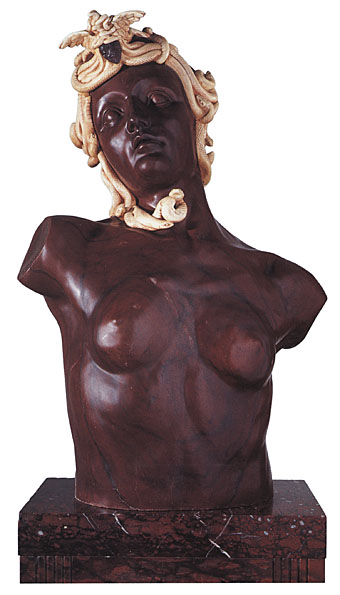
The art of Philippe Wolfers, 1858–1929

wolfers1.jpg

Maléficia (1905).

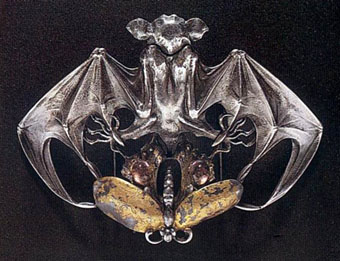
Much of the jewellery and sculpture produced by Phillipe Wolfers demonstrates the tendency of Art Nouveau and decorative Symbolism to evolve from Decadence to full-blown Gothic. The sinister recurs in Wolfers’ creations whether in the form of baleful females such as Malèficia and his Medusa pendant, or in the shape of bats, insects and the ubiquitous fin de siècle serpent. There’s more Wolfers on the web than there was a couple of years ago but still too little; I scanned Malèficia from a book and swiped the bat brooch belt buckle (also a book scan) from Beautiful Century.

wolfers2.jpg

Large dragonfly (1903–04).

wolfers3.jpg

Le Jour et la Nuit (1897).

Previously on { feuilleton }
Lalique’s dragonflies
Lucien Gaillard
The Masks of Medusa

The recurrent pose 12

ysl.jpg

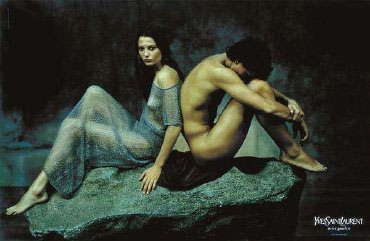
It wouldn’t surprise me if there are more examples of the fashion world borrowing the Flandrin pose but this is the only one I’ve seen so far, part of a 1998 art-inspired photo series by Mario Sorrenti for Yves Saint-Laurent. There don’t seem to be any larger copies available, unfortunately.

Elsewhere on { feuilleton }
The recurrent pose archive

Previously on { feuilleton }
Last Suppers and last straws
The last circle of the Inferno

Blog this: tits out for the future

blogs.jpg

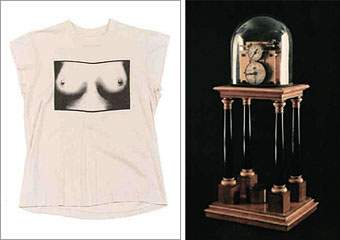
left: tits t-shirt by Vivienne Westwood and Malcolm McLaren.
right: the Hipp Chronoscope via io9.

A new year brings new blogs which is perhaps just as well seeing as the old year drew a line under some regular reads.

The Look, “Adventures in pop and rock fashion”, began posting a couple of weeks ago, spinning off from Paul Gorman’s book of the same name. Pieces there which immediately catch my eye are a skate through Billy Bowers’ outrageous clothing designs and a nice potted-history of the “tits tee”. I’d not realised before that the history of this latter creation goes back beyond punk to the early Seventies, another example of the evolution from post-psychedelic freakery to punk being a process of gradual elision, not the clean break that lazy commentary often suggests.

Also arriving (and noted everywhere by now) is io9, a new addition to the Gawker network, which looks at sf-related culture. I’ve already had a traffic spike from there after they linked to my Hugh Ferriss post and it’s good to see that Bldg Blog‘s Geoff Manaugh is among their contributors.

Previously on { feuilleton }
Ave Atque Vale!

Lalique’s dragonflies

lalique1.jpg

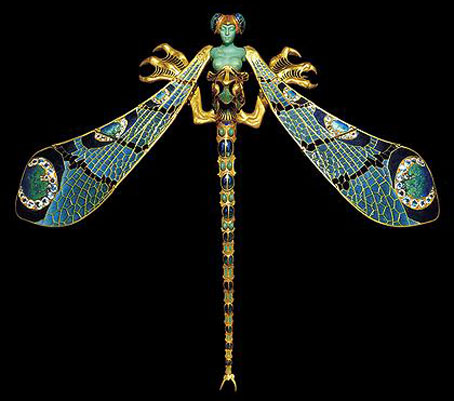
Dragonfly woman corsage ornament (1897–1898).
Gold, enamel, chrysoprase, moonstones, and diamonds.

Seeing as dragonflies emerged as a theme this week I can’t resist mentioning my favourite of all, this bizarre confection by glass artist and jeweller René Lalique (1860–1945), a dragonfly with female torso and gryphon claws. This was owned by wealthy Armenian collector Calouste Gulbenkian (in whose museum it now resides) and was worn once by Sarah Bernhardt. You can barely tell from this picture but the delicate gold wings are hinged at several points so they wouldn’t be obtrusive for the wearer.

lalique2.jpg

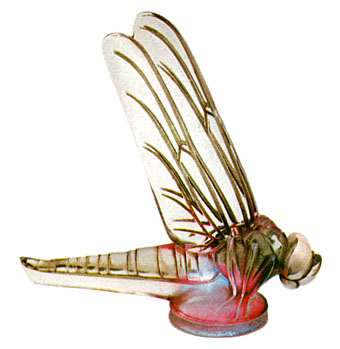
The Lalique company made more glassware than they did jewellery and these included a range of unique automobile mascots whose pedestrian-puncturing potential saw them banished to museum cabinets as road safety laws evolved. The dragonfly design was an especially splendid example, being placed above a multicoloured disc lit from beneath which rotated in accordance with the speed of the car. The faster the car travelled, the faster the colours changed.

Previously on { feuilleton }
Lucien Gaillard
Wesley Fleming’s glass insects
The glass menagerie

Lucien Gaillard

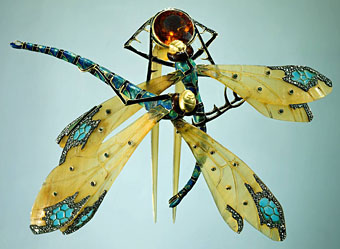
gaillard1.jpg

Two dragonflies (1904).

Art Nouveau insect jewellery by Lucien Gaillard (1861–1933).

gaillard2.jpg

Perfume bottle (?) (c. 1923).

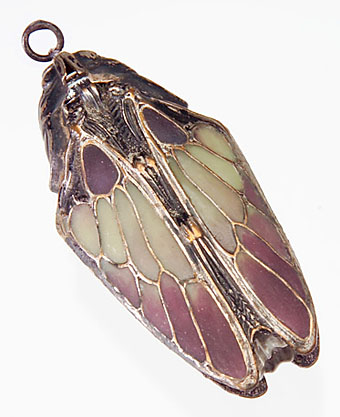
gaillard3.jpg

Moth pendant (1900).

And while we’re on the subject, a display of precious stones and metals has opened at London’s Natural History Museum in a new gallery they’re calling The Vault.

Previously on { feuilleton }
Wesley Fleming’s glass insects
The art of Sergei Aparin
Insect Lab
The glass menagerie
The Museum of Fantastic Specimens