Maurice Leloir’s Three Musketeers

leloir03.jpg

Just after Christmas I watched the recent French film adaptation of The Count of Monte Cristo, after which I resolved to finally read The Three Musketeers, something I’d been intending to do since reading The Count of Monte Cristo four years ago. I’m currently two thirds of the way through The Three Musketeers and enjoying it very much despite the familiarity of the story. (I’ve watched Richard Lester’s two-part film adaptation many times.) For the most part, the novel avoids the flaws which make Monte Cristo a laborious read (Umberto Eco described the latter as “one of the most exciting novels ever written and on the other hand…one of the most badly written novels of all time and in any literature”), but The Three Musketeers isn’t without flaws of its own. I don’t think too many people would regard the lack of descriptive detail as a flaw per se—this is an adventure story, after all—but I enjoy a well-crafted description, and Dumas’s sketching of costume and place ranges from the scant to the non-existent. We’re told, for example, that d’Artagnan is a member of the King’s Guard, and that the Guards and the Musketeers are identifiable by the differences of their uniforms. But I don’t recall any instance when we’re told how these differences are manifest, or even how any of the principle characters dress from day to day. The same applies to the settings; much of the novel is set in the Paris of the 1620s but Dumas ignores any scenic description in what would have been a darker, muddier and altogether less salubrious city than his own Paris of the 1840s.
leloir01.jpg

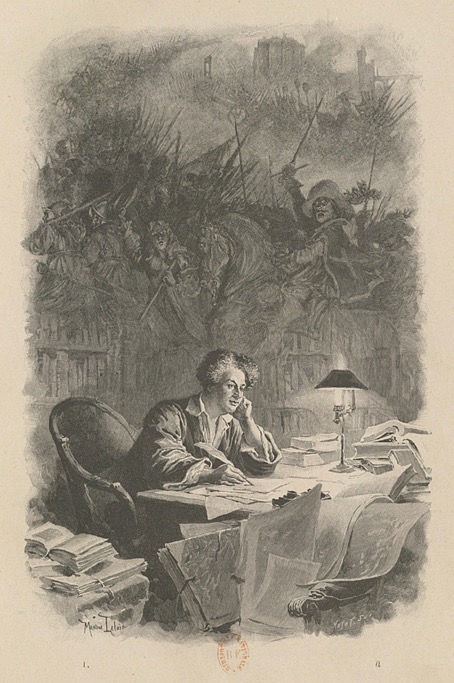
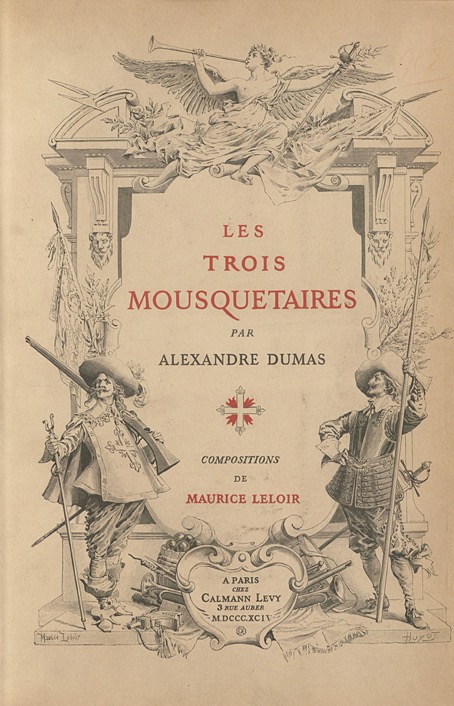
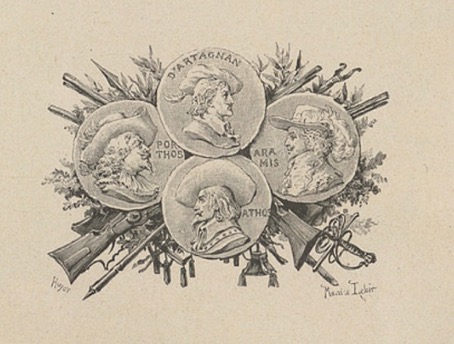
All of which brings us to Monsieur Maurice Leloir (1853–1940) and his illustrations for the novel which were published in a two-volume edition in 1894 (Tome 1 | Tome 2). Leloir was a painter and illustrator with a considerable knowledge of French historical dress; in 1907 he became the founding president of the Société de l’histoire du costume. His illustrations of The Three Musketeers, therefore, may be taken as authoritative when it comes to the costuming of the characters. Leloir was very good with everything else, as it happens; his characterisation is better than those of an earlier edition which makes d’Artagnan and friends barely distinguishable from each other, something not helped by the barbering habits of the day which had every gentleman sporting the same elaborate moustaches.
leloir02.jpg

Most of Leloir’s illustrations are placed vignette-style inside the page but a few of the larger ones run across two pages, especially those involving fights or other action scenes. And there are many illustrations, what you see here is a very small sample. A couple of them so closely match scenes in the Richard Lester films that I’m sure the books must have been referred to for details of costuming. Douglas Fairbanks certainly saw them; after playing d’Artagnan in his own film production of The Three Musketeers he invited Maurice Leloir to advise with the costuming of another Dumas adaptation, The Iron Mask, in 1929.
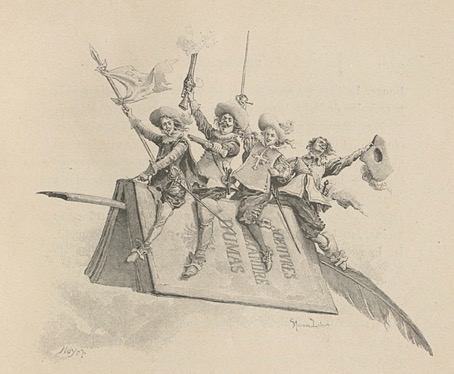
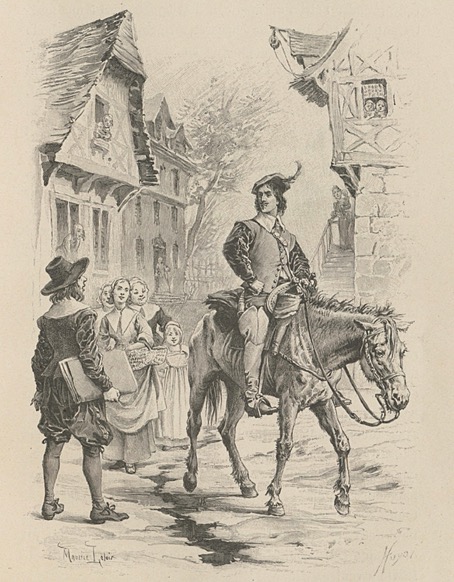
leloir05.jpg

leloir06.jpg

Continue reading “Maurice Leloir’s Three Musketeers”

De Nerée and Luisa Casati

casati6.jpg

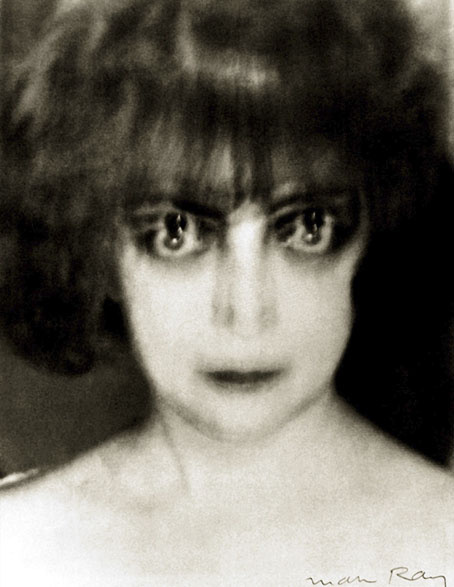
Luisa Casati (1922) by Man Ray.

Today’s post is another in the series of irregular art essays by Sander Bink. The subject this time is Luisa Casati (1881–1957), the Italian heiress who burnt through a fortune living extravagantly while being drawn or painted by many of the most notable artists of her time. (I did my own very stylised portrait of the Marchesa for Bruce Sterling’s Pirate Utopia, a novel where Casati briefly appears among the cast of real and fictional characters.) As before with Sander’s posts, Carel de Nerée tot Babberich is one of the artists under discussion. Thanks, Sander!

* * *

casati1.jpg

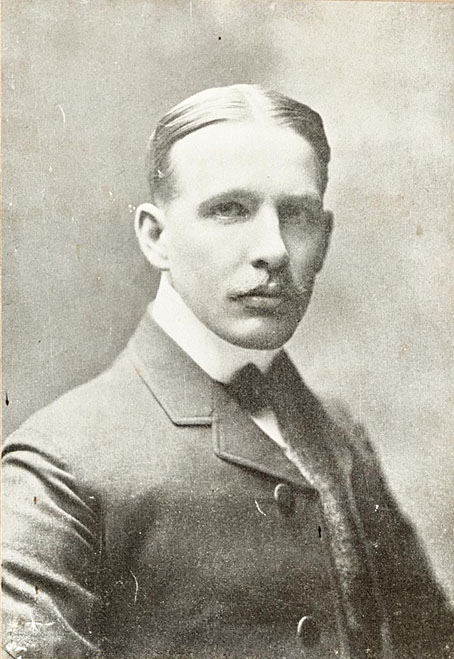
Carel de Nerée around 1905.

Many artists have paid homage to the ‘living artwork’ and legendary fashion icon Luisa Casati. Artists such as Man Ray, Paul-César Helleu, Giovanni Boldini, Léon Bakst, Kees van Dongen, Alastair, Romaine Brooks and Giacomo Balla have immortalised her. Legend has it that a certain fascinating Dutch artist should also be added to this list: Carel de Nerée tot Babberich (1880–1909). (Previously: 1 & 2)

casati5.jpg

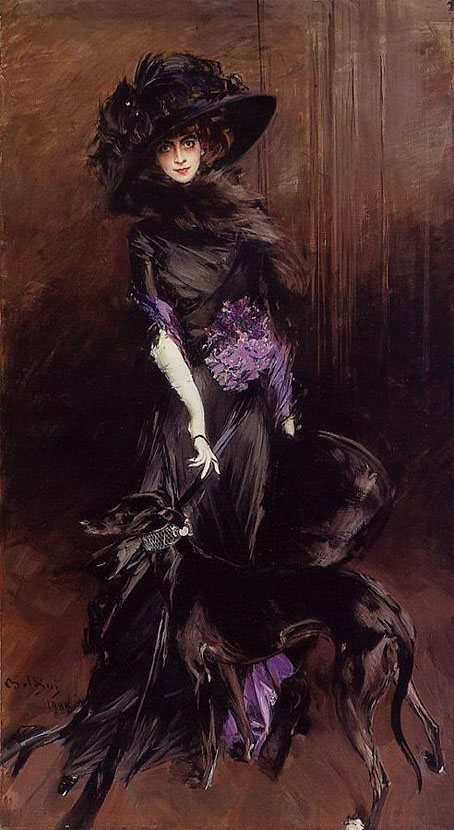
Luisa Casati with Greyhound (1908) by Giovanni Boldini. Private collection.

By 1930, Casati’s decadent and luxurious lifestyle had left her millions in debt. To escape her creditors, she moved to London. In the years before her death in 1957, she was seen scavenging for food in rubbish bins. In these final years, she naturally preferred to look to the past rather than the present, making lists of all those who had portrayed her then fading glory. Remarkably, one of these features De Nerée. Scot D. Ryersson and Michael Yaccarino, in their classic biography Infinite Variety: The Life and Legend of the Marchesa Casati, write about this period:

Whereas her evenings were absorbed by occult passions, the Marchesa spent part of her days writing lists. One was an inventory of the renowned personages she had known. There were others cataloguing the many artists, famous and lesser known, who had represented her. The difficulty of creating a comprehensive index of contributors to the ‘Casati Gallery’ is compounded both by Luisa’s incomplete and inaccurate records and by the lack of information concerning the minor portraitists, such as Mrs. Leslie Cotton and Karel de Nerée tot Babberich and those who were simply wealthy dilettantes. Boldini, John, van Dongen, and Epstein are noted alongside Hohenlohe, Nikolai Riabushinsky, theatrical designer Oliver Messel, and Eduardo Chicharro, director of the Spanish Academy of Fine Art in Rome.

The footnote to this paragraph states:

Christophe Henri Karel de Nerée tot Babberich (1880–1909) was a little-known Dutch artist whose pen and ink work is highly reminiscent of Martini and Alastair. Although there is little material documenting Casati’s association with or influence on the artist, many of the highly stylized and bizarre female subjects of his drawings share a more than coincidental resemblance to the Marchesa.

De Nerée did, indeed, draw several dark-eyed female figures in extravagant dresses, all of which could easily pass for a portrait of Casati. In the book The Marchesa Casati: Portraits of a Muse (2009), Ryersson and Yaccarino give an overview of all the works of art based on Casati. A drawing by De Nerée of a very slender figure with dark eyes is identified as a portrait of Casati and dated 1905.

casati9.jpg

Het schone beeld (The beautiful image, 1900–01) by Carel de Nerée. Private Collection. Estate of Barry Humphries.

The authors were not 100% sure of this identification, but due to the almost complete lack of documentation on De Nerée’s life and work at the time, they chose this drawing. In an email to me in 2010, the authors withdrew this identification because of this lack of documentation. It is actually a drawing dating from 1900–01, based on a story by Henri Borel. Of course, we immediately set about trying to find out which of De Nerée’s drawings could be a portrait of Casati.

In their email, Ryersson and Yaccarino give some more information:

In the papers left behind by the Marchesa, after her death in 1957, was a list she had made herself of those artists who had done her portraits. Babberich was on that list. His portrait of her, done in pencil, was from around 1905. We do not know how they met, but the Marchesa travelled frequently and extensively and was fond of the work of such symbolist artists as Alberto Martini, Gustav Mossa, and Alastair, so it is not surprising that Babberich caught her attention somehow.

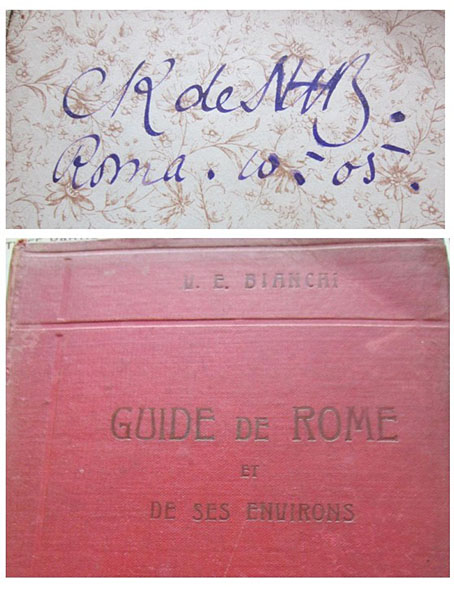
De Nerée and Casati make an excellent match indeed. ‘She was only too pleased to promote artists whose aesthetic she felt an affinity with, and those whose work was so contrary to popular taste’, Ryersson and Yaccarino write in Portraits of a Muse. In 2015, I began working on what has now become the first full-length biography of De Nerée. Research showed that De Nerée actually deregistered from The Hague in October 1905 in order to settle in Rome.

casati3.jpg

Rome travel guide with De Nerées’ annotation “Roma, October 1905”. Private collection.

One reason for this was that, from 1905, De Nerée’s life was increasingly set in the aristocratic and very wealthy circles of southern Europe. In 1907, for example, he met Gabriel d’Annunzio, a lover of Casati’s, in Florence. Perhaps he had met him before. And in 1908, for example, he drew a portrait of Baroness Clementine Maria von Reuter (1855–1941), daughter of the wealthy Baron Paul von Reuter (1816–1899), founder of Reuters news agency. (Private collection, Netherlands).

Continue reading “De Nerée and Luisa Casati”

Weekend links 648

klee.jpg

The Twittering Machine (1922) by Paul Klee.

• “Thinking of ‘writer Twitter’ as more important than writers themselves is an insult to the profession. People have been trading words for money for thousands of years. They will continue to do so after the death of a platform built on manufactured outrage, social hierarchy, unfunny jokes, stale memes, pornography, and spam. I mention this Atlantic essay only because it echoes what so many people are saying in the ether right now, not to pick on its author. The piece reads like a parody of how writers overestimate the importance of Twitter to their work and careers. It’s frankly a little embarrassing. Your work is the product you sell! Not the shitty jokes you tell with people you want to impress.” Freddie deBoer on the kerfuffle du jour. For “writer” see also “artist” or anyone else working at the intersection between commerce and creativity. From what I’ve read this week about potential technical problems at the pestilential birdcage I’d be less sanguine about its immediate survival. Since I retreated from the place as an active user two-and-a-half years ago all I get from it is the inflated subscriber number you see on the right-hand side of this page, a combination of Twitter followers plus email subscribers. The latter currently stand at some 270 individuals so if you’re among that number you can consider yourself part of a more exclusive group. And thanks for subscribing!

• “…the books of the past, besides adding to our understanding, offer something we also need: repose, refreshment and renewal. They help us keep going through dark times, they lift our spirits, they comfort us. Which means that I also strongly agree with the poet John Ashbery, who once wrote, ‘I am aware of the pejorative associations of the word “escapist,” but I insist that we need all the escapism we can get and even that isn’t going to be enough.'” Michael Dirda makes a case for reading classic, unusual and neglected books. Kudos for the mention of Anthony Skene‘s Monsieur Zenith, a character few of Dirda’s readers will have heard of.

• “While Haeckel’s paintings turn the floating phantoms into baroque spectacles of colour and flowing form, Mayer’s medusae are more sober, their tentacles subdued, their umbellate bells transparent.” Kevin Dann on the jellyfish and other “floating phantoms” described in AG Mayer’s Medusae of the World (1910).

• “The passing of time has added potency to the images, giving this interpretation of the Dracula story the feel of a distant fairy tale, a myth emerging from the mists of time, erupting across the world of cinema, its shadow reaching everywhere.” Martyn Bamber on 100 years of Murnau’s Nosferatu.

• At AnOther: Camille Vivier talks about shooting nude models in the treasure-filled home of HR Giger.

• New music: In Concert & In Residence by Sarah Davachi, and Anglo-Saxon Androids by Moon Wiring Club.

• At Spoon & Tamago: Kimono portraits were popular souvenirs for sailors visiting Japan in the 1800s.

• Mix of the week: Saturnalia: Deep Jazz for Long Nights, 1969–1980 at Aquarium Drunkard.

• At Dennis Cooper’s: Clouds.

Dark Clouds With Silver Linings (1961) by Sun Ra | Obscured By Clouds (1972) by Pink Floyd | Firmament (Cloudscape) (1995) by Main

Weekend links 577

preisler.jpg

Black Lake (1904) by Jan Preisler.

• Upcoming releases on the Ghost Box label will include a new album by {feuilleton} faves Pye Corner Audio, plus the surprising appearance of figures from Bruegel on a Ghost Box cover design.

Tilda Swinton and Olivier Saillard pay tribute to the films of Pier Paolo Pasolini. (Or to Pasolini’s costume designer, Danilo Donati.)

• New music: Spectral Corridor by The House In The Woods, and Re:Moving (Music for Choreographies by Yin Yue) by Machinefabriek.

• At Spoon & Tamago, Technopolis gets all the good things: “Giant kitty now greets commuters at Shinjuku Station.”

Anil Ananthaswamy on the ways in which psychedelics open a new window on the mechanisms of perception.

• Mixes of the week: Isolated Mix 112 by Suna, and GGHQ Mix #56, “An Unfortunate Kink”, by Abigail Ward.

• In this week’s impossible task, Alexis Petridis attempts to rank The Velvet Underground’s greatest songs.

• DJ Food unearths more flyers for London’s Middle Earth club, plus covers for the East Village Other.

• Global signals: Aki Onda on Holger Czukay and radio’s power to connect.

• At The Paris Review: Paintings and collages by Eileen Agar (1899–1991).

Will Sergeant’s favourite albums.

The Babel Tower Notice Board

Shaking Down The Tower Of Babel (1983) by Richard H. Kirk | Pärt: An Den Wassern Zu Babel (1991) by Estonian Philharmonic Chamber Choir conducted by Paul Hillier | The Black Meat (Deconstruction Of The Babel-Tower of Reason) (1994) by Automaton

Weekend links 575

barbier-gazette.jpg

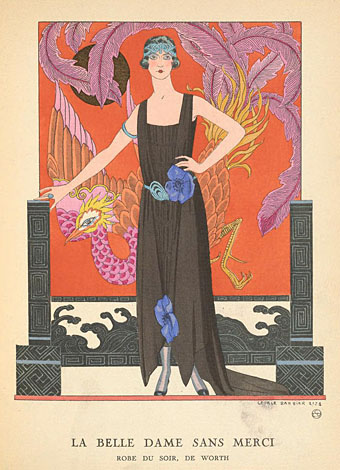
La Belle Dame Sans Merci (1921) by George Barbier.

• “Organic Music Theatre goes beyond jazz into something else entirely—an ecstatic, openhearted melding of cultures. It is the first live recording of Don and Moki’s ‘organic music’ concept, a holistic blend of the arts and education. It is an album that everyone should own, an absolute marvel.” Geeta Dayal on Don and Moki Cherry’s Organic Music Theatre: Festival de jazz de Chateauvallon 1972.

DJ Food continues his dig into the history of London’s Middle Earth venue with an account of a Magical Mystery Tour that ended up being more mystery than magic.

The Lamp Magazine is running a Christmas Ghost Story contest with a first prize of publication in the Christmas issue of the magazine, plus $1000.

Dennis Cooper‘s favourite fiction, poetry, non-fiction, film, art, and internet of 2021 so far. Thanks again for the link here!

• From sport to sex: Louis Staples on how the jockstrap became part of gay culture.

• At Wormwoodiana: Mark Valentine on the weird fiction of AE Coppard.

• “How vinyl records are trying to go green.” Trying…

• Mix of the week: XLR8R Podcast 701 by 40 Winks.

• New music: Rushes Recede by Sarah Davachi.

Lisa Gerrard‘s favourite music.

• RIP Peter Zinovieff.

Organic (1982) by Philip Glass | Core (Organic) (1995) by Main | Organic Mango (1996) by HAT