The Kelpies

kelpies1.jpg

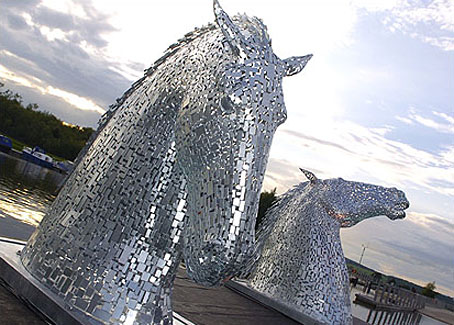
Maquettes from which the final works will be produced.

Given the choice between Thomas Heatherwick’s B of the Bang sculpture—a vast bundle of metal spikes situated near the City of Manchester Stadium—and Andy Scott’s proposal for The Kelpies, a pair of giant horse heads due to be erected in Falkirk, Scotland, I’d probably prefer the latter as a piece of colossal public art. Horse heads, from the Selene horse of the Parthenon onwards, are especially suited to statuesque representation and the horse has a venerable history as a symbol in the British countryside. It should be noted that between the two works, Andy Scott has the better location, Heatherwick’s giant piece is stuck in a redeveloped area near busy roads which makes its rusted spikes seem like leftovers from the stadium’s construction. He’s also been unfortunate in having created a work which began falling apart as soon as it was finished, with falling spikes causing a public hazard and a lengthy row with Manchester City Council which was only resolved this week.
kelpies2.jpg

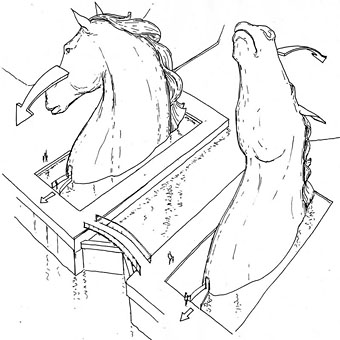
Scott’s enormous horse heads will be standing alone and monumental in newly-created parkland, symbolically representing a gateway to Scotland as they flank and help operate a canal lock. Kelpies is the name for the “water-horses” of Scottish myth and Scott’s Kelpies will stand 35 metres high, taller than the Angel of the North. Unlike Anthony Gormley’s static monument they’ll move back and forth as the level of the locks rises and falls. Scott’s website has more pictures of the maquettes as well as photos of his other public works.

Update: ‘Bang’ sculpture to be taken down

The Kelpies at Falkirkonline
Meet the Kelpies, Scotland’s giant addition to the UK sculptural skyline

Previously on { feuilleton }
Dark horses
Planet by Marc Quinn

Al Farrow’s Reliquaries

farrow1.jpg

Trigger Finger and two Ribs of Santo Guerro (detail).

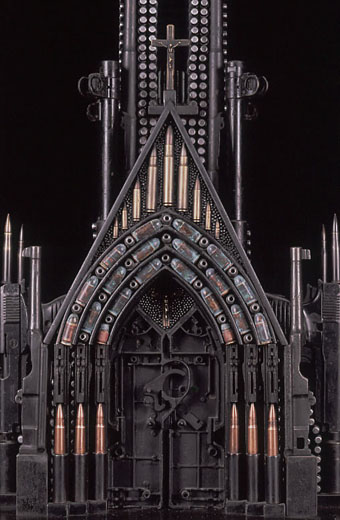
Amazing sculpture from Al Farrow’s Reliquaries series. Gun parts, bullets and bones, about which the artist says this:

I am not a gun person. My fascination with guns is with their function and use. It is the ubiquitous presence, seeming necessity and actual accessibility of guns in our culture that inspires my investigation. I am interested in their impact on society and cultures: Past, Present (and Future).

I do not personally use guns (Except as a medium for making art), so I was amazed at the availability of gun related paraphernalia when I started to accumulate supplies for this body of work.

I am also perpetually surprised by the historical and continuing partnership of war and religion. The atrocities committed in acts of war absolutely violate every tenet of religion, yet rarely do religious institutions speak against the violations committed in the name of God. Historically, Popes have even offered eternal salvation to those who fought on their behalf (The crusades, etc.).

In my constructed reliquaries, I am playfully employing symbols of war, religion and death in a facade of architectural beauty and harmony. I have allowed my interests in art history, archeology and anthropology to influence the work. The sculptures are an ironic play on the medieval cult of the relic, tomb art, and the seductive nature of objects commissioned and historically employed by those seeking position of power.

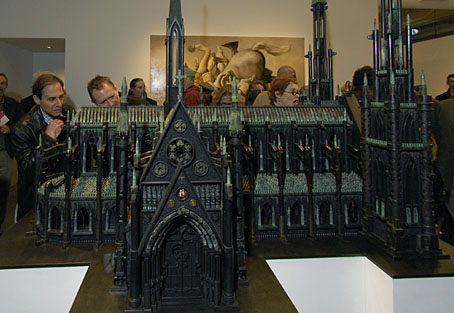
And when you’ve looked through the small pieces, there’s the cathedral

farrow2.jpg

Previously on { feuilleton }
Guillaume Bijl’s buried church

The recurrent pose 22

flandrin_statue.jpg

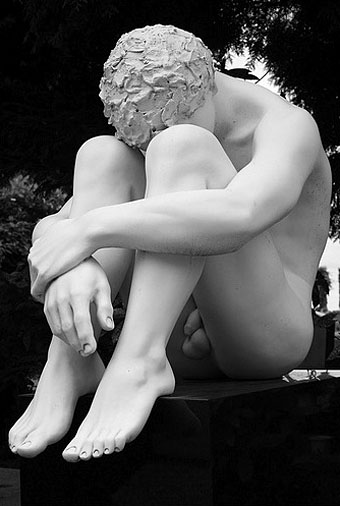
I don’t have any information as to the location of this statue (Hermosa Beach?) or the identity of the artist, unfortunately, but it’s another rare example of the Flandrin pose done as a sculpture. Unlike an earlier version by Pierre Yves Trémois, this seems copied directly from Flandrin’s painting.

Update: Note Hermosa Beach but the Cimetière d’Ixelles, Brussels.

Elsewhere on { feuilleton }
The recurrent pose archive

Le Sphinx Mystérieux

sphinx.jpg

Le Sphinx Mystérieux (1897).

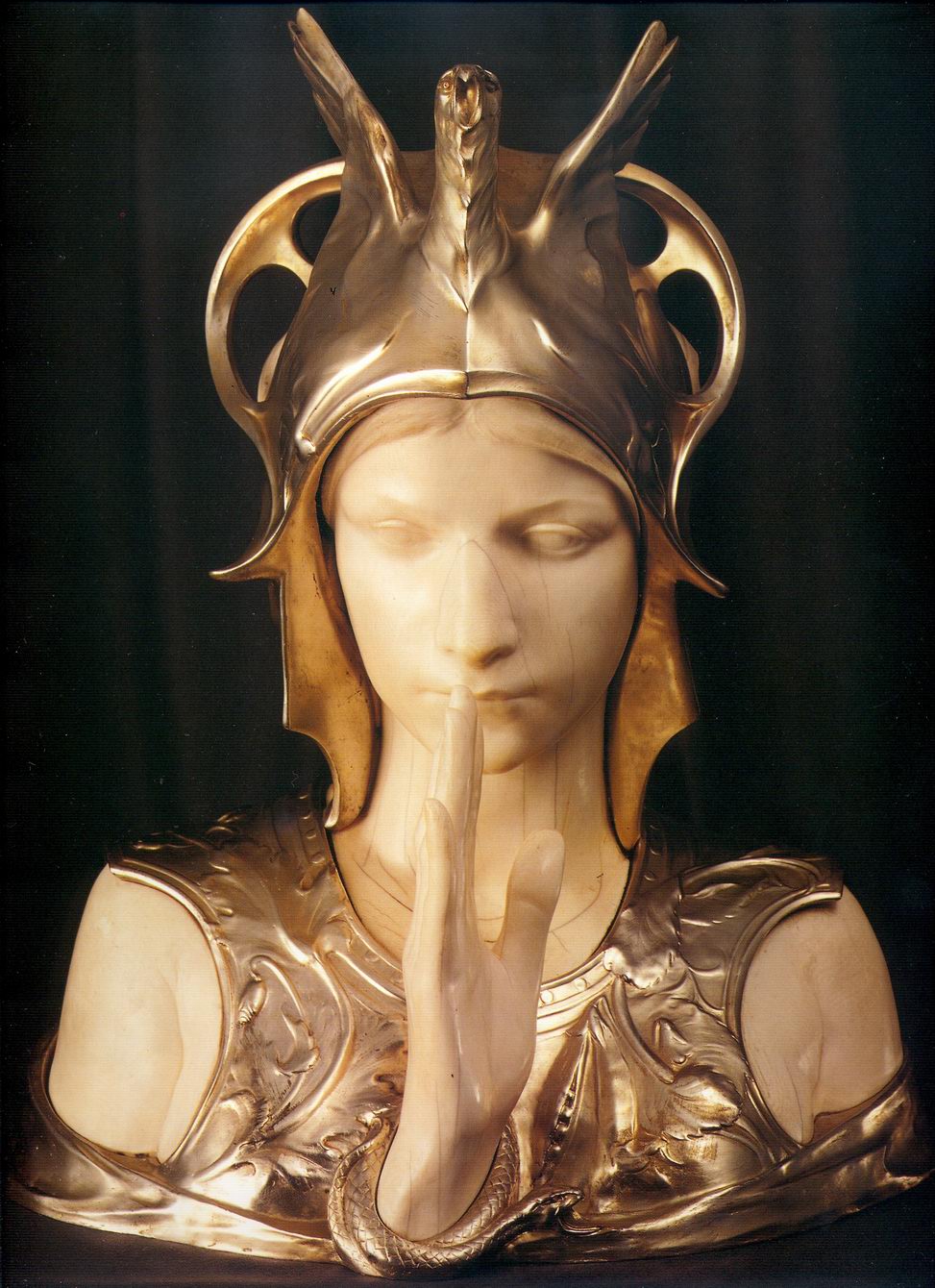
Charles van der Stappen’s most impressive sculptural work and one I missed including in this earlier post. Van der Stappen doesn’t seem to have done anything else like this which is a shame as it’s a very striking fin de siècle image, conveying a sense of enigma without resorting to the usual human/animal hybrids; Sarah Bernhardt would have loved the costume. This picture was swiped from Beautiful Century and Mariana took it from the book with the best reproduction I’ve seen to date, Gabriele Fahr-Becker’s Art Nouveau.

Previously on { feuilleton }
La belle sans nom
The Feminine Sphinx
Le Monstre
Carlos Schwabe’s Fleurs du Mal
Empusa

Return to Las Pozas

las_pozas.jpg

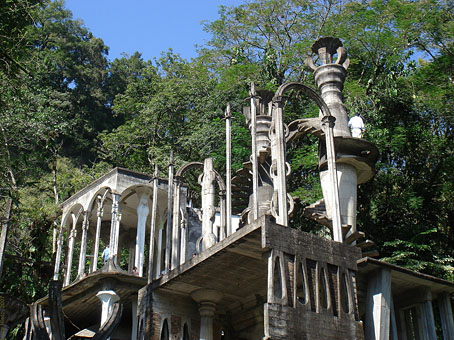
Las Pozas is the unique fantasy/folly/Surrealist paradise which Edward James spent years building (and never quite finished) in the Mexican jungle of Xilitla. When I wrote about the place a couple of years ago decent photos were hard to find. Flickr has now filled the gap with this extensive set of views by Lucy Nieto. Lots of great details and some remarkable shots which show the scale of the structures, as does the picture above (note the people).

Previously on { feuilleton }
The magic kingdom
Las Pozas and Edward James