Luke Jerram’s Glass Microbiology

jerram1.jpg

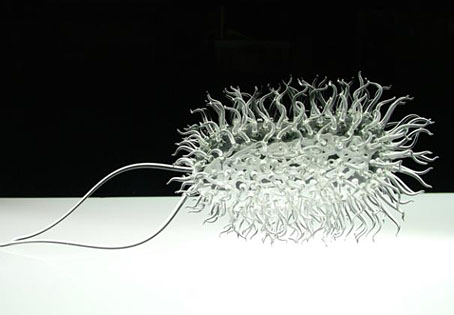
Large E-Coli.

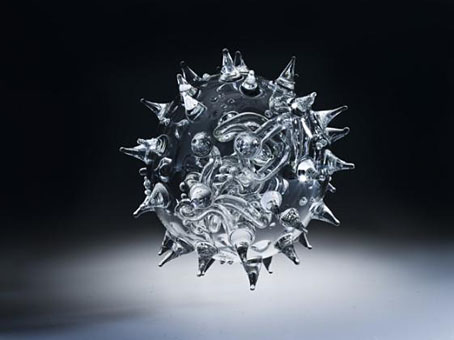
Or art as virus…. Just because micro-organisms can make us seriously ill doesn’t mean they can’t be beautiful. Luke Jerram‘s glass renderings of some of the most deadly examples are on display at the Smithfield Gallery, London, until October 3rd.

The sculptures were designed in consultation with virologists from the University of Bristol using a combination of different scientific photographs and models. They were made in collaboration with glassblowers Kim George, Brian Jones and Norman Veitch. (More.)

jerram2.jpg

Avian flu.

Previously on { feuilleton }
Andy Paiko’s glass art
The art of Josiah McElheny
The art of Angelo Filomeno
IKO stained glass
Cristalophonics: searching for the Cocteau sound
Glass engines and marble machines
Wesley Fleming’s glass insects
The art of Lucio Bubacco
The glass menagerie

Angels of Anarchy: Women Artists and Surrealism

fini.jpg

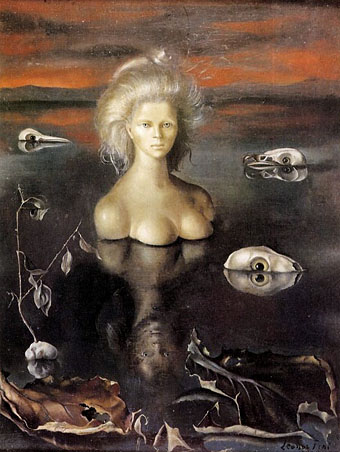
Le Bout du monde by Leonor Fini (1948).

Yes, I’ll definitely be going to see this one.

The first major exhibition of women artists and Surrealism to be held in Europe, Angels of Anarchy, opens this autumn at Manchester Art Gallery.

Featuring over 150 artworks by 32 women artists, the exhibition is a celebration of the crucial, but at the time not fully recognised, role that women artists have played within Surrealism. Paintings, prints, photographs, surreal objects and sculptures by well-known international artists including Frida Kahlo, Meret Oppenheim, Leonora Carrington and Lee Miller will be exhibited alongside works by artists less well-known in the UK, such as Emila Medková, Jane Graverol, Mimi Parent, Kay Sage and Francesca Woodman. Manchester Art Gallery is the only venue for this exhibition, making it a once-in-a-lifetime opportunity to see the works of so many significant women artists displayed together, with many of the works on loan from international public and private collections.

Angels of Anarchy runs from 26 September 2009–10 January 2010 at Manchester Art Gallery, and it’s a paying event with tickets at £6 (concessions £4, free entry for under 18s and Manchester Art Gallery Friends).

Elsewhere on { feuilleton }
The fantastic art archive

Previously on { feuilleton }
The art of Leonor Fini, 1907–1996
Surrealist women

David Lynch window displays

lynch1.jpg

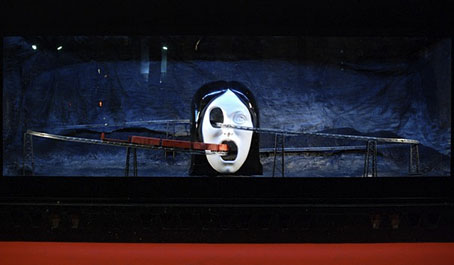
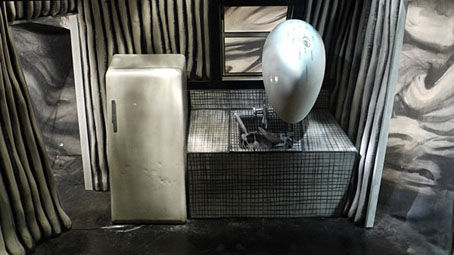
Two of the stunning displays created from sketches by David Lynch for the Galeries Lafayette department store, Paris. The series is entitled Machine-Abstraction-Women, and I don’t think Mr Lynch would mind too much having his description of the works translated in an extruded manner from French to English:

I was always fascinated by the spectacle of the women in front of the windows of the department stores. By designing the fronts of the Lafayette Galleries, I wanted to show all the identities which coexist at the woman of the 21st century. With the reflection of glass which returns the floutée image of the passers by, this set of parallel universes approaches my films, where the same actress interprets several characters. I drew very abstract decorations. Landscapes cubists populated of sculptures, wheels, pieces of furniture, of vidéos, sounds. I see these windows like a labyrinth, a street museum where to move through indices. A window, it is a transparent door on the unknown. (More.)

Much as I like Lynch’s films, I’ve never been very taken with his paintings, they always seem to lack the powerful quality he achieves in other media. But I like these a great deal and it’s a shame this is a one-off commission for a store. He’s also produced an attendant series of lithograph works, I See Myself.

David Lynch aux Galeries
David Lynch en vitrine

lynch2.jpg

Previously on { feuilleton }
David Lynch in Paris
Inland Empire

Antonin Mercié’s David

david1.jpg

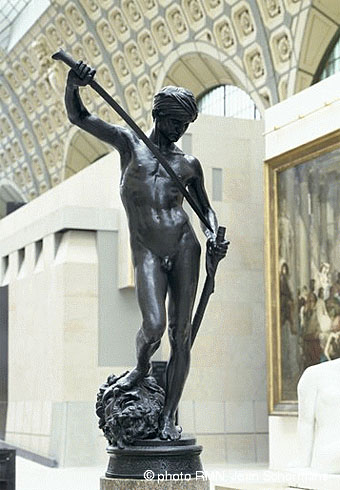
David (c.1872).

I’d marked out this statue as a suitable addition to the burgeoning men with swords archive some time ago but it took the discovery of a piece of writing to prompt this post. Antonin Mercié’s statue of David resides today in the Musée d’Orsay, Paris, but I managed to miss it on my visit there. Judging by the photos it’s situated at the end of the main hall near Rodin’s enormous Gates of Hell, and it was the Rodin which claimed my attention that day. It’s also the case that the D’Orsay hall (formerly a railway station) is such a cavernous space that free-standing works such as this lose their impact, they’d look far better in smaller rooms.

At the late 1870s, Antonin Mercié incarnated the young generation of French sculptors who, without breaking away from the traditional canons, wanted to make their figures more vibrant. He sought to combine the skilled composition and lively modelling seen in the great models of the Florentine Renaissance: hence the sweeping curves of the arm extended by the movement of the sword, the bent knee, and the graceful movement of this David. A spectator walking round it can appreciate the way the planes gradually modulate the space. Mercié carved himself an original path between modern classicism and explicit realism. (More.)

david2.jpg

You tend to find with many nude sculptures of the 19th century that the original is the naked one while the copies have gained additional items of clothing. This is the case with Mercié’s David whose replicas like the one above from the University of Copenhagen has a wrap around his waist. It’s the nude condition of the Paris statue that lends a frisson to a piece of writing by French author Patrick Drevet which may be fiction or may be reportage. An Angel at Orsay describes an elaborate game of homoerotic voyeurism as the narrator wanders through the museum and stops by Mercié’s David when he spots a student boy sketching the statue. Drevet’s piece is a sustained reverie inspired by his act of studying the student who studies the statue in turn and then becomes engaged by another student boy, the latter deliberately placing himself on view gazing at the statue and hoping (so the narrator surmises) to be sketched himself. A meagre précis like this fails to do Drevet’s piece any justice, it really needs to be read in its entirety. I found it in the Penguin Book of International Gay Writing (1995), and it may well be available in a collection of the author’s work. It’s certainly enough to make me want to read more of Drevet’s writing.

Elsewhere on { feuilleton }
The men with swords archive

Previously on { feuilleton }
Behold the (naked) man

A=P=P=A=R=I=T=I=O=N

apparition.jpg

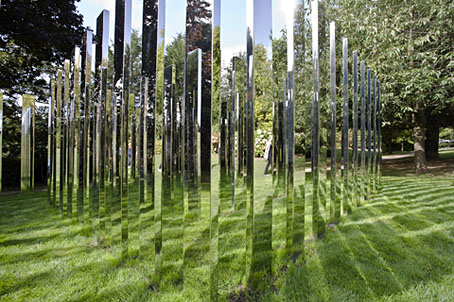
A=P=P=A=R=I=T=I=O=N is a collaboration between artist Cerith Wyn Evans and Throbbing Gristle, the once notorious Industrial music act now enjoying a resurgence of activity and attention. Evans and TG have an earlier connection via Derek Jarman, for whom Evans worked as an assistant. Given how much I enjoy seeing mirrors used in art, I’m very taken with these, and knowing that they function as drifting speakers transmitting specially recorded TG audio makes them doubly interesting. The mirrors-plus-audio aspect is reminiscent of Josiah McElheny’s recent Island Universes with Paul Schütze but that’s not to imply any influence, both artists have been following their individual paths for some time.

The title of this work comes from a poem by Stephan Mallarmé (1842–1898), a poet closely associated with the Symbolists. Looking at an English translation, the piece ends with the line “a snow of white bouquets of perfumed stars”; that final, impossible flourish—perfumed stars—is a very Symbolist touch. Claude Debussy, who took the title of his Prélude à l’après-midi d’un faune from Mallarmé, set Apparition to music in 1884.

A=P=P=A=R=I=T=I=O=N can be seen at Tramway, Glasgow until September 27, 2009.

A=P=P=A=R=I=T=I=O=N test run on Chris Carter’s Flickr pages.

Previously on { feuilleton }
In the Shadow of the Sun by Derek Jarman
The art of Josiah McElheny