The art of Robert Sherer

sherer1.jpg

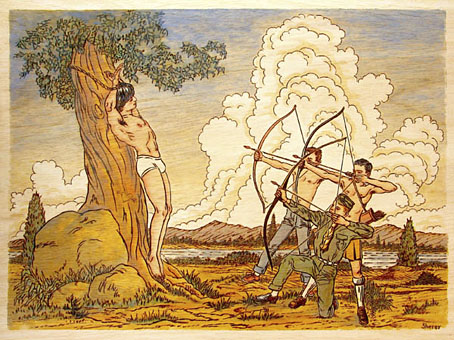
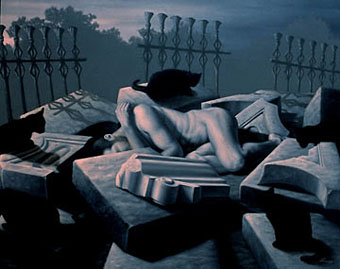
American Martyr.

The Sebastian-esque piece above is a pyrograph by American artist Robert Sherer. Pyrographs—pictures burned onto wood—aren’t very common here but are a fixture of craft classes at US summer camps. Sherer adopts the medium to subvert the wholesome orthodoxies of American life, that side of America which persistently stigmatises minorities as “other”, and to resurrect and explore his memories of youthful feelings for other boys.

sherer2.jpg

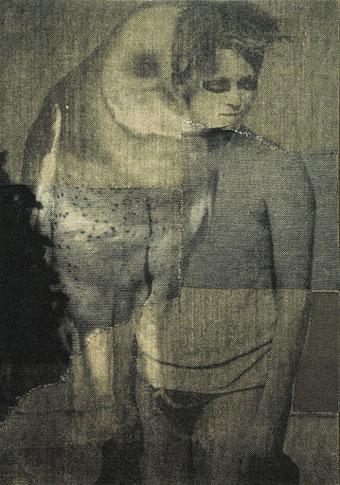
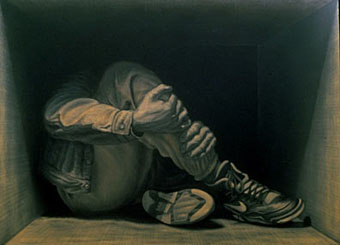
Newborn.

“Stigma” is an apt word when discussing Sherer’s work. His paintings in the Male Nudes series, of which Newborn (above) is a part, have suffered censorship at the hands of those who found their representations of men in the postures of traditional female nudes to be bizarrely unacceptable. (The tribulations are detailed here.) Then there’s his Blood Works series of symbolic botanical illustrations—some of which are entitled Stigmata—which use HIV+ blood as a medium to explore “the complexities of romantic life and sexual attraction in the HIV era.” The challenge of these works to the viewer makes a considerable change from the usual parade of undressed men which comprise the majority of work by male artists dealing with gay themes.

sherer3.jpg

Condo.

Robert Sherer slideshow at GLBTQ
Robert Sherer at Lyman-Eyer

Elsewhere on { feuilleton }
The gay artists archive

Blast

blast.jpg

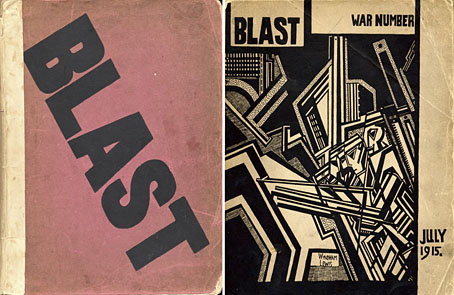
Both issues of Wyndham Lewis’s avant garde art and literature journal can be found in a collection of similar publications from the Modernist years at Brown University here and here. I’ve always liked the bold graphics of Lewis and his fellow Vorticists, and BLAST 2, “the War Number”, is especially good in that regard. The MJP site reminds us that BLAST is still under copyright control outside the US and is also available in facsimile editions from Gingko Press.

BLAST was the quintessential modernist little magazine. Founded by Wyndham Lewis, with the assistance of Ezra Pound, it ran for just two issues, published in 1914 and 1915. The First World War killed it, along with some of its key contributors. Its purpose was to promote a new movement in literature and visual art, christened Vorticism by Pound and Lewis. Unlike its immediate predecessors and rivals, Vorticism was English, rather than French or Italian, but its dogmas emerged from Imagism in literature and Cubism plus Futurism in visual art.

The original BLAST was published by Aubrey Beardsley’s first publisher, John Lane, and it’s fascinating to see Lane advertising back issues of The Yellow Book in pages which include Lewis’s anti-Victorian polemic. Meanwhile I’m still waiting for copies of the Art Nouveau journal Ver Sacrum to turn up somewhere. If anyone runs across quality scans, please leave a comment.

Via Things Magazine.

Previously on { feuilleton }
Wyndham Lewis: Portraits

Bridget Riley Flashback

riley.jpg

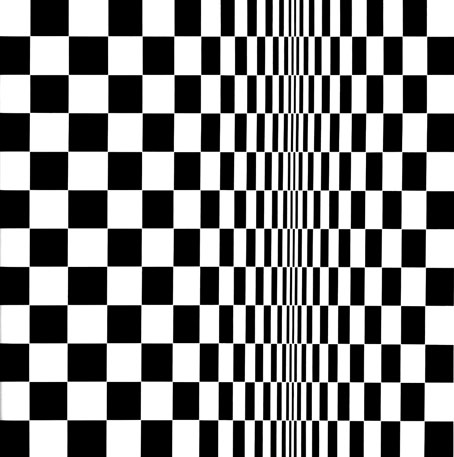
Movement in Squares (1961).

Continuing the Sixties theme, the Walker Art Gallery in Liverpool has an exhibition running whose title, Bridget Riley Flashback, alludes to the connection between Riley’s vibrant Op Art and the psychotropic concerns of the decade which brought her to the world’s attention. Riley’s works nearly always look very clean and mechanical in reproduction which can tend to defeat their purpose as paintings. The actual pictures are paint on canvas, with each square or line carefully applied by hand (not always by herself it should be noted; she had assistants), and present a deliberate contradiction in their rigid formalism and hand-crafted production. Their large size also gives them substantially greater visual impact.

A seminal work in the show is ‘Movement in Squares’, which was purchased by the Arts Council collection in 1962, the year after it was made. Consistently exhibited in retrospectives of her work, she credits the work as the beginning of her breakthrough into abstraction. This shows an insight into the role of the Arts Council collection in supporting British artists and collecting the art treasures of the future.

Bridget Riley Flashback runs until December 13, 2009.

Previously on { feuilleton }
Design as virus #4: Metamorphoses
New Bridget Riley

The recurrent pose 29

slimane.jpg

Taner photographed by Hedi Slimane.

No, I don’t go looking for these deliberately, they just keep turning up. This latest manifestation of the Flandrin pose is from a photo shoot by Hedi Slimane. I was going to write a bit more on this subject but haven’t had the opportunity today since the webhost has been having problems and the site was down for a few hours. Something for later. Meanwhile, a commenter recently pointed out this similar example by John Jude Palencar, a Flandrinesque painting for a book cover.

Elsewhere on { feuilleton }
The recurrent pose archive

Angels of Anarchy: Women Artists and Surrealism

fini.jpg

Le Bout du monde by Leonor Fini (1948).

Yes, I’ll definitely be going to see this one.

The first major exhibition of women artists and Surrealism to be held in Europe, Angels of Anarchy, opens this autumn at Manchester Art Gallery.

Featuring over 150 artworks by 32 women artists, the exhibition is a celebration of the crucial, but at the time not fully recognised, role that women artists have played within Surrealism. Paintings, prints, photographs, surreal objects and sculptures by well-known international artists including Frida Kahlo, Meret Oppenheim, Leonora Carrington and Lee Miller will be exhibited alongside works by artists less well-known in the UK, such as Emila Medková, Jane Graverol, Mimi Parent, Kay Sage and Francesca Woodman. Manchester Art Gallery is the only venue for this exhibition, making it a once-in-a-lifetime opportunity to see the works of so many significant women artists displayed together, with many of the works on loan from international public and private collections.

Angels of Anarchy runs from 26 September 2009–10 January 2010 at Manchester Art Gallery, and it’s a paying event with tickets at £6 (concessions £4, free entry for under 18s and Manchester Art Gallery Friends).

Elsewhere on { feuilleton }
The fantastic art archive

Previously on { feuilleton }
The art of Leonor Fini, 1907–1996
Surrealist women