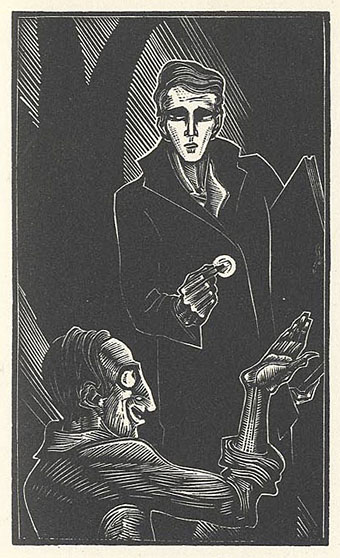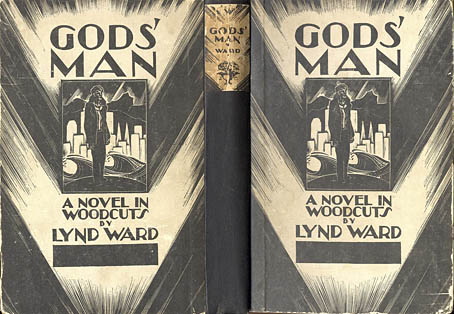
Gods’ Man by Lynd Ward

ward1.jpg

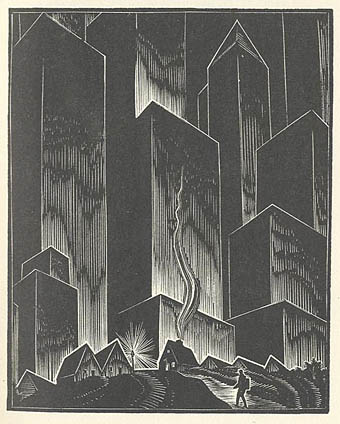
I’ve never tried woodcut engaving—the closest was scraperboard and some linocuts when I was a teenager—but I’ve always admired the form and Lynd Ward (1905–1985) was one of its masters. Ward’s wordless “novels” were inspired by the similar work of Frans Masereel and you can see pages from two of these, Gods’ Man (1930) and Madman’s Drum (1930) at The Visual Telling of Stories. Ward’s work is frequently referred to as an inspiration by later illustrators, and comic artists especially have responded to these pictorial narratives. Woodcut illustration had a resurgence of popularity before and after the Second World War; most of MC Escher‘s early work is woodcut engraving, for instance. There are still a few contemporary practitioners, Clifford Harper being one of the most visible in the UK.

Bud Plant’s Lynd Ward page
A Lynd Ward site with examples from other books
ward2.jpg

ward3.jpg

Elsewhere on { feuilleton }
The etching and engraving archive
The illustrators archive

The art of Maleonn Ma

ma1.jpg

Portrait of Mephisto #1 (2006).

ma2.jpg

Portrait of Mephisto #5 (2006).

The carefully-constructed and coloured tableaux of Shanghai-based art Maleonn Ma remind me of Joel-Peter Witkin‘s grainier and nastier works only without the body parts or dead babies. The repeated use of Michelangelo’s Creation of Adam in contemporary culture is a whole subject in itself.

Via Phantasmaphile.

Previously on { feuilleton }
Behold the (naked) man
Sculptural collage: Eduardo Paolozzi
Michelangelo revisited

In the hands of FATE

fate.jpg

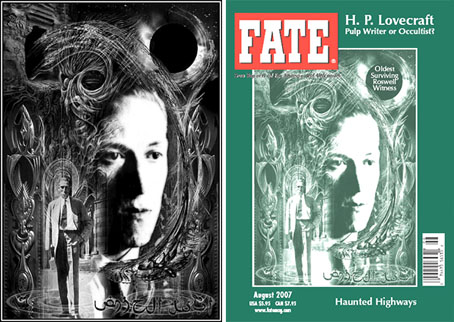
One of my works graces the cover of an American institution this month with the appearance of my HP Lovecraft portrait on the August issue of FATE magazine (volume 60, number 8, issue 688, if you must know). This is for an article about Lovecraft’s occult connections and I believe they’ve also used one of my views of R’lyeh for the article itself although I can’t confirm this just now.

predators.jpg

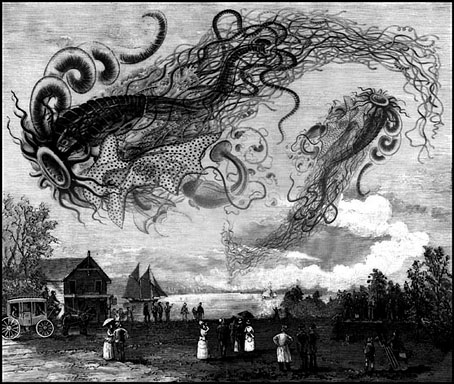
This is the third time my work has appeared in FATE (like TIME, the magazine prefers to see its name in caps). The first occasion was for another Lovecraft feature about Cthulhu in (I think) 1999. Then in 2000 I was commissioned to produce the illustration above for an article on “sky predators” which led me to plunder once again Ernst Haeckel’s Art Forms in Nature, a wonderful book I’ve frequently swiped from when in need of organic weirdness.

A couple of years later this picture was featured in a Fox TV documentary of all things, part of a post X-Files series called Conspiracy Theory. The subject was “flying rods”, one of the less convincing manifestations of cryptozoological phenomena, and the program needed some antique pictures to back up their thin veneer of evidence. They rather scurrilously used my picture to illustrate flying rod history as though this was a Victorian illustration, not a piece of Photoshop work. Fox documentaries, like their news channel, seem to have a flexible approach to the truth.

Previously on { feuilleton }
New things for June
Le horreur cosmique

Impressions de la Haute Mongolie revisited

impressions.jpg

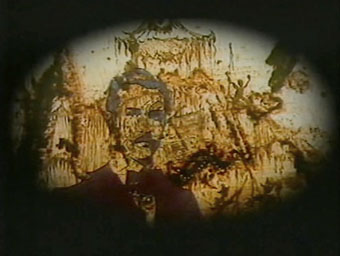
Impressions de la Haute Mongolie – Hommage á Raymond Roussel (1974-75).

When I wrote a short reminiscence about Impressions de la Haute Mongolie last March I really didn’t expect I’d be watching it again just over a year later having waited thirty years for the opportunity. But now we can all see José Montes-Baquer’s collaboration with Salvador Dalí, thanks to the indispensable Ubuweb. The copy there doesn’t have English subtitles, unfortunately, but the visuals are still beguiling and not too difficult to follow if you can understand some French and Spanish. It was a curious experience seeing this again, some parts I remembered very well, others I’d completely forgotten about. Most surprising was the soundtrack of electronic music, much of it taken from recordings by Wendy Carlos, including a part of her ambient Sonic Seasonings suite and portions of her complete score for A Clockwork Orange. There’s more about this deeply strange film in Tate Etc.

And speaking of surreal landscapes, it’s worth mentioning that I’ve spent the past few weeks working on a new piece of Lovecraft-themed artwork for an exhibition at Maison d’Ailleurs, the Museum of science fiction, utopia and extraordinary journeys in Yverdon-les-Bains, Switzerland. The exhibition of newly-commissioned work based on themes from HP Lovecraft’s Commonplace Book will be launched in October 2007. More details about the event, and my contribution, closer to that date. In the meantime, the European edition of TIME magazine has a short feature about the gallery and its ethos.

Previously on { feuilleton }
Dalí and Film
Ballard on Dalí
Fantastic art from Pan Books
Penguin Surrealism
The Surrealist Revolution
The persistence of DNA
Salvador Dalí’s apocalyptic happening
The music of Igor Wakhévitch
Dalí Atomicus
Las Pozas and Edward James
Impressions de la Haute Mongolie

Weel done, Cutty-sark!

faed.jpg

Brad David wrote last week asking about the picture I used on the recent Jack Rose poster design. I’d seen this engraving for years in various books but was unsure of its provenance so the enquiry made me curious as well. The picture in question is an illustration for the poem Tam O’Shanter by Robert Burns and since it’s a depiction of cavorting witches and warlocks it turns up frequently in occult encyclopedias.

After a bit of searching it transpires that the engraving is based on a series of six paintings illustrating the poem by Scottish artist John Faed (1819–1902). Here we’re seeing the moment just before drunken Tam (his face visible at the window) shouts “Weel done, Cutty-sark!” to the young witch in the centre, whereupon the lights go out and a shrieking horde of angry witches chase him home.

Elsewhere on { feuilleton }
The etching and engraving archive