Metzengerstein

satty.jpg

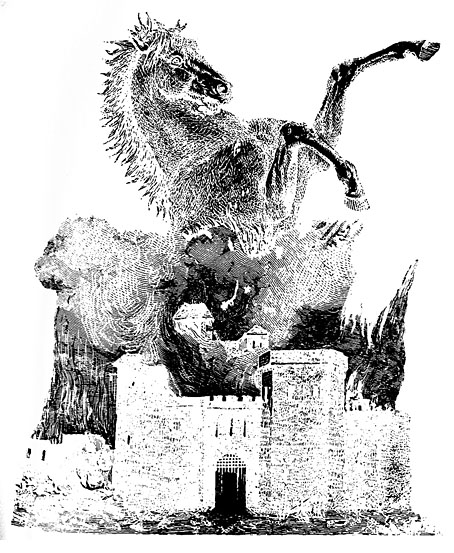
Metzengerstein by Wilfried Sätty.

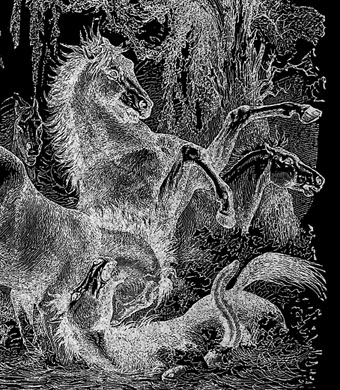
One of the horses in yesterday’s post seemed familiar until I realised it had been used by Wilfried Sätty for his final Metzengerstein illustration in The Illustrated Edgar Allan Poe (1976). This has been happening a lot since I started delving into the book scans at the Internet Archive, Sätty’s collage sources leaping abruptly from old engravings. The horse is a good example of Sätty’s evolved approach to collage which often reversed the printing of assembled artwork, or used a printing press (or PMT process) to duplicate and mirror his collage elements.

Not all Poe illustrators bother with this Gothic pastiche, and those that do don’t always provide an effective rendering of the climax when the clouds of smoke above a smouldering castle assume the form of a colossal horse. Byam Shaw’s illustration is typical, with the horse standing inertly above the flames. Sätty’s picture only occupies half a page but is much more successful, as are many of the other illustrations in a volume that remains one of the very best Poe collections, and the finest of Sätty’s books.
horses3.jpg

Previously on { feuilleton }
The original Gandharva
The Occult Explosion
Wilfried Sätty album covers
Nature Boy: Jesper Ryom and Wilfried Sätty
Wilfried Sätty: Artist of the occult
Illustrating Poe #4: Wilfried Sätty
Gandharva by Beaver & Krause
John Batten’s Indian Fairy Tales

batten01.jpg

I keep intending to write some longer pieces, including a review of Aleksei German’s unforgettable Hard To Be A God, but the workload has been heavy again so here’s another illustrated book.

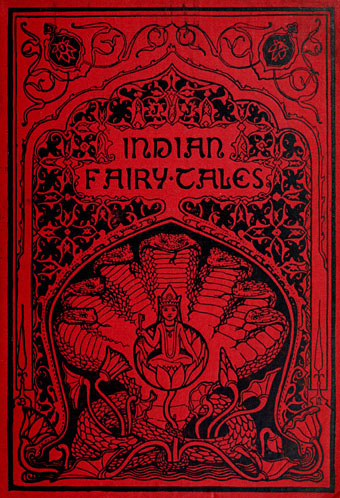
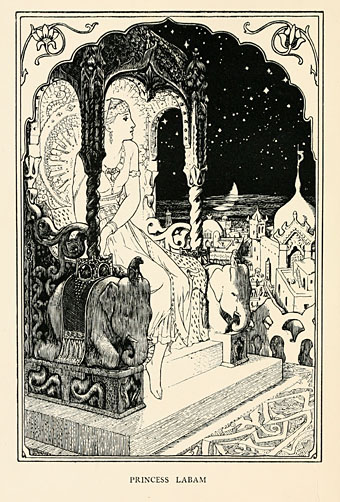
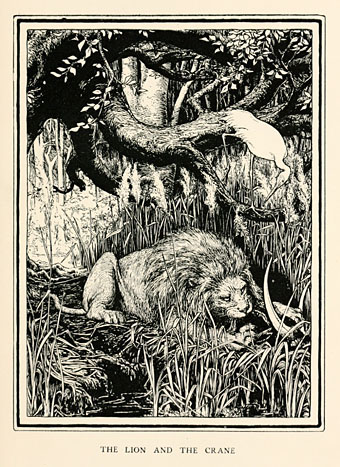
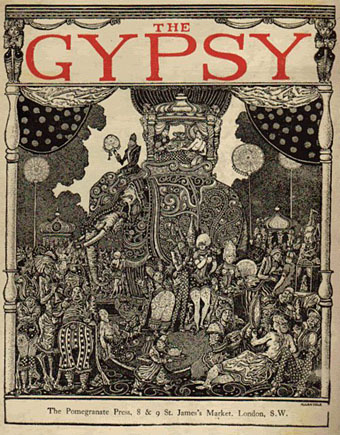
Illustrations by John Dickson Batten (1860–1932) have appeared here before, all of them for collections of fairy tales compiled and adapted by Joseph Jacobs. Indian Fairy Tales (1892) is another Batten/Jacobs collaboration, and is as fine as their other books, with Batten enclosing many of his full-page drawings in elaborate frames. Most of the figures look nothing like Indian people but that’s standard for books of this period. The Internet Archive has several copies of this title, including a limited, numbered copy with hand-coloured illustrations. I prefer the illustrations in black-and-white, however, so that’s what you see here.

batten02.jpg

batten03.jpg

Continue reading “John Batten’s Indian Fairy Tales”

The art of Erhard Amadeus Dier, 1893–1969

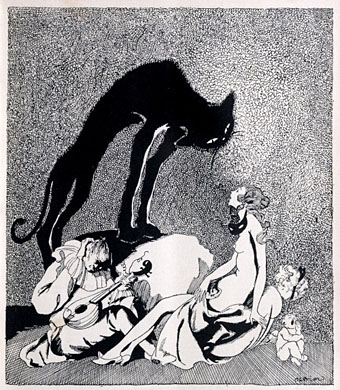
walpurgisnacht.jpg

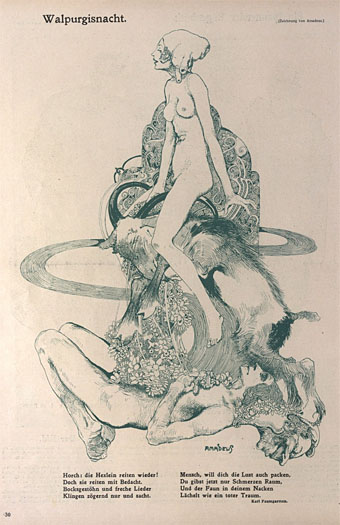
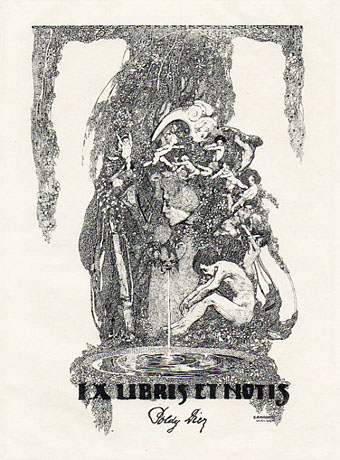
This is the third time this drawing has appeared here but the first time I’ve been able to fully credit the artist. Walpurgisnacht appeared in issue 604 (April 26, 1917) of Austrian humour magazine Die Muskete. Dier was Austrian, and contributed to many issues of Die Muskete around this time, always credited as “Amadeus” hence the difficulty in tracing his identity. Most of the other magazine illustrations I’ve seen are a lot less memorable than this one; as I’ve said before, Walpurgisnacht could easily have been drawn in 1971. The erotic qualities of the drawing may be deliberate if the attribution of a pornographic series (see below) is accurate. I’ve not been able to find authoritative confirmation for this so don’t take my word for it.

ead02.jpg

Big thanks to Kuinesis for sending the solution to this mystery. The drawings above and below are also from Die Muskete, and via Kuinesis’s Tumblr, as is one of the bookplates.

ead03.jpg

ead05.jpg

Continue reading “The art of Erhard Amadeus Dier, 1893–1969”

Hugo Steiner-Prag’s Ghostly Ballads

steinerprag01.jpg

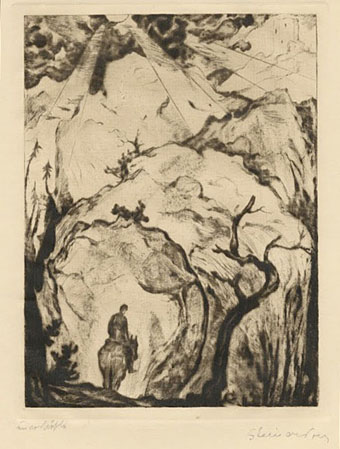
Mountain Voices.

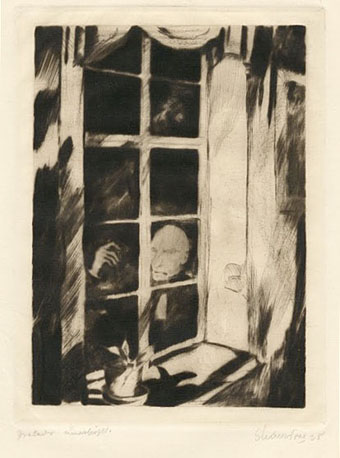
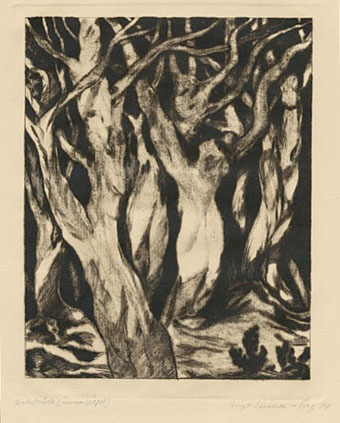
In which the illustrator of Gustav Meyrink’s The Golem illustrates six ballads or lieder by Heinrich Heine. These etchings don’t bear comparison to Steiner-Prag’s peerless Golem illustrations, or those for his illustrated Poe, but they’re good to see even if the meaning remains obscure.

steinerprag02.jpg

Man Behind a Window.

steinerprag03.jpg

The Dream.

Continue reading “Hugo Steiner-Prag’s Ghostly Ballads”

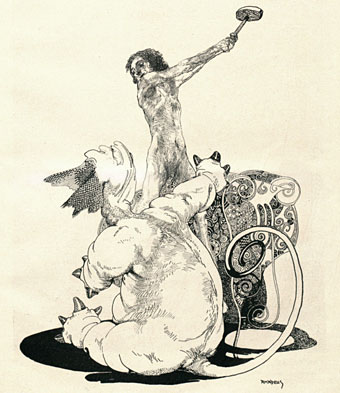
The art of Alan Odle, 1888–1948

odle1.jpg

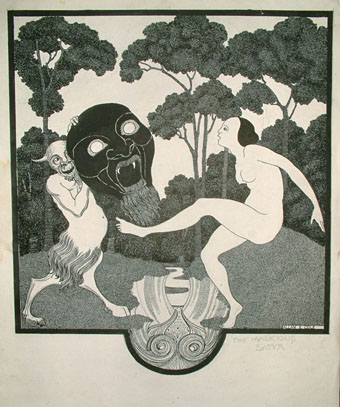
The Malicious Satyr.

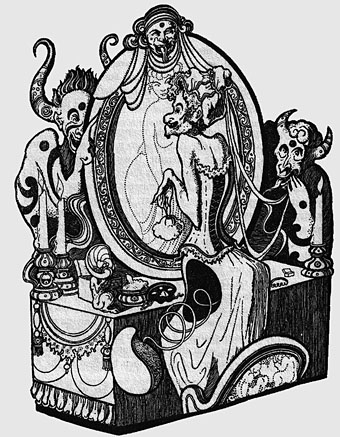
Following yesterday’s post, a little more about British illustrator Alan Odle. A cursory search between work sessions today yielded a variety of Odle drawings but not the illustrated edition of Candide I was hoping for. The examples here are all taken from Pinterest, and I believe the ones towards the end are from Candide but that’s only a guess. In a reversal of the usual state of affairs, Odle’s career has been overshadowed by that of his wife, Dorothy M. Richardson, a Modernist novelist of some note. But the neglect has been addressed recently with the publication in 2012 of a monograph, The Life and Work of Alan Odle by Martin Steenson. Mark Valentine reviewed the book at Wormwoodiana. Some of Odle’s drawings are for sale at the Victor Arwas and Chris Beetles galleries.

odle2.jpg

odle3.jpg

Continue reading “The art of Alan Odle, 1888–1948”