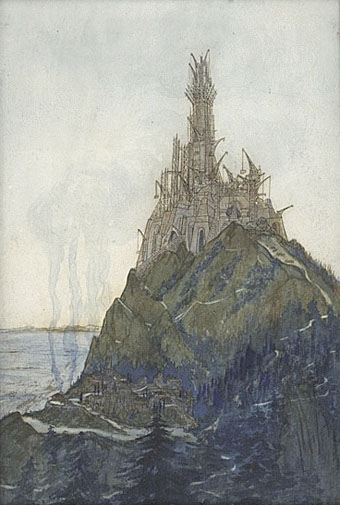
Temple à la Pensée, dédié à Beethoven, vue en cours de construction (1897).
Another artist discovered whilst searching for something quite unrelated. The Musée d’Orsay are custodians of this drawing by François Garas (1866–1925), and they also have the most substantial appraisal of his career.
François Garas remains a mysterious architect, whose artistic pantheon included Baudelaire and Edgar Allan Poe, as well as John Ruskin, Richard Wagner, Jean Carriès and Edouard Manet. He obtained his diploma in 1894, and until 1914 regularly exhibited utopian architectural projects at the Salon de la Société Nationale des Beaux Arts. His career started with the exhibition Architects’ Impressions in 1896 at the Le Barc de Bouteville gallery, alongside his fellow architects Henri Sauvage, Henry Provensal and Gabriel Guillemonat. This exhibition, accompanied by a rebellious booklet by the architect Frantz Jourdain, wanted to get rid of “the mental slavery produced by the exclusive study of Greek and Roman architecture, and by a knowledge of nothing but the Italian Renaissance”. This drawing featured in the exhibition; then it was seen again, the same year, in an exhibition by the Société Nationale des Beaux Arts, as part of a collection entitled Artists’ Interiors.
From 1897, Garas exhibited increasingly oneiric projects at the Salon – “temples for future religions”, dedicated to Beethoven, Wagner, Life, Death and Thought. While his companions from the early days were designing social housing, Garas continued along the same fanciful path, then disappeared from the architectural scene without any of his projects ever having been built.
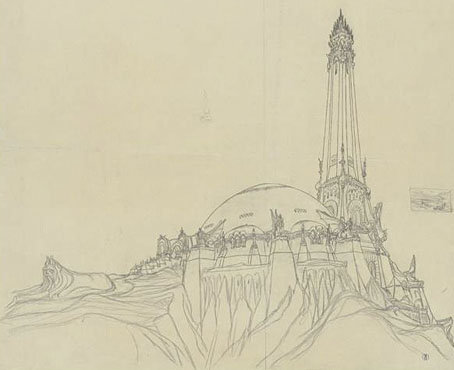
Temple à la Pensée, dédié à Beethoven, vue perspective depuis l’arrière du temple (1897).
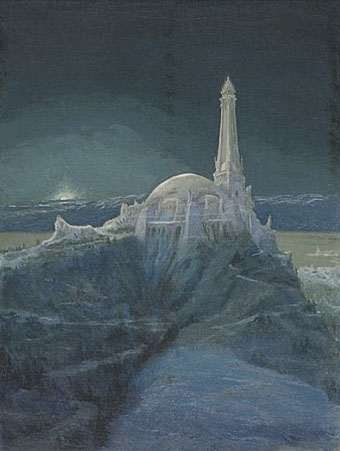
Temple à la Pensée, dédié à Beethoven, visions du temple, clair de lune (1900).
The museum has several pages of various plans and sketches for these Temples for Future Religions, and also some quasi-Gothic designs for “Artist’s interiors” which would benefit from being seen at a larger size. Among his other works are a series of very diffuse pastel studies which look more like Claude Monet drawing the ruins of Angkor than architectural designs.
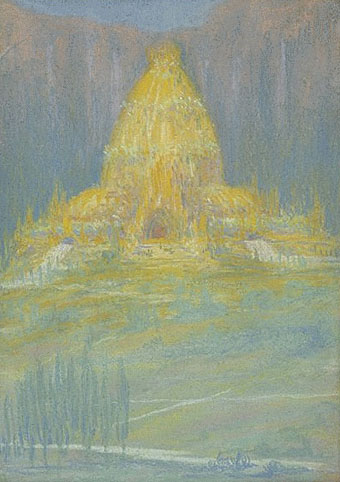
Un temple pour les religions futures (1901).
Previously on { feuilleton }
• Exposition Universelle publications
• Exposition cornucopia
• Return to the Exposition Universelle
• The Palais Lumineux
• Louis Bonnier’s exposition dreams
• Exposition Universelle, 1900
• The Palais du Trocadéro
• The Evanescent City