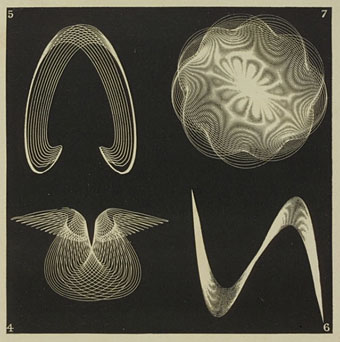
Thought-Forms and Auras

leadbeater01.jpg

Like yesterday’s squid, some of these Theosophist illustrations from Thought-Forms (1905) by Charles Webster Leadbeater & Annie Besant, and Man Visible and Invisible: Examples of different types of men as seen by means of trained clairvoyance (1902) by Leadbeater alone, have been reproduced for years in books yet you seldom see the complete set. The University of Heidelberg has scans of both volumes so I’ll direct the curious there for detailed explanations of the illustrations which were intended to graphically portray mental states, and the auras which Theosophists believed surrounded the human body. The diagrams above are harmonographs created by pendulum motion, and evidently seemed sufficiently strange for Leadbeater and Besant to interpret them as representations of emotional experience. They’ve always made me think of the similar pendulum drawings used by Saul Bass in his Vertigo title sequence, although I’ve never seen any indication that Bass had these particular diagrams in mind. In the pictures below there’s also a suitably spiky depiction of an angry person’s aura, and representations of music emerging from a cathedral in the form of polychrome mushroom clouds.


leadbeater02.jpg

leadbeater03.jpg

Continue reading “Thought-Forms and Auras”

Le Poulpe Colossal

poulpe1.jpg

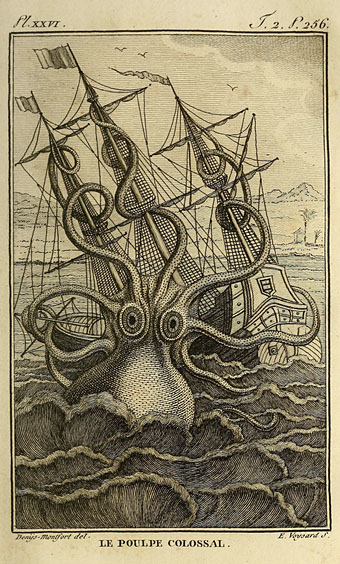
If this isn’t quite the ur-Kraken of illustration history, it’s one of them, reproduced countless times when sea monster depictions are required. The source is Histoire naturelle, générale et particuliere, des mollusques, animaux sans vertèbres et a sang blanc (1802) by Felix de Roissy, some of whose other illustrations are in this Flickr set from the Biodiversity Heritage Library.

poulpe2.jpg

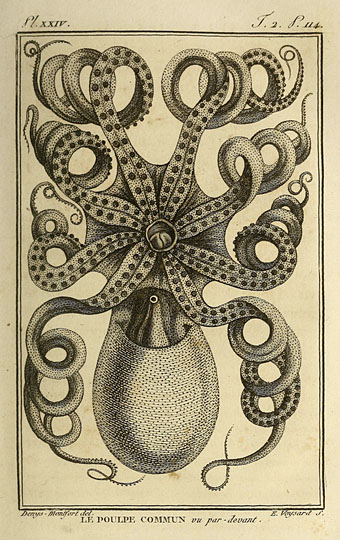
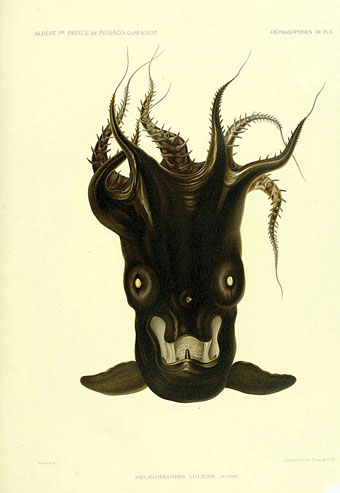
There are further cephalopodic curios in the BHL Mollusks and Invertebrates sets, the example below being from Résultats des campagnes scientifiques accomplies sur son yacht (1889), a fine collection of what the French would call aquarelles.

poulpe3.jpg

Previously on { feuilleton }
Abysmal creatures
Fascinating tentacula
Jewelled butterflies and cephalopods
The art of Rune Olsen
Octopulps
Coming soon: Sea Monsters and Cannibals!

The art of Rob Clarke

clarke.jpg

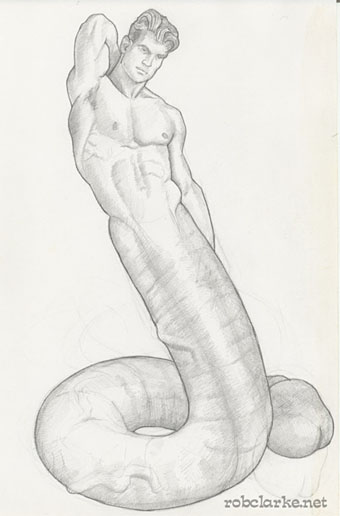
International Monster (1993).

I found this drawing on a Tumblr site, as I recall, then traced its lineage back to the artist’s own Tumblr, and his own website where he states that “This site contains fucked up shit. If that bugs you please go away.” After all that it was a surprise to discover that Rob Clarke was one of the artists whose work was featured in the Dirty Comics exhibition in San Francisco back in October, a show to which I also contributed. There’s another of what he calls his “penis python things” on his Tumblr pages, while his website contains a “menagerie of nasty pigs, dogboys, gymbunnies, trolls, bears and other critters”, some of which are for sale.

Elsewhere on { feuilleton }
The gay artists archive

The Flatiron Building

flatiron1.jpg

The Flatiron Building, Detroit Publishing Company (1903).

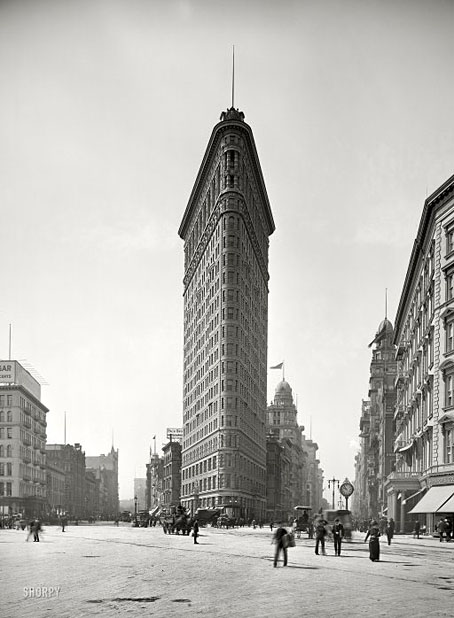
Beautiful Century posted this view of New York’s Flatiron Building at the weekend which had me looking for a larger copy. Happily this is one of the many high-resolution photos at the Shorpy Historical Archive where it’s possible to scrutinise a wealth of detail. Old photos like this are, as Michael Moorcock once said about old postcards, a form of time travel, especially when they’re as good as those in the Shorpy collection. The Flatiron was a popular subject for photographers—famously so in Edward Steichen’s 1904 nocturne—and Shorpy has many more examples such as the street-level view below. Both these photos show a common feature of pictures taken before the age of the motor car: people standing in the middle of the road. The Flatiron also has an oblique connection with Julian Biggs’ film via the mysterious origins of the phrase “23 skidoo“.

flatiron2.jpg

The Flatiron Building, Detroit Publishing Company (c. 1905).

Reinhart Wolf photographed many of New York’s skyscrapers in the late 1970s, the Flatiron included. I have a book of those photos and noticed in his Flatiron view that one of the circular decorations on the foremost angle of the building near the top is now missing (compare his view with the Shorpy photos). Every time I look at the Flatiron now I think of that missing chunk of masonry. Was it removed or did it fall? If the latter, when did this happen and what damage did it cause?

Previously on { feuilleton }
Edward Steichen

Cheeky Frawg Books

cheeky1.jpg

Being a new ebook imprint from Ann & Jeff VanderMeer:

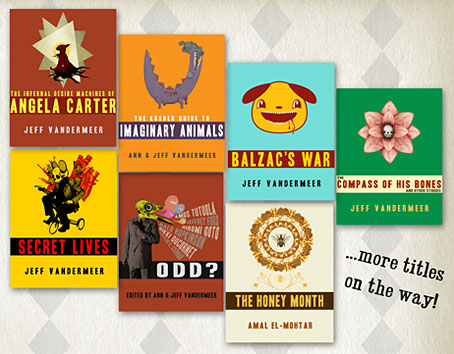
Cheeky Frawg Books has launched a new website. Does it sell our ebooks? Yes! But very…cheekily. It’s an interactive and mysterious experience you truly won’t want to miss, in a 180-degree scrollable environment. Free content, hidden treasures, singing fish, the animated Myster Odd video, and, of course, the full catalogue of Cheeky Frawg ebooks, including Amal El-Mohtar’s The Honey Month and the ODD? anthology, featuring Jeffrey Ford, Caitlin R. Kiernan, Amos Tutuola, Hiromi Goto, Nalo Hopkinson, and many more.

Cheeky Frawg specializes in quality, self-aware e-books. We hand-craft every e-book on a letterpress using only the best, most perfectly formed 00000s and 111111s.  Forthcoming titles include the legendary The Encyclopedia of Victoriana by Jess Nevins, It Came From the North: Finnish Weird edited by Jukka Halme and Tero Ykspetäja, Jagganath by Swedish sensation Karin Tidbeck and Don’t Pay Bad for Bad by iconic Nigeria writer Amos Tutuola.

Note: A percentage of direct sales in December will go to aid iconic fantasy editor, artist, and writer Terri Windling, who is suffering from financial woes.

cheeky2.jpg

In the first run of titles is the ebook edition of The Kosher Guide to Imaginary Animals whose print edition I designed a while back. And mention of Amos Tutuola reminds me that I’ve had a copy of his My Life in the Bush of Ghosts for years and still not read it. While we’re on the subject of Ann & Jeff’s projects, a reminder that Weird Fiction Review is still posting unique pieces of weird fiction, interviews and essays.

Previously on { feuilleton }
Weird Fiction Review