Frederic Leighton’s sculptures

leighton1.jpg

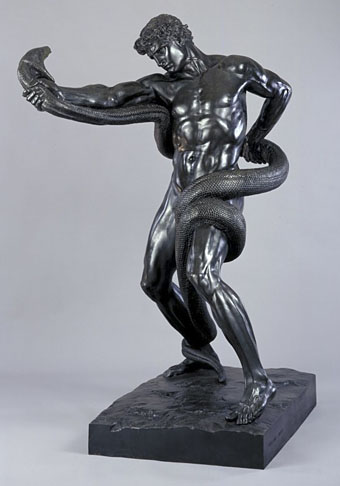
An Athlete Wrestling with a Python (1877).

The python wrestler by Frederic Leighton (1830–1896) has appeared here before, and it’s one sculpture that always catches my eye for having appeared in my adaptation of The Call of Cthulhu in 1988. It’s now one of the Leighton works available for close viewing at the Google Art Project although only from a single angle, something that seems a flaw in web presentation of three-dimensional art.
leighton2.jpg

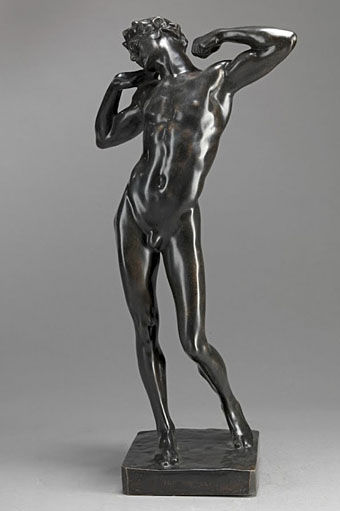
The Sluggard (c. 1895).

In the same collection is a copy of Leighton’s The Sluggard from the Yale Center for British Art. What’s notable about this piece is that it’s generally offered as Exhibit A for the homo-prosecution during discussion of the artist’s sexuality. The Sluggard to which most people refer is the life-size bronze which is a lot more robust and muscular than this lithe and twinky specimen. According to a note at the V&A Yale’s copy is one of many cast from the clay model for the life-size version. What was excused at the time as a late Victorian exercise in contrapossto looks even more camp—in the Philip Core definition—than the finished piece which makes me wonder whether Leighton beefed up the original to disguise something. Core defined camp as “the lie that tells the truth”; camp art always pretends to be one thing whilst simultaneously telegraphing a very different message about its creator. Leighton’s sexuality is a source of continual speculation which means it’s unlikely now to be resolved in any direction, and the artist himself would loathe our prurience, but it’s only by reappraising works in this way that we’re able to show that gay people didn’t magically erupt via some process of spontaneous generation in 1967. If Leighton had any dalliances whilst holidaying in the gay resort of Capri then he was perfectly circumspect. Back at home, as a President of the Royal Academy he had a rather pompous and remote reputation, being memorably described by Violet Paget as “something between an Olympian Jove and a head waiter.” For more camp, see The Narcissus Hall in the artist’s incredibly lavish home, Leighton House in London, where 1st Baron Leighton, PRA, lived splendidly alone.

Previously on { feuilleton }
Angelo Colarossi and son
Men with snakes

Jean de Bosschère’s Folk Tales of Flanders

bosschere01.jpg

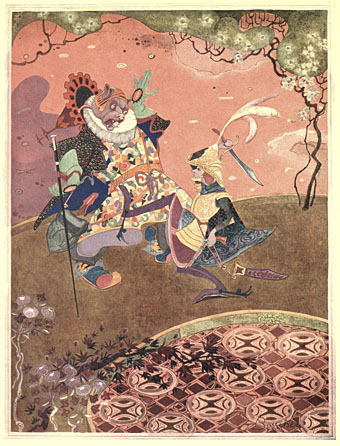
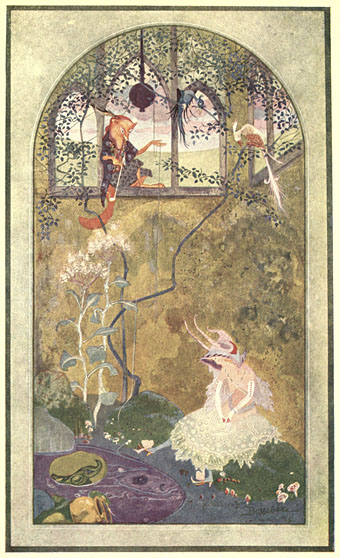
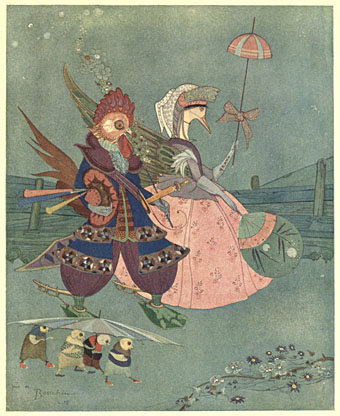
The illustrations of Belgian artist Jean de Bosschère (1878–1953) aren’t as easy to find as those of his British and American contemporaries so it’s a shame there isn’t more of his idiosyncratic work at the Internet Archive. Folk Tales of Flanders is there, however, an edition from 1918 featuring a number of colour plates and many black-and-white illustrations. For once I prefer the paintings over the line drawings, de Bosschère’s colour work perhaps owes something to Edmund Dulac’s style but it’s a lot more eccentric, especially here where he’s required to depict the activities of a host of anthropomorphic animals. The eccentricities extended to the artist’s life and the books he wrote, one of which is an autobiography entitled Satan l’Obscure (1933). A lighter work, Weird Islands (1921), was featured at BibliOdyssey a couple of years ago.

bosschere02.jpg

bosschere03.jpg

Continue reading “Jean de Bosschère’s Folk Tales of Flanders”

Viddy well: Back in the Chelsea Drug Store

drugstore.jpg

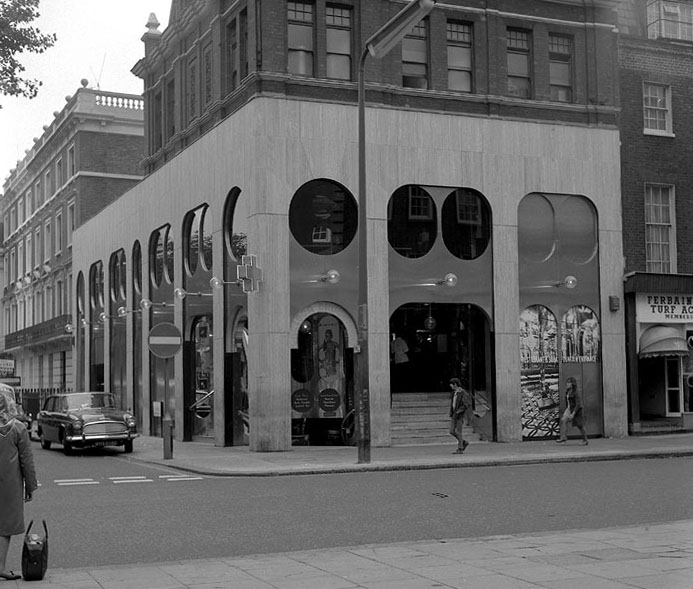
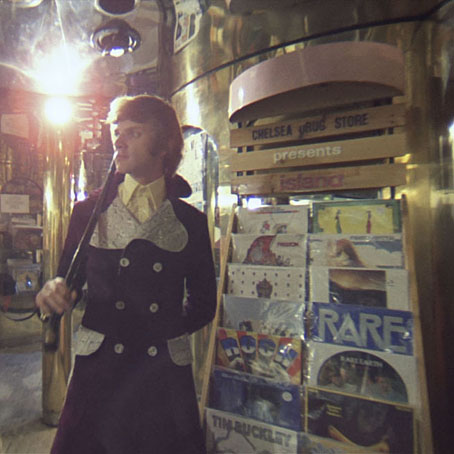
The Chelsea Drug Store, 49 King’s Road, London, circa 1970.

How quickly things change. It was almost six years to the day that I posted an unapologetically sedulous analysis of the record shop scene in Stanley Kubrick’s A Clockwork Orange, something that’s still one of the most regularly visited of all the entries here. That post concerned the excitement of being able to at last scrutinise on DVD a single shot whose details had earlier been obscured by no end of noise and interference, the embargoed film having previously been available in the UK on various bootleg videos. Fuzzy warbles indeed. The DVD wasn’t ideal, however, and many of the frame enlargements looked pretty shoddy. Last month I acquired a box of Blu-ray Kubrick films so all the images on that post have now been upgraded. There isn’t a great deal more to see in a shot that lasts all of sixty-six seconds, but John Alcott’s wide-angle photography is now crystal clear.

As for the location of the record shop, I noted in the original post that the famous Chelsea Drug Store building is now a McDonald’s. A place that once sold music and magazines becomes another outlet for an international burger chain; that’s the real future horror, not rampaging youth. See it up close on Google’s Street View.

alex.jpg

Alex and the sounds of 1970.

Previously on { feuilleton }
Kubrick shirts
A Clockwork Orange: The Complete Original Score
Juice from A Clockwork Orange
Clockwork Orange bubblegum cards
Alex in the Chelsea Drug Store

Yuri Norstein animations

norstein1.jpg

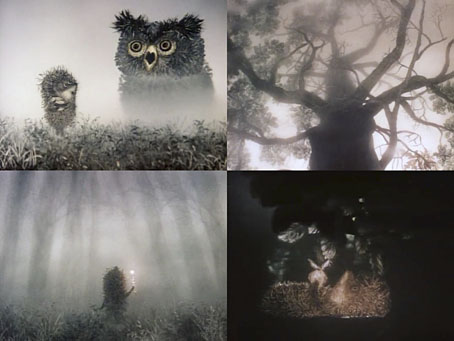
Hedgehog in the Fog (1975).

One more animation post before I move onto other things. Since the 1970s Russian animator Yuri Norstein has been regarded as one of the greatest living practitioners of the medium despite having only made a handful of films. Hedgehog in the Fog is a 10-minute piece with a self-explanatory title: a hedgehog sets out one evening to visit his friend, the bear, but before he can reach the bear’s house he has to cross a fog-filled field. Norstein’s animation style involves the skillful manipulation of hand-drawn paper shapes which in this film and the later Tale of Tales achieve a remarkable sense of depth and solidity. The fog effects in Hedgehog are especially striking, created using layers of translucent paper.

norstein2.jpg

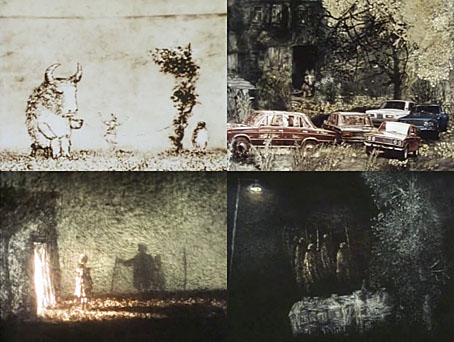
Tale of Tales (1979).

The 29-minute Tale of Tales takes the same technique but lifts the animation into a different league, an elusive and (for want of a better term) poetic meditation on life and memory whose central figure is a small grey wolf borrowed from the Russian lullaby sung in the opening scene. The film’s Wikipedia note compares Tale of Tales to Andrei Tarkovsky’s Mirror (1975), and for once the hyperbole feels justified. There’s the same concentration on natural elements such as fire, wind and water, while the recurrent wordless tableaux of a family whose members comprise a poet, a bull with a skipping-rope, and a talking cat might be compared with Tarkovsky’s dream sequences. If meaning here seems reluctant to disclose itself (and why does everything have to mean something anyway?) then that’s all the more reason to watch it again.

Since 1979 Norstein has been working sporadically on a feature-length adaptation of Gogol’s The Overcoat, work on which has been endlessly delayed due to lack of resources and the animator’s painstaking production methods. A few clips can be found on YouTube if you hunt around. Here’s hoping we get to see the finished film soon.

Previously on { feuilleton }
Barta’s Golem

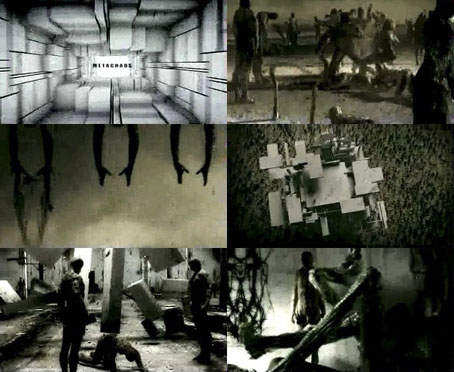
Metachaos

metachaos.jpg

Animation of a more contemporary kind (do you detect a theme?), Metachaos is a frenetic 8-minute apocalypse by Alessandro Bavari whose Photoshop collages I recall being impressed by some years ago. His video uses computer rendering but with a lot more grit than the usual CGI. The soundtrack is the kind of quasi-Industrial thing you’d expect for the imagery but you can always mute the sound and play something else. Thanks to Paul at Dressing the Air for the tip!