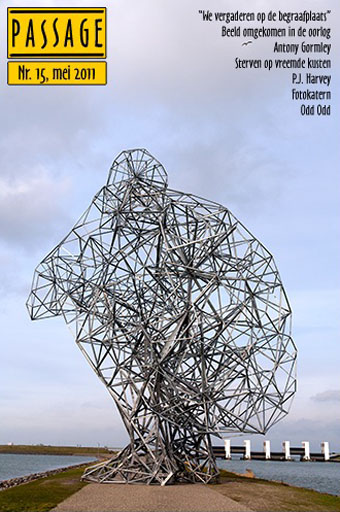
Passage 15

passage15.jpg

Directing your attention elsewhere again today, to the latest edition of Passage the Dutch webzine run by my good friend Ed Jansen. Number 15 is described thus:

Passage 15 is, with a few exceptions, entirely devoted to art. Images govern our lives, literally and figuratively. Gaudier-Brzeska nearly a hundred years ago and Antony Gormley today affect our way of looking. Odd Nerdrum does so with his painting on a very different way. The music of Polly Jean Harvey made us curious about her sources of inspiration. The piece about Gallipoli is actually a kind of enormous footnote to her latest cd “Let England Shake”. The photo section provides an overview of exhibitions and performances in the past few months in and around The Hague, Netherlands.

Seeing Gaudier-Brzeska’s sculptures reminds me that I haven’t seen Ken Russell’s film of the artist’s life, Savage Messiah, for many years. The large Antony Gormley work on the cover (Exposure) makes a welcome change from the artist’s cast-iron clones. I’m still waiting for Gormley to create the Ejaculating Man, a seawater-spurting statue he proposed for Seattle. It was rejected, of course, and it’s difficult to imagine any American city exhibiting something of that nature given the current climate. Maybe he should try Amsterdam.

futuro.jpg

Back at Ed’s work, his varied Flickr stream includes some recent views of Futuro, a mobile holiday home designed by Matti Suuronen in 1968. What was once futuristic now has a Jetsons-like retro glamour.

Previously on { feuilleton }
Passage 14
Passage 13
Passage 12
Passage 11
Passage 10

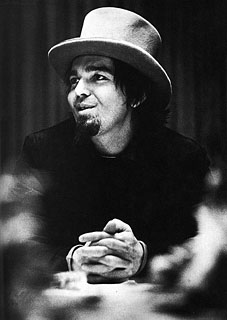
The genius of Captain Beefheart

beefheart.jpg

Mission: unlistenable
His music is described as a metal sock, an action painting and a mad, giant watch—yet it has inspired bands from Talking Heads to the White Stripes. John Harris gets to grips with Captain Beefheart

John Harris
Friday August 4, 2006
The Guardian

IN THE 1980s, American researchers found that the average album was played 1.6 times. Given the new practice of impatiently scouring a CD for one or two highlights and then discarding it, the iPod age has presumably seen that figure tumble, but the basic point remains: most of the music we buy lies pretty much unplayed – either because it is rubbish, or because it says a lot more about our vanity than what we actually like. On the latter score, history’s most shining example may be Trout Mask Replica by Captain Beefheart and His Magic Band, an allegedly classic album that must surely sit undisturbed in thousands of households. Playing it—or rather, attempting to—is a bit like being in one of those cartoons in which the principal characters cagily open a door, only to find all hell – elephants, possibly, or a speeding train – breaking loose behind it, whereupon they slam it shut again. Its opening moments let you know what you’re in for: a discordant racket, all biscuit-tin drums and guitars that alternately clang and squall, eventually joined—apparently by accident—by a growling man complaining that he “cannot go back to your land of gloom”. Skipping through the remaining 27 tracks does not throw up anything much more uplifting. Indeed, one song finds the same voice rather distastefully evoking the Holocaust: “Dachau blues, those poor Jews/ Dachau blues, those poor Jews/ One mad man, six million lose.”

When this kind of experience happens to a rock critic, it can easily bring on a chill feeling of inadequacy. After all, Beefheart—those in the know rarely use the “Captain”—remains a gigantic influence on so much rock music that has claimed to stand as something more than mere entertainment, from the post-punk likes of Pere Ubu, Talking Heads, Gang of Four and Public Image Limited, through names as varied as Tom Waits and Happy Mondays, and on to such talents as PJ Harvey, Franz Ferdinand and the White Stripes. Equally importantly, he is a crucial part of the gnomic culture through which those people (men, mostly) whose lives have been hopelessly afflicted by music commune with one another. It’s not in the film, but the Jack Black character in High Fidelity was surely a Beefheart obsessive.

Continues here.