Monsieur Fantômas by Ernst Moerman

fantomas.jpg

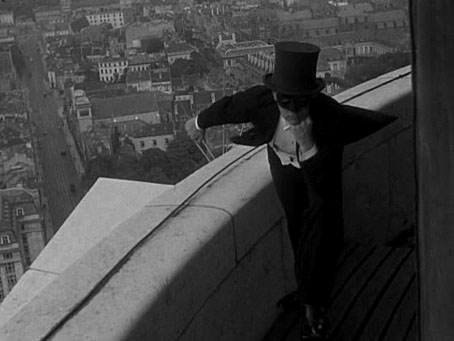
Jean Michel as Fantômas.

Ernst Moerman’s Belgian short from 1937 is available for viewing at Ubuweb and is described on its title card as “Un film Surrealiste”. One might equally describe it as “un film amateur” since it’s very much in the home movie mould as was much of the independent cinema of this time. The direction may be perfunctory but the photography is surprisingly good in places. The action, such as it is, concerns an avatar of the Surrealists’ favourite anti-hero, Fantômas, in a series of farcical scenes many of which are filmed on a beach with a few spare props. The most notable moment for me is one which none of the online documentation mentions, a brief appearance by a youthful René Magritte who pretends to be painting Le Viol. Magritte was a great Fantômas enthusiast so his presence here isn’t too surprising.

Previously on { feuilleton }
The Dark Ledger
Judex, from Feuillade to Franju
Fantômas

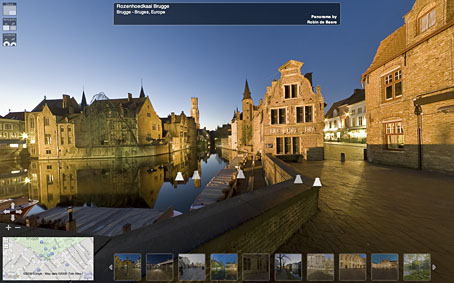
Bruges panoramas

bruges1.jpg

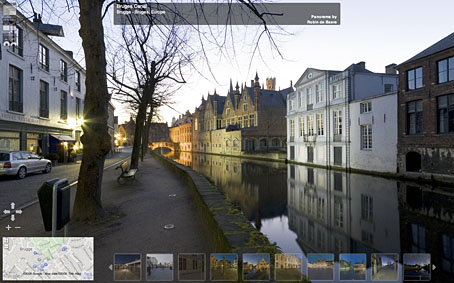
Do you detect a theme here? The 360º Cities site which I linked to yesterday won’t be news to some since its panorama views are now incorporated into Google Earth. I hadn’t fully investigated it before, however, so I wasted some time today wandering the streets of Bruges almost as you would in a computer game thanks to the way the different panoramas are linked. Clicking the arrows or the thumbnail views means you’re immediately transported to the next location. (Needless to say this works best using the full screen option on a large monitor.) The photographs in this instance are by Robin de Baere.

bruges2.jpg

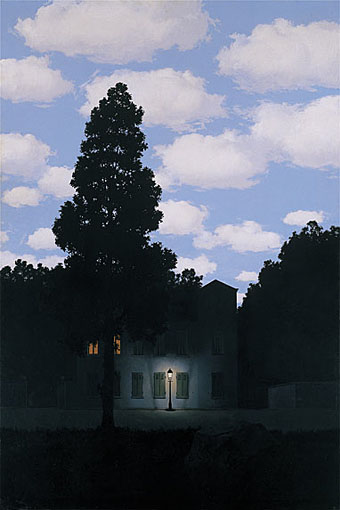
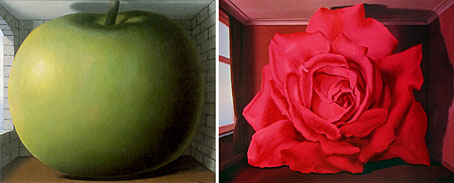
Bruges is another of those waterlogged places with cobbled streets which so beguile me, hence the choice of a Belgian town over more obvious European locations. The light skies in the night shots—a result of long exposures—lend the empty streets some of the same mysterious atmosphere captured by René Magritte in his Empire of Light series. Magritte was Belgian, of course, so it’s rather fitting, as was Paul Delvaux, another painter of noctural mystery.

empire.jpg

Empire of Light by René Magritte (1953–54).

Elsewhere on { feuilleton }
The panoramas archive

Previously on { feuilleton }
Bruges-la-Morte
Taxandria, or Raoul Servais meets Paul Delvaux

Bruges-la-Morte

rodenbach.jpg

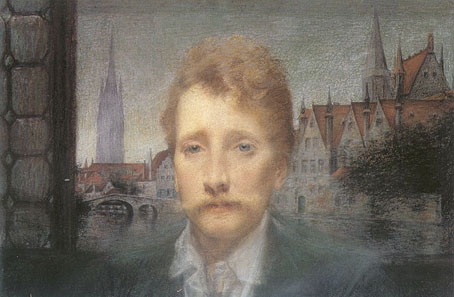
Portrait of Georges Rodenbach by Lucien Lévy-Dhurmer (1895).

Georges Rodenbach’s short, atmospheric novel is one of the key texts of Symbolism, not only for its themes but also for the art it either inspired or complemented. Bruges-la-Morte was first published in 1892 and the recent Dedalus Books edition, edited by Alan Hollinghurst and with a new translation by Mike Mitchell and Will Stone, was reprinted late last year.

Bruges-la-Morte…concerns the fate of Hugues Viane, a widower who has turned to the melancholy, decaying city of Bruges as the ideal location in which to mourn his wife and as a suitable haven for the narcissistic perambulations of his inexorably disturbed spirit. Bruges, the ‘dead city’, becomes the image of his dead wife and thus allows him to endure, to manage the unbearable loss by systematically following its mournful labyrinth of streets and canals in a cyclical promenade of reflection and allusion. The story itself centres around Hugue’s obsession with a young dancer whom he believes is the double of his beloved wife. The consequent drama leads Hugues onto a plank walk of psychological torment and humiliation, culminating in a deranged murder. This is a poet’s novel and is therefore metaphorically dense and visionary in style. It is the ultimate evocation of Rodenbach’s lifelong love affair with the enduring mystery and haunting mortuary atmosphere of Bruges.

Continue reading “Bruges-la-Morte”