Land art

spiral.jpg

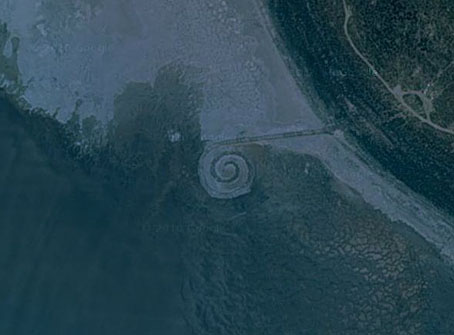
Spiral Jetty.

Reading this story about an ownership dispute over Robert Smithson’s Spiral Jetty in Utah had me searching out his celebrated artwork on Google Maps. It’s easy to find since Google have many of the well-known pieces of 1970s land art marked on their satellite views. Having found Smithson’s construction I went looking for a few more.
city.jpg

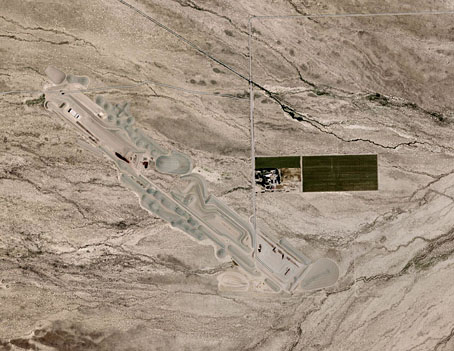
City.

Less easy to find, since it’s not marked and the artist forbids visitors, is Michael Heizer’s enormous and enigmatic City, an earthwork complex he’s been constructing in the Nevada desert since the early 70s. From the air it looks like a secret military base, the art area being the diagonal arrangement of structures on this view while the squares to the right are the artist’s home. I’ve been fascinated by this creation ever since a part of it, Complex One, was featured in Robert Hughes’s The Shock of the New, not least for Hughes’s assertion that these remote works impel an act of pilgrimage on any would-be visitors. This page has more about City and some of the few photos which have been released of its structures. See also A Sculptor’s Colossus of the Desert and Art’s Last, Lonely Cowboy.
roden.jpg

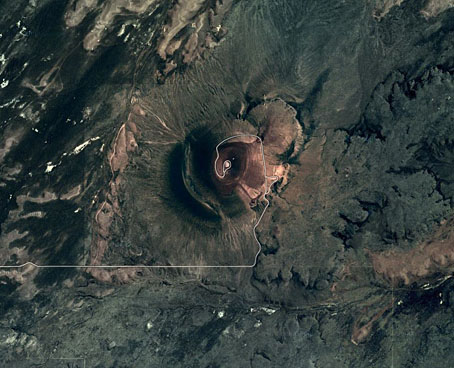
Roden Crater.

Equally remote, and for the time being inaccessible to the public, is James Turrell’s Roden Crater in Arizona, an extinct volcano which Turrell has been converting into an enormous viewing space for astronomical events and the transitory effects of natural light. This was begun in 1978 and seems like it may actually get finished, unlike Heizer’s construction site. This NYT article discusses the work’s history while Paul Schütze has recent photos of site details as well as a free download of some of the music he’s composed for the interior.
Continue reading “Land art”

Bindu Shards by James Turrell

turrell1.jpg

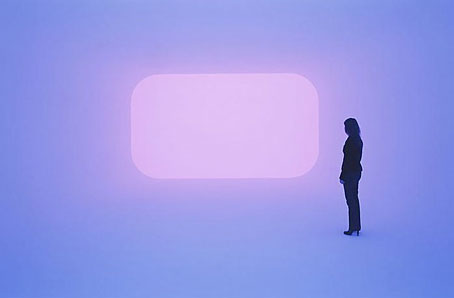
Dhatu (2010).

The intensities of colour found in some of James Turrell’s light works might warrant the description “psychedelic” at times, although “transcendental” is probably more apt when it comes to his immersive environments. Dhatu is one of the latter, a new installation at the Gagosian Gallery, London, where a room filled with changing shades of light has been named after a bodily element from Buddhism. The gallery says of the work:

Light like this is seen rarely with the eyes open, yet it is familiar to that which can be apprehended with the eyes closed in lucid dream, deep meditation, and near-death experiences.

turrell2.jpg

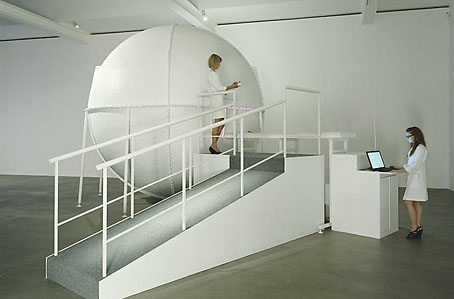
Bindu Shards (2010).

As for Bindu Shards, also at the Gagosian, the name refers to a kind of cosmic singularity in Hinduism and for this Turrell has created a bathysphere-like chamber which visitors are required to enter one at a time in order to experience its light show. This one really does sound psychedelic if Jonathan Jones’ frothing description is anything to go by:

Then I see a cityscape of vertiginous skyscrapers, with no earth below. All these forms and volumes that pulse and metamorphosise are defined by colours that change convulsively – the most intensely saturated greens and reds you can imagine, colours that seem solid, then burst into microscopic patterns of oranges, blacks, gold and misty white; all these colours bubble and whir at breakneck speed, as if you were in a particle accelerator. (More)

And a frothing description is all that’s available unfortunately, now that visiting sessions are fully-booked, but the other Turrell works will be on view until December 10, 2010.

Greeting the Light: An Interview with James Turrell
Other Turrell works at Flickr

Previously on { feuilleton }
Colorscreen
New Olafur Eliasson
New work from James Turrell

New work from James Turrell

turrell1.jpg

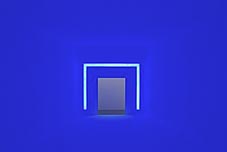
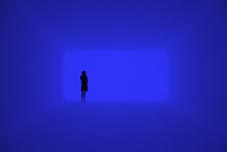
Left and below: End Around (2006).
Neon light, fluorescent light, and space.

GRIFFIN is pleased to announce an exhibition of new works by internationally acclaimed artist James Turrell. The exhibition will constitute the American debut of the artist’s Tall Glass series with three new works, along with End Around, a new work from his Ganzfeld series. This exhibition of new work highlights the most recent developments in Turrell’s forty-year exploration of light and human perception. It also serves as a bracket to the artist’s previous GRIFFIN exhibition, which featured the light projection works from the 1960s that constituted his earliest experimentations with the medium. As with that exhibition, the interior space of the gallery will be completely reconstructed to accommodate the new works.

turrell2.jpg

In his Tall Glass series, Turrell adds a temporal element to his perception-altering oeuvre. Each piece consists of a core of LEDs individually programmed by Turrell to carry out a subtle shift in color over time, similar to the deliberate but beautiful fashion in which the sky changes from late afternoon to night. However, these works’ careful construction insures that the viewer will see only a large floating, subtly changing field of light – a revelatory experience of photons as tangible entities and physical presence.

Also on exhibition will be End Around, one of Turrell’s Ganzfeld works. Upon entering the chamber housing the artwork, viewers instinctively approach what appears to be a faint wall of light in the distance. But upon reaching the light source, one’s entire visual field is consumed by an apparently limitless field of blue light. Turrell engineers the Ganzfeld works to eliminate all visual cues that the human brain uses to process depth. As a result, one is unable to tell whether the ethereal blue field he sees from the platform extends for inches, feet, or into infinity. The loaded act of “moving toward the light” and the subsequent experience of limitlessness reopen the spiritual dialectic that has perpetually surrounded Turrell’s light works.

James Turrell: New Work

GRIFFIN
2902 Nebraska Avenue
Santa Monica, California
90404

May 20th–August 26th, 2006