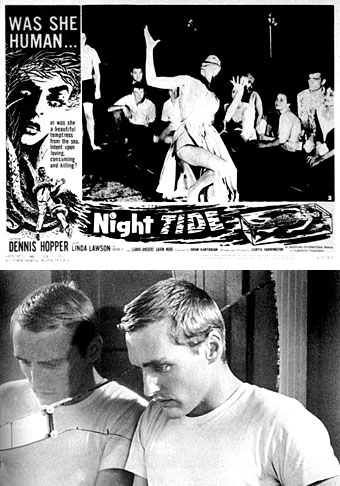
Curtis Harrington, who died on Monday, was chiefly known as a director of low-budget horror films, the most acclaimed of which is his debut feature Night Tide (1961), a watery riff on Cat People (1942) starring a young Dennis Hopper. But Harrington should also be remembered for his associations with early American avant garde cinema, especially the productions of Kenneth Anger. Harrington was behind the camera for Anger’s Puce Moment (1949) and appeared in front of it as Cesare the Somnambulist in Inauguration of the Pleasure Dome (1954). Harrington’s early films were similarly uncommercial experimental shorts, one of which, The Wormwood Star (1956), was based around the paintings and person of Marjorie Cameron Parsons Kimmel aka Cameron. Harrington and Cameron both appeared in Anger’s Pleasure Dome and Harrington featured Cameron again when he came to make Night Tide, where she appears as a mysterious, witch-like presence.
Night Tide is well worth a look, despite the limitations of its budget. Dennis Hopper had been ostracised from Hollywood after a fall-out with director Henry Hathaway and was hanging around with various artists and experimental filmmakers (including Andy Warhol’s crowd), acting in TV shows and generally biding his time. Harrington gave him a starring role and the opportunity to pull some Method faces, and he’s very impressive as he falls for a girl who may or may not turn into a murderous sea creature with the next full moon. Good use is made of the crumbling beachfront of Venice, CA, and there’s some sly camp humour to be found in Hopper’s appearance (he’s dressed in a sailor uniform most of the time, looking like an extra from Anger’s Fireworks), and in the scene where he goes for a (chaste) massage. Night Tide isn’t as strange as Carnival of Souls (1962) but both films share enough of the same atmosphere and period detail to make a perfect double-bill.
Previously on { feuilleton }
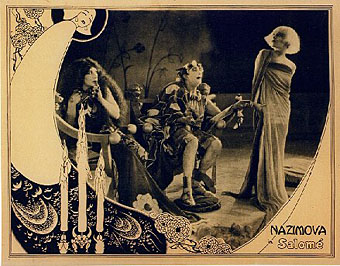
• Alla Nazimova’s Salomé
• Coming soon: Sea Monsters and Cannibals!
• Freddie Francis, 1917–2007
• The art of Cameron, 1922–1995
• Kenneth Anger on DVD…finally
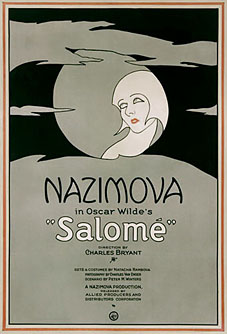 We tend to think of cinema as a modern medium, quintessentially 20th century, but the modern medium was born in the 19th century, and the heyday of the Silent Age (the 1920s) was closer to the Decadence of the fin de siècle (mid-1880s to the late-1890s) than we are now to the 1970s. This is one reason why so much silent cinema seems infected with a Decadent or Symbolist spirit: that period wasn’t so remote and many of its more notorious products cast a long shadow. Even an early science fiction film like Fritz Lang’s Metropolis has scenes redolent of late Victorian fever dreams: the vision of Moloch, Maria’s parable of the tower of Babel, the coming to life of statues of the Seven Deadly Sins, and—most notably—the vision of the Evil Maria as the Whore of Babylon. Woman as vamp or