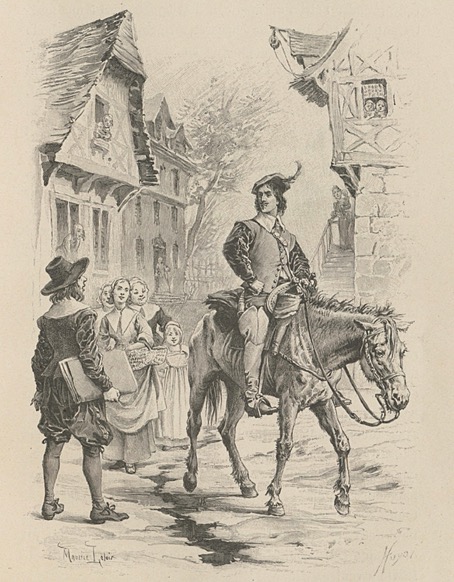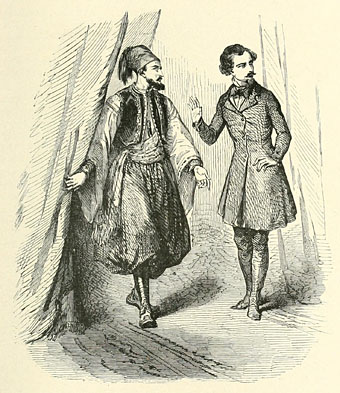
Illustration by Pierre-Gustave-Eugène Staal.
I mentioned at the weekend that my current reading is the Dumas père doorstop The Count of Monte Cristo. One of the things I enjoy about reading novels like these that “everyone knows” (ie: everyone knows mostly from truncated film or television adaptations) is finding something surprising about the story that you’ve never seen mentioned before. The following passage from chapter 31 turns out to be quite well-known as it happens, but only to those who’ve read the original text, not the Reader’s Digest version.
The story so far: Baron Franz d’Épinay has hired a boat to take him to the uninhabited Mediterranean island of Monte Cristo where he hopes to do a spot of hunting. On reaching the island Franz and his crew discover a small group of bandits camped there, with a leader dressed in Arabian clothes. This man—our hero, Edmond Dantès—insists on concealing his identity with a pseudonym, “Sinbad the Sailor”, and suggests that Franz might wish to do the same. The latter chooses the name “Aladdin”, and the pair retire to a sumptuously decorated cave for an evening meal. When the meal is over “Sinbad” offers “Aladdin” a special treat:
“You cannot guess,” said he, “what there is in that small vase, can you?”
“No, I really cannot.”
“Well, then, that green preserve is nothing less than the ambrosia which Hebe served at the table of Jupiter.”
“But,” replied Franz, “this ambrosia, no doubt, in passing through mortal hands has lost its heavenly appellation and assumed a human name; in vulgar phrase, what may you term this composition, for which, to tell the truth, I do not feel any particular desire?”
“Ah, thus it is that our material origin is revealed,” cried Sinbad; “we frequently pass so near to happiness without seeing, without regarding it, or if we do see and regard it, yet without recognizing it. Are you a man for the substantials, and is gold your god? taste this, and the mines of Peru, Guzerat, and Golconda are opened to you. Are you a man of imagination—a poet? taste this, and the boundaries of possibility disappear; the fields of infinite space open to you, you advance free in heart, free in mind, into the boundless realms of unfettered reverie. Are you ambitious, and do you seek after the greatnesses of the earth? taste this, and in an hour you will be a king, not a king of a petty kingdom hidden in some corner of Europe like France, Spain, or England, but king of the world, king of the universe, king of creation; without bowing at the feet of Satan, you will be king and master of all the kingdoms of the earth. Is it not tempting what I offer you, and is it not an easy thing, since it is only to do thus? look!”
At these words he uncovered the small cup which contained the substance so lauded, took a teaspoonful of the magic sweetmeat, raised it to his lips, and swallowed it slowly with his eyes half shut and his head bent backwards. Franz did not disturb him whilst he absorbed his favourite sweetmeat, but when he had finished, he inquired:
“What, then, is this precious stuff?”
“Did you ever hear,” he replied, “of the Old Man of the Mountain, who attempted to assassinate Philippe Auguste?”
“Of course I have.”
“Well, you know he reigned over a rich valley which was overhung by the mountain whence he derived his picturesque name. In this valley were magnificent gardens planted by Hassen-ben-Sabah, and in these gardens isolated pavilions. Into these pavilions he admitted the elect, and there, says Marco Polo, gave them to eat a certain herb, which transported them to Paradise, in the midst of ever-blooming shrubs, ever-ripe fruit, and ever-lovely virgins. What these happy persons took for reality was but a dream; but it was a dream so soft, so voluptuous, so enthralling, that they sold themselves body and soul to him who gave it to them, and obedient to his orders as to those of a deity, struck down the designated victim, died in torture without a murmur, believing that the death they underwent was but a quick transition to that life of delights of which the holy herb, now before you, had given them a slight foretaste.”
“Then,” cried Franz, “it is hashish! I know that—by name at least.”
“That is it precisely, Signor Aladdin; it is hashish—the purest and most unadulterated hashish of Alexandria—the hashish of Abou-Gor, the celebrated maker, the only man, the man to whom there should be built a palace, inscribed with these words, A grateful world to the dealer in happiness.”
“Do you know,” said Franz, “I have a very great inclination to judge for myself of the truth or exaggeration of your eulogies.”
“Judge for yourself, Signor Aladdin—judge, but do not confine yourself to one trial. Like everything else, we must habituate the senses to a fresh impression, gentle or violent, sad or joyous. There is a struggle in nature against this divine substance—in nature which is not made for joy and clings to pain. Nature subdued must yield in the combat, the dream must succeed to reality, and then the dream reigns supreme, then the dream becomes life, and life becomes the dream. But what changes occur! It is only by comparing the pains of actual being with the joys of the assumed existence, that you would desire to live no longer, but to dream thus forever. When you return to this mundane sphere from your visionary world, you would seem to leave a Neapolitan spring for a Lapland winter—to quit paradise for earth—heaven for hell! Taste the hashish, guest of mine—taste the hashish.”
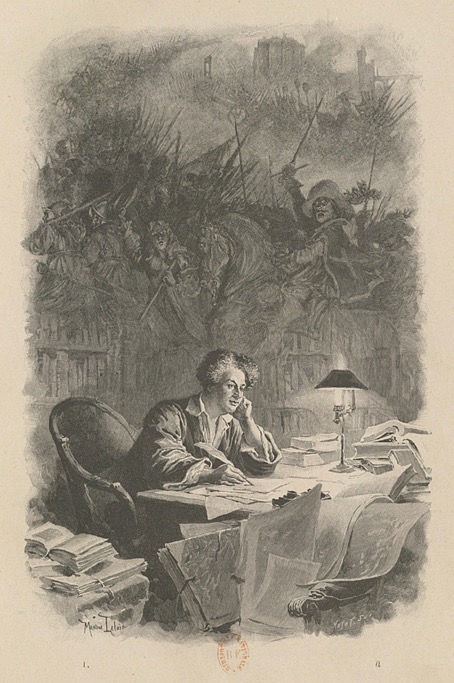
Franz does as requested and thereafter passes the night in an erotic delirium. The whole sequence is an example of the personal preoccupations of the author entering his fiction, Dumas having been a member of the Club des Hashishins in Paris, whose monthly “séances” took place at a hotel on the Île Saint-Louis. Other members of the club included Victor Hugo, Charles Baudelaire, Gérard de Nerval, and Honoré de Balzac. The “magic sweetmeat” which Franz is offered was just that, a greenish paste from Algeria known as Dawamesc which disguises the bitter taste of the hashish with honey, pistachio and spices. (This page has a recipe should you require it.) Reading about the history of the hashish club I see that the hotel was located on the Quay d’Anjou, the river-facing street which is also the location of Baroness Ungern’s occult library in The Dumas Club by Arturo Pérez-Reverte. The Dumas thread in that novel (which is omitted from the film adaptation, The Ninth Gate) concerns rare manuscript pages of the “Anjou Wine” chapter from The Three Musketeers yet I don’t recall any mention of the Club des Hashishins in the story. I wish now I’d known all this before I spent a week in Paris; the Île Saint-Louis was one of my favourite places in the city, and I walked along the Quay d’Anjou one evening, photographing the river views.
Further reading: Franz d’Épinay’s night of dreams is recounted in The Green Jam of Doctor X, an essay by Mike Jay which explores the history of the literary hashish club.
Previously on { feuilleton }
• More trip texts
• The Art of Tripping, a documentary by Storm Thorgerson
• Haschisch Hallucinations by HE Gowers