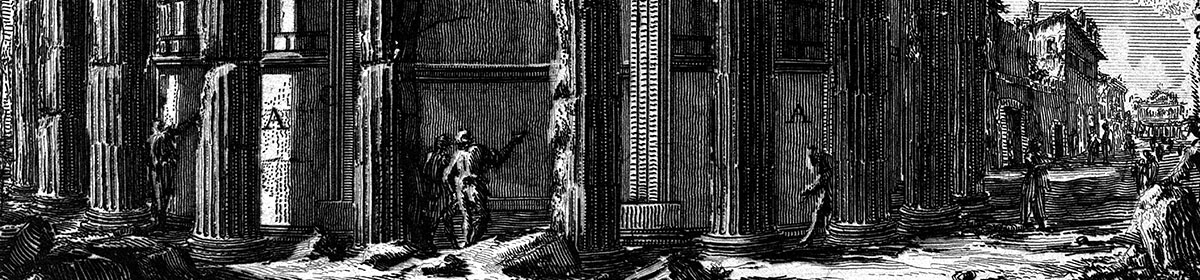
Penguin designer David Pelham talks
Great lecture about some classic book designs.
Postopolis: Art and Architecture
Postopolis: Art and Architecture
Event details and live blog at City of Sound.
A splendid time is guaranteed for all

It was forty years ago today, etc. Sgt Pepper was actually released on May 26th 1967 but June 1st was the official UK release date, June 2nd in the US. Love it or hate it (I love it, of course), popular music has to be divided into “before and after Sgt Pepper” such is the scope of the album’s impact. Yes, many of its vaunted innovations weren’t so unprecedented, yes Abbey Road is better musically, and so on. But it’s unlikely that any album will be so eagerly awaited by so many people, or be so influential, again.
• Song-by-song description from the band members
• Trivia page with parody covers from the Mothers to the Simpsons
• The hip-hop version
Previously on { feuilleton }
• Joe Orton
• Please Mr. Postman
• All you need is…
Peter Eudenbach’s Eiffel Ferris wheel
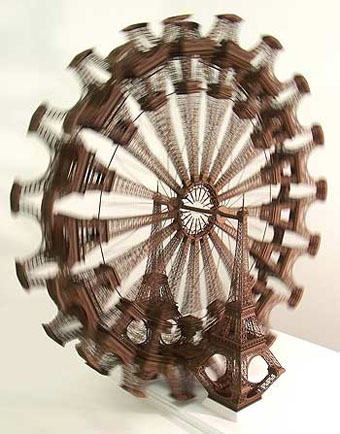
Tours de Revolutions by Peter Eudenbach (2007).
Built to commemorate the French Revolution, the Eiffel Tower inspired Ferris to create a revolving wrought iron marvel to surpass it. Twenty years later Duchamp’s love of Ferris Wheels led to the first readymade and caused a revolution in art. Tours de Revolution is a Ferris wheel made of Eiffel towers, bringing this famous landmark full circle.
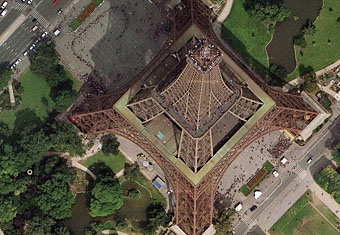
And speaking of Gustave Eiffel’s monument, Google Maps now has very clear views of central Paris. That snaking line of people is the queue to use one of the lifts.
Previously on { feuilleton }
• City of Light
• Paris V: Details
• Enormous structures II: Tatlin’s Tower
Howard Pyle’s pirates
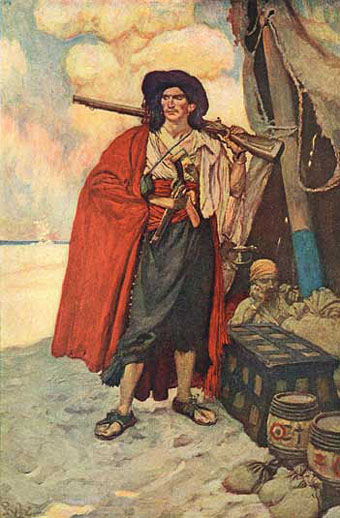
The Buccaneer was a Picturesque Fellow by Howard Pyle (1905).
Seeing as how Johnny Depp and co. are sailing the Spanish Main once more (to mixed reviews, unfortunately), now is perhaps a suitable moment to note the genesis of our popular conception of buccaneers. The famous characters of the Wild West were being mythologised while many of them were still alive and some survived long enough to be consulted by filmmakers such as John Ford when the first of the silent Westerns were being made. Pirates had their exploits recounted in tabloid fashion via books like The Newgate Calendar but our romantic image of the pirate comes primarily from Robert Louis Stevenson and artist/writer Howard Pyle (1853–1911).
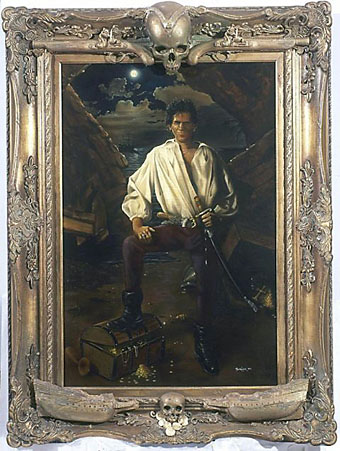
Keith Richards by Paul Karslake (1998).
Pyle’s articles for Harper’s Monthly Magazine in the early 1900s were later collected as the very popular Howard Pyle’s Book of Pirates, “Fiction, Fact & Fancy concerning the Buccaneers & Marooners of the Spanish Main”. The considerable gulf between fact and fiction can be see in early pirate portraits, most of which are crude woodcut renderings. Pyle ignored these for the most part, relying on imagination to exaggerate details of worn-out 18th century clothing in much the same way that Sergio Leone and others exaggerated certain qualities of 19th century garb for their Westerns, turning what would have been a rather sorry reality into something more visually thrilling. Hollywood costume designers have used Pyle’s paintings as source material for pirate characters ever since so it’s perhaps fitting that Johnny Depp’s conception of Jack Sparrow’s character also came from a painting, Paul Karslake’s portrait of Keith Richards posing as a pirate. And now Richards is in the latest film playing Sparrow’s father…
• Howard Pyle at 100 Years of Illustration
• A Pyle pirate gallery
Elsewhere on { feuilleton }
• The illustrators archive
Previously on { feuilleton }
• Coming soon: Sea Monsters and Cannibals!
• Seamen in great distress eat one another
• Druillet meets Hodgson
• Rogue’s Gallery: Pirate Ballads, Sea Songs, and Chanteys
• Davy Jones