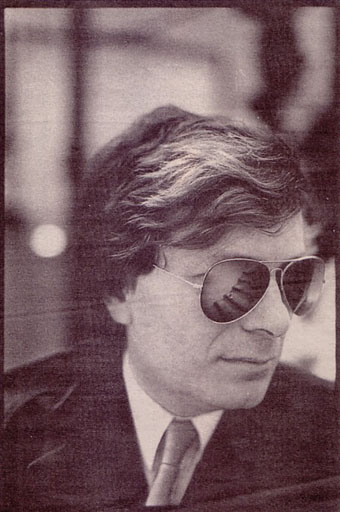
Paul Morley remembers Tony Wilson in The Observer.
A journal by artist and designer John Coulthart.
Paul Morley remembers Tony Wilson in The Observer.
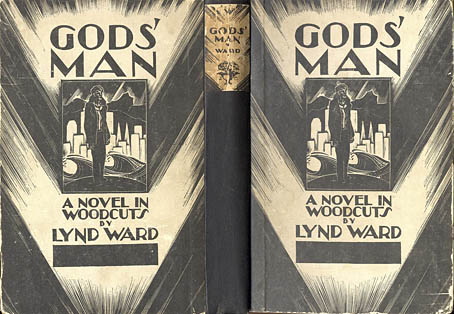
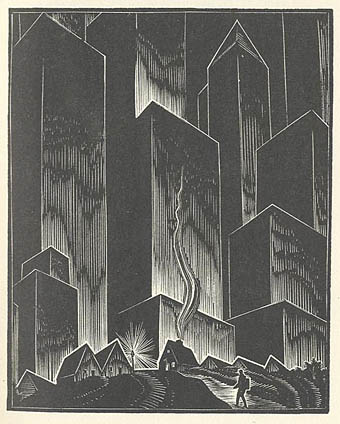
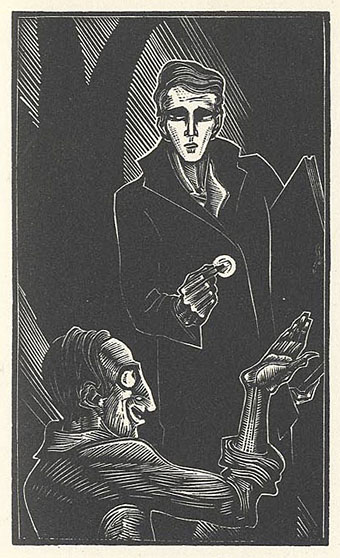
I’ve never tried woodcut engaving—the closest was scraperboard and some linocuts when I was a teenager—but I’ve always admired the form and Lynd Ward (1905–1985) was one of its masters. Ward’s wordless “novels” were inspired by the similar work of Frans Masereel and you can see pages from two of these, Gods’ Man (1930) and Madman’s Drum (1930) at The Visual Telling of Stories. Ward’s work is frequently referred to as an inspiration by later illustrators, and comic artists especially have responded to these pictorial narratives. Woodcut illustration had a resurgence of popularity before and after the Second World War; most of MC Escher‘s early work is woodcut engraving, for instance. There are still a few contemporary practitioners, Clifford Harper being one of the most visible in the UK.
• Bud Plant’s Lynd Ward page
• A Lynd Ward site with examples from other books
Elsewhere on { feuilleton }
• The etching and engraving archive
• The illustrators archive
Animal Instinct: Raging Bull
David Thomson revisits Scorsese’s masterpiece.

Dancer by Felix D’Eon at his Flickr pages. His artwork based on the photos, including some gay erotica, can be seen at his website.
Elsewhere on { feuilleton }
• The gay artists archive
Previously on { feuilleton }
• Dancers by John Andresen
• Youssef Nabil
• Images of Nijinsky
• The art of Hubert Stowitts, 1892–1953

Portrait of Mephisto #1 (2006).

Portrait of Mephisto #5 (2006).
The carefully-constructed and coloured tableaux of Shanghai-based art Maleonn Ma remind me of Joel-Peter Witkin‘s grainier and nastier works only without the body parts or dead babies. The repeated use of Michelangelo’s Creation of Adam in contemporary culture is a whole subject in itself.
Via Phantasmaphile.
Previously on { feuilleton }
• Behold the (naked) man
• Sculptural collage: Eduardo Paolozzi
• Michelangelo revisited