Textorizer
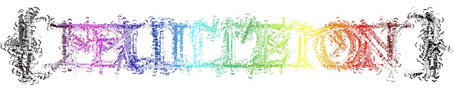
Textorizer takes a raster image in a format such as png, jpeg or gif, detects edges using a Sobel convolution filter and replaces them with supplied lines of text.
In a similar vein, you can Textorize a picture using a downloadable application. Flickr has a pool of examples.
Previously on { feuilleton }
• Word games
Particle physics

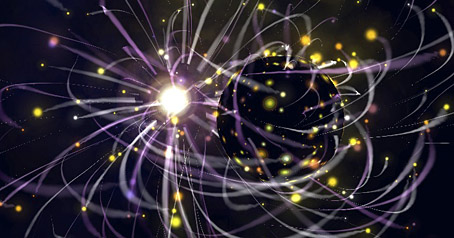
It’s perhaps fitting that in the same week (almost the same day) that the Large Hadron Collider was finally switched on, Apple should release iTunes v. 8.0. The improved Visualizer for this application generates patterns not so far removed from the graphics created to explain quantum interactions or cosmic motion. (And while we’re discussing quantum events, let’s not forget this.)
I enthused last year about the Jelly setting of the Visualizer but these new graphics are a step—a quantum leap, even—beyond that, with a variety of spinning orbs and glowing lights which shoot out streams of sparks and flares of colour. Variations can be had by pressing the M key which cycles through the settings. The abstract fish and/or spermatozoa are especially impressive the way they charge around the screen while their world revolves in three dimensions. If Jelly makes you feel like you’re on drugs, watching these new effects reacting in time to some suitably contemporary music—Aerial by 2562, for instance—makes me feel for once that I’m living in the future I expected to find this side of the year 2000.
• Nature explains what the LHC has actually been built for.
Previously on { feuilleton }
• Aerial by 2562
• From LSD to OSX
• iTunes 7
Planet by Marc Quinn
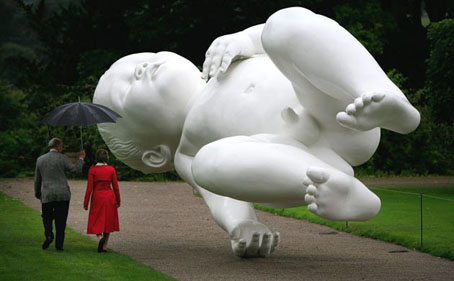
Planet by Marc Quinn. Photo by Christopher Furlong.
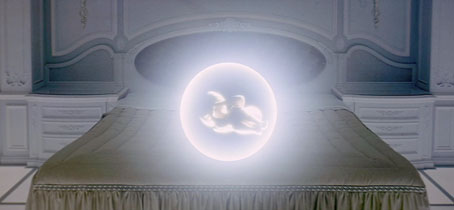
Marc Quinn’s remarkable sculpture is one of several pieces by different artists (including Salvador Dalí) being displayed in the gardens of Chatsworth House until November 2, 2008. I much prefer this to Quinn’s recent works which have gained attention almost solely for having Kate Moss as their model. A floating baby with a stellar name can’t help but remind me of another weightless infant with a cosmic genesis.
Previously on { feuilleton }
• Giant Skeleton and the Chocolate Jesus
• 2001: A Space Odyssey program
Painted screams
Painted screams
| Adrian Searle on the Bacon retrospective.