A Journey to Avebury by Derek Jarman

jarman2.jpg

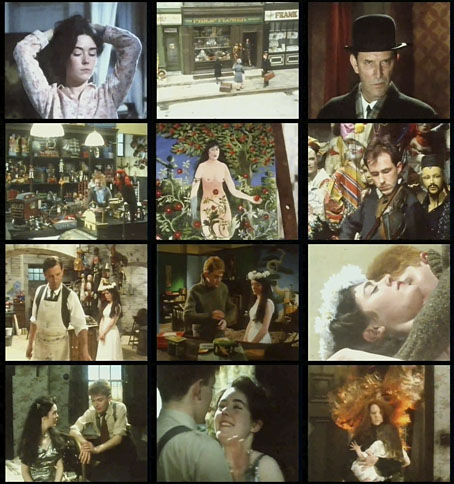
Among the Doublevision video releases I was writing about earlier this month there’s a notable omission from those which have been reissued on DVD: Derek Jarman’s In the Shadow of the Sun was the seventh release on the label, the 1980 version of a film which was compiled in 1974 using footage from his earlier Super-8 shorts, one of which was A Journey to Avebury (1971). Several of the short films have appeared as extras on recent DVDs but the gorgeously oneiric In the Shadow of the Sun remains stubbornly unavailable.

jarman1.jpg

A Journey to Avebury lasts for ten minutes, and in its original state was nothing more than silent, static shots of fields, pathways (putative ley lines, perhaps), silhouetted trees, and finally the Avebury stones. I still find it one of the most fascinating of his short films. The yellow filter gives all the shots an oppressive, sulphurous cast which turns the otherwise bucolic landscape into a place of imminent (or even post-) apocalypse. I’m reminded of the yellow skies in Charles Platt’s erotic nightmare The Gas (1970), or some of the outdoor shots in Penda’s Fen (1974) which are equally suffused with menace.

jarman3.jpg

The copy of A Journey to Avebury that’s currently on YouTube is a recent version with an uncredited electronic score. I still don’t know who did the music; it doesn’t sound like Coil. Cyclobe? (It’s Coil.) The YouTube version can be found in far better quality on the Second Sight DVD of Jarman’s The Last of England.

cots6.jpg

And just to show how everything here is connected to everything else, that brooding megalith above (known locally as “The Devil’s Seat”) can be seen in at least one shot in Children of the Stones. No surprise there but the shot also reveals the place where Jarman and co. would have been standing five years earlier.

Previously on { feuilleton }
Children of the Stones
Avebury panoramas
Derek Jarman’s music videos
Derek Jarman’s Neutron
Mister Jarman, Mister Moore and Doctor Dee
The Tempest illustrated
Penda’s Fen by David Rudkin
In the Shadow of the Sun by Derek Jarman
Derek Jarman at the Serpentine
The Angelic Conversation
The life and work of Derek Jarman

The art of Gösta Adrian-Nilsson, 1884–1965

gan19.jpg

Tjur och Matador III (Bull and Matador III) (1926).

My thanks again to Will at 50 Watts for generously sending me this selection of paintings by Swedish artist Gösta Adrian-Nilsson, or GAN as he was known. These pictures alone show him to have been a very versatile artist, ranging from the late Symbolism of his Young man with death to the works below which deploy a variety of Modernist styles including nods to Cubism and Futurism. A translation of his Swedish Wikipedia page explains the preponderance of matelots and toreadors thus:

The GAN was homosexual reflected in several of his works. For example, he was at times almost manic fixed at the Mariners, and he worshiped the masculine force. Other favorite subjects were male athletes. Meanwhile, the homosexual eroticism both forbidden and taboo and GAN forced to live a double life.

It’s a shame there isn’t a good single site for his work but Google’s image search turns up a lot more paintings. There’s also this Swedish site which contains more biographical detail.

gan01.jpg

Ynglingen och döden (Young man with death) (1908).

gan02.jpg

Epilog.

gan03.jpg

Ilja (Portrait of Karl Edvard Holmström) (1911–12).

gan04.jpg

Inspiration (1928).

Continue reading “The art of Gösta Adrian-Nilsson, 1884–1965”

Children of the Stones

cots1.jpg

“Pretty phantasmagorical!” says precocious teenager Matthew when he and his father drive into the fictional village of Milbury in the opening scene of Children of the Stones. Matthew’s father is a scientist whose work requires a three-month stay in a village built in the centre of a series of ancient ramparts and stone circles. Once settled, they find many of the villagers to be blandly cheerful, while Matthew discovers that his maths skills at the local school pale beside younger children who can solve complex equations with ease. Omnipresent characters in the village are Hendrick, a retired astronomer who owns the local manor house and acts as village squire; Margaret, a newly-arrived archaeologist who knows the history of the stones; and Dai, a vagrant poacher who lives outside the circle, and who seems eager to remain free of the Stepford-like happiness afflicting his neighbours.

cots2.jpg

Matthew (Peter Demin).

Matthew’s “phantasmagorical” epithet is directed at the neolithic mound outside the village but could easily apply to the whole of this seven-part serial which I watched again recently. HTV produced Children of the Stones which was first broadcast in early 1977. A mystery serial for children involving pagan history, folk rituals and an undercurrent of science fiction wasn’t such a surprising thing in the 1970s, this being a decade when a popular interest in the occult and the paranormal was more prevalent than at any time before or since. Children’s television reflected adult trends which is why we got to see an adaptation of Alan Garner’s The Owl Service, the occult adventure series Ace of Wands (with its hero named “Tarot”), The Tomorrow People (which occasionally strayed from science fiction to science fantasy) and others (see an earlier post, Occultism for kids). Children of the Stones was the most complex of all of these, a well-crafted drama with similarities to Nigel Kneale’s TV plays, The Wicker Man and The Prisoner. With a slight change of emphasis it would have worked just as well as a serial for adults. The best children’s serials of the period were usually adaptations of novels; Children of the Stones was an original work for television, written by Jeremy Burnham & Trevor Ray, and directed by Peter Graham Scott.

cots4.jpg

Adam (Gareth Thomas), Margaret (Veronica Strong) and Hendrick (Iain Cuthbertson).

Continue reading “Children of the Stones”

The art of Gregorio Prieto, 1897–1992

prieto01.jpg

Predicadors del be i del mal (c. 1928–1930).

My thanks to Will at 50 Watts for sending these experimental photos by Spanish artists Eduardo Chicharro (1873–1949) and Gregorio Prieto, neither of whose work I’d looked at before. Prieto is of most interest here (that’s him in photo five with the metalwork wrapped around his head) for the homoerotic quality of his other work, a quality which no doubt explains why some of these pictures set the gaydar bells ringing. I thought that Javier at Bajo el Signo de Libra might have featured Prieto already but it seems not.

prieto02.jpg

Iluita (c. 1928–1930).

The photos are from Les avantguardes fotografiques a espanya, 1925–1945. The superimposed images are reminiscent of those that Emil Cadoo was producing in the 1950s albeit with more of a deliberate Surrealist flavour; the ruins and Classical references are also a feature of Prieto’s paintings, some of which can be seen here. (Also a coloured print of the first photo above.) The homoerotics is most evident in his line drawings, some of which can be seen here. His reclining youths and embracing sailors look rather Cocteau-like but they probably owe more to the etchings of Picasso’s Vollard Suite which were being produced around the same period. There’s more Picasso-esque Prieto at Flickr including a drawing dedicated to Lorca.

prieto03.jpg

Metamorfosi (c. 1928–1930).

Continue reading “The art of Gregorio Prieto, 1897–1992”

Frantisek Drtikol’s Salomés

drtikol1.jpg

Salomé (c. 1919).

Frantisek Drtikol (1883–1961) was a Czech artist and photographer whose nude studies frequently borrowed fin de siècle themes. Salomé was a subject he returned to on many occasions with different models. In other hands this might be a pretext for showing naked flesh but Drtikol’s work goes beyond mere soft porn with his female figures (and the occasional males) juxtaposed against abstract shapes and shadows, giving them the appearance of Art Deco figurines. There’s a foretaste of that development in the strip of white in the picture below. See more of his earlier work here.

drtikol2.jpg

Salomé (c. 1920).

Elsewhere on { feuilleton }
The Salomé archive