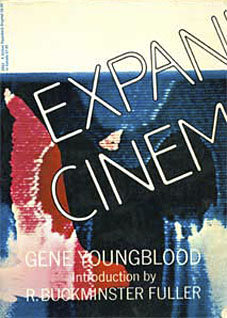
 This prescient out-of-print volume from 1970 is available as a free PDF download here. Also at the essential ubu.com. (Thanks to Jay for the tip!)
From the original back jacket copy:
“Today when one speaks of cinema, one implies a metamorphosis in human perception,” writes the author of this extraordinary book. “Just as the term ‘man’ is coming to mean man / plant / machine, so the definition of cinema must be expanded to include videotronics, computer science, and atomic light.”
In a brilliant and far-ranging study, Gene Youngblood traces the evolution of cinematic language to the end of fiction, drama, and realism. New technological extensions of the medium have become necessary. Thus he concentrates on the advanced image-making technologies of computer films, television experiments, laser movies, and multiple-projection environments. Outstanding works in each field are analyzed in detail. Methods of production are meticulously described, including interviews with artists and technologists. Expanded Cinema is filled with provocative post-McLuhan philosophical probes into: “the Paleocybernetic Age,” “the videosphere,” and “the new nostalgia,” all in the context of what the author calls “the global intermedia network.” In “Image-Exchange and the Post-Mass Audience Age,” Mr. Youngblood discusses the revolutionary implications of videotape cassettes and cable television as educational tools. His observations are placed in a comprehensive perspective by an inspiring introduction written by R. Buckmister Fuller. Vast in scope, both philosophical and technical, Expanded Cinema will be invaluable to all who are concerned with the audio-visual extensions of man, the technologies that are reshaping the nature of human communication.
About Gene Youngblood:
Gene Youngblood is an internationally known theorist of electronic media arts, and a respected scholar in the history and theory of experimental film and video art, which he has taught for 34 years. He is the author of Expanded Cinema (1970), the first book about video as an art medium, which was influential in establishing the field of media arts. He is also widely known as a pioneering voice in the Media Democracy movement, and has been teaching Media and Democracy for 30 years. He has lectured at more than 400 colleges and universities throughout North America, Europe, Japan, and Australia, and his writing is published extensively around the world. He has received grants from the Rockefeller Foundation, the Rockefeller Brothers Fund, the National Endowment for the Arts (NEA), The New Mexico Arts Division, and the New Mexico Endowment for the Humanities. He has taught at CalArts, The California Institute of Technology, Columbia University, the School of the Art Institute of Chicago, UCLA and USC.
Elsewhere on { feuilleton }
• The abstract cinema archive