Weekend links 268

paul.jpg

A City on Pluto (1940) by Frank R. Paul. Related: Paul’s predictions about life on other planets.

23 Skidoo’s Peel Session from September 16th, 1981. Only 18 minutes of music but I’m thrilled for its being unique material that’s never been given an official release. There are many more Peel Sessions at the uploader’s channel, not all of which were reissued on the Strange Fruit label. Download favourites in their as-broadcast form (some with John Peel’s introductions) before they vanish or get blocked like the 1981 Cabaret Voltaire session. Related: Wikipedia’s list of Peel Sessions.

• Mixes of the week comprise two collections by Jon Dale of strange and beguiling Italian music: The Prevarications Of The Sky Against The Earth and La Verifica Incerta; the Summer Window Mix (“telly detritus, new-not-new synth nonsense & off-colour pop oddities”) by Moon Wiring Club; and Secret Thirteen Mix 158 by Haunter Records.

• “Hello, this is David Bowie. It’s a bit grey out today but I’ve got some Perrier water, and I’ve got a bunch of records…” Two hours of the Thin White Duke playing favourite music on BBC Radio One, 20th May, 1979.

Some of Vidal’s guests were writers, not exactly his favorite group. “Writers are the only people who are reviewed by people of their own kind,” Vidal said in an interview. “And their own kind can often be reasonably generous—if you stay in your category. I don’t. I do many different things rather better than most people do one thing. And envy is the central fact of American life.”

Frank Pizzoli reviews Sympathy for the Devil: Four Decades of Friendship with Gore Vidal by Michael Mewshaw

• Yair Elazar Glotman’s new album, Études, conjures “bone-rattling resonance, thick, alien-like atmospheres, and percussive fragments”. Stream it in full here.

• London’s Lost Department Store of the Swinging Sixties: Inge Oosterhoff on the splendours of Biba.

• It’s that Ungeziefer again: Richard T. Kelly on 100 years of The Metamorphosis by Franz Kafka.

• The History of Creepy Dolls: Linda Rodriguez McRobbie explores the uncanny valley.

• At Dangerous Minds: Matt Groening tells the story of The Residents in 1979.

• The NYT collects NASA’s photos from the New Horizons Pluto flyby.

The Museum of Imaginary Musical Instruments

Written on the Body: tattoos in cinema

The Doll’s House (1981) by Landscape | Voodoo Dolly (1981) by Siouxsie and the Banshees | Devils Doll Baby (1986) by Sonny Sharrock

James Ellroy’s Feast of Death

ellroy.jpg

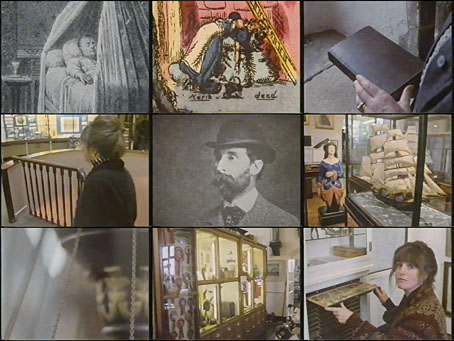
In which the Demon Dog discusses his obsession with unsolved murders whilst meeting cop friends (and Nick Nolte) over a series of dinners. Vikram Jayanti’s 90-minute film was made for the BBC’s Arena strand in 2001, and was later released on DVD. It’s one of the best films I’ve seen about Ellroy whose take-no-prisoners attitude can be gauged from the anecdote at the very beginning. Films about writers are often better when they’re like this, talking about the things that interest them rather than discussing their work in a manner which can get blunted by having to answer to the same questions over and over again. Discussion touches inevitably on the murder of Ellroy’s mother, and the Black Dahlia case. “…with very strong language, and scenes you may find disturbing…” Watch it here.

23 Skidoo

1: A slang phrase

skidoo1.jpg

Postcard via.

From the Oxford English Dictionary:

skidoo, v. N. Amer. slang. (ski’du:) Also skiddoo. [Orig. uncertain, perh. f. skedaddle v.]

2. In catch-phrases. a. Used as an exclamation of disrespect (for a person). Esp. in nonsense association with twenty-three. (temporary.)

1906 J. F. Kelly Man with Grip (ed. 2) 99 As for Belmont and Ryan and the rest of that bunch, Skidoo for that crowd when we pass. Ibid. 118 ‘I can see a reason for ‘skidoo’,’ said one, ‘and for ‘23’ also. Skidoo from skids and ‘23’ from 23rd Street that has ferries and depots for 80 per cent. of the railroads leaving New York.’ 1911 Maclean’s Mag. Oct. 348/1 Surrounded by this conglomerate procession as I went on my way, the urchins would yell ‘Skidoo,’ ‘23 for you!’

b. spec. as twenty-three skidoo: formerly, an exclamation of uncertain meaning; later used imp., go away, ‘scram’.

1926 C. T. Ryan in Amer. Speech II. 92/1, I really do not recall which appeared first in my vocabulary, the use of ‘some’ for emphasis or that effective but horrible ‘23-Skiddoo’—perhaps they were simultaneous. 1929 Amer. Speech IV. 430 Among the terms which the daily press credits Mr. Dorgan with inventing are:…twenty-three skiddoo (go away). 1957 W. Faulkner Town iii. 56 Almost any time now Father would walk in rubbing his hands and saying ‘oh you kid’ or ‘twenty-three skidoo’. 1978 D. Bagley Flyaway xi. 80 This elderly, profane woman…used an antique American slang… I expected her to come out with ‘twenty-three, skidoo’.


2: An esoteric poem by Aleister Crowley

[23]

SKIDOO

What man is at ease in his Inn?
Get out.
Wide is the world and cold.
Get out.
Thou hast become an in-itiate.
Get out.
But thou canst not get out by the way thou camest in. The Way out is THE WAY.
Get out.
For OUT is Love and Wisdom and Power.
Get OUT.
If thou hast T already, first get UT.
Then get O.
And so at last get OUT.

From The Book of Lies (1912/13)


3: A film by Julian Biggs

biggs.jpg

23 Skidoo (1964).

If you erase the people of downtown America, the effect is bizarre, not to say disturbing. That is what this film does. It shows the familiar urban scene without a soul in sight: streets empty, buildings empty, yet everywhere there is evidence of recent life and activity. At the end of the film we learn what has happened.


4: 23 Skidoo Eristic Elite by William Burroughs

skidoo2.jpg

International Times, issue 18, Aug 31–Sept 13, 1967.

From Burroughs proceed to Illuminatus! (1975) by Robert Shea and Robert Anton Wilson, and many subsequent derivations.


5: A one-off comic strip by Rick Griffin and Rory Hayes

skidoo3.jpg

From Bogeyman Comics #2 (1969).


6: A music group

skidoo4.jpg

Just Like Everybody (1987). Design by Neville Brody.

Website | Discography


7: A poetry collection by Eckhard Gerdes

skidoo5.jpg

23 Skidoo! 23 Form-Fitting Poems (2013) by Eckhard Gerdes.

Previously on { feuilleton }
Seven Songs by 23 Skidoo
23 Skidoo by Julian Biggs
Neville Brody and Fetish Records

The Plutonian Drug

amazing.jpg

Cover art by Leo Morey.

To HP Lovecraft, Pluto was the planet Yuggoth, home to the fungoid, brain-harvesting Mi-go whose exploits are detailed in The Whisperer in Darkness (1931). Clark Ashton Smith wasn’t averse to imagining the planets of the Solar System as exotic worlds, but in The Plutonian Drug, a short story published in Amazing Stories for September 1934, he stayed closer to what was known of Pluto at the time, albeit with an exception or two:

“There are some other drugs, comparatively little known, whose effects, if possible, are even more curious than those of mnophka. I don’t suppose you have ever heard of plutonium?”

“No, I haven’t,” admitted Balcoth. “Tell me about it.”

“I can do even better than that — I can show you some of the stuff, though it isn’t much to look at — merely a fine white powder.”

Dr. Manners rose from the pneumatic-cushioned chair in which he sat facing his guest, and went to a large cabinet of synthetic ebony, whose shelves were crowded with flasks, bottles, tubes, and cartons of various sizes and forms. Returning, he handed to Balcoth a squat and tiny vial, two-thirds filled with a starchy substance.

“Plutonium,” explained Manners, “as its name would indicate, comes from forlorn, frozen Pluto, which only one terrestrial expedition has so far visited — the expedition led by the Cornell brothers, John and Augustine, which started in 1990 and did not return to earth till 1996, when nearly everyone had given it up as lost. John, as you may have heard, died during the returning voyage, together with half the personnel of the expedition: and the others reached earth with only one reserve oxygen-tank remaining.

This vial contains about a tenth of the existing supply of plutonium. Augustine Cornell, who is an old school friend of mine gave it to me three years ago, just before he embarked with the Allan Farquar crowd. I count myself pretty lucky to own anything so rare.

“The geologists of the party found the stuff when they began prying beneath the solidified gases that cover the surface of that dim, starlit planet, in an effort to learn a little about its composition and history. They couldn’t do much under the circumstances, with limited time and equipment; but they made some curious discoveries — of which plutonium was far from being the least.

“Like selenine, the stuff is a bi-product of vegetable fossilization. Doubtless it is many billion years old, and dates back to the time when Pluto possessed enough internal heat to make possible the development of certain rudimentary plant-forms on its blind surface. It must have had an atmosphere then; though no evidence of former animal-life was found by the Cornells.

“Plutonium, in addition to carbon, hydrogen, nitrogen, and oxygen, contains minute quantities of several unclassified elements. It was discovered in a crystalloid condition, but turned immediately to the fine powder that you see, as soon as it was exposed to air in the rocketship. It is readily soluble in water, forming a permanent colloid, without the least sign of deposit, no matter how long it remains in suspension.”

“You say it is a drug?” queried Balcoth. “What does it do to you?”

“I”ll come to that in a minute — though the effect is pretty hard to describe. The properties of the stuff were discovered by chance: on the return journey from Pluto, a member of the expedition, half delirious with space-fever, got hold of the unmarked jar containing it and took a small dose, imagining that it was bromide of potassium. It served to complicate his delirium for a while — since it gave him some brand-new ideas about space and time.

“Other people have experimented with it since then. The effects are quite brief (the influence never lasts more than half an hour) and they vary considerably with the individual. There is no bad aftermath, either neural, mental, or physical, as far as anyone has been able to determine. I”ve taken it myself, once or twice, and can testify to that.

“Just what it does to one, I am not sure. Perhaps it merely produces a derangement or metamorphosis of sensations, like hashish; or perhaps it serves to stimulate some rudimentary organ, some dormant sense of the human brain. At any rate there is, as clearly as I can put it, an altering of the perception of time — of actual duration — into a sort of space-perception. One sees the past, and also the future, in relation to one’s own physical self, like a landscape stretching away on either hand. You don’t see very far, it is true — merely the events of a few hours in each direction; but it’s a very curious experience; and it helps to give you a new slant on the mystery of time and space. It is altogether different from the delusions of mnophka.”

The most immediately notable detail here is the word “plutonium” which Smith was using as his own six years before the radioactive element was officially named. (By coincidence, transuranic plutonium was discovered the year Smith’s story was published.) Also of note is yet more discussion in a Smith story of real drugs such as opium and hashish. I’ve never seen any evidence that Smith was a drug user but he was happy to exploit the visionary potential of these substances. The time-viewing effects of Smith’s plutonium might have made for an effective weird tale but the piece runs out of steam fairly quickly; this is one of those stories with a promising idea that needs someone like HG Wells to do it justice. Many of Smith’s stories were written in haste so this isn’t too surprising but The Plutonian Drug lacks the imaginative scope of a piece of psychedelic science fiction like The City of the Singing Flame. Nevertheless, it was druggy enough to open Michel Parry’s Strange Ecstasies which is how I came to revisit it recently.

I was hoping the story might have been illustrated for its early printings but it seems not. The best I can find is this card design; there’s also a metal song by a band named Innsmouth that was released as a double-bill single in 2012. Smith’s story may be read in full at Eldritch Dark.

Previously on { feuilleton }
More trip texts
Yuggoth details
The Garden of Adompha
The City of the Singing Flame
Haschisch Hallucinations by HE Gowers
Odes and Sonnets by Clark Ashton Smith
Clark Ashton Smith book covers