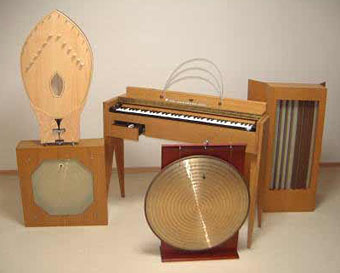
At Wikipedia.
At 120 Years of Electronic Music.
At Peter Pringle’s site.
A journal by artist and designer John Coulthart.

The Natural History Museum of Oslo University has opened an exhibition dedicated to homosexuality in the animal kingdom.
Today we know that homosexuality is a common and widespread phenomenon in the animal world. Not only short-lived sexual relationships, but even long-lasting partnerships; partnerships that may last a lifetime.
The exhibit puts on display a small selection among the more than 1500 species where homosexuality have been observed. This fascinating story of the animals’ secret life is told by means of models, photos, texts and specimens. The visitor will be confronted with all sorts of creatures from tiny insects to enormous spermwhales.
How can we know that an animal is homosexual? How can homosexual behaviour be consistent with what we have learned about evolution and Darwinism?
Sadly, most museums have no traditions for airing difficult, concealed, and possibly controversial questions. Homosexuality is certainly such a question. We feel confident that a greater understanding of how extensive and common this behaviour is among animals, will help to de-mystify homosexuality among people. At least, we hope to reject the all too well known argument that homosexual behaviour is a crime against nature.
Naturally (ahem), this has attracted the ire of the usual god-botherers who are happy to ignore inconvenient Scriptural declarations about loving your neighbour when sending the museum directors hate mail. Unfortunately for the bigots, evidence about homosexuality being very much a part of the natural world continues to mount (pardon the pun again…), as shown in an article in US science magazine, Seed, earlier this year. That won’t convince the American (and other) Talibans, of course, but then if it was up to them we’d still be burning witches and thinking that the sun orbited the earth.
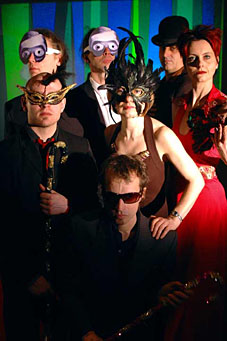 Electric light orchestra
Light bulbs. Biscuits. A 10,000-volt charge. The only thing you won’t find making music at a Photophonic Experiment gig is guitars and pianos, says Maddy Costa.
Maddy Costa
Friday, October 20, 2006
The Guardian
Ceinws in north Wales is the kind of tiny, bucolic town where nothing unusual is supposed to happen. And possibly it didn’t before Mark Anderson moved in. A sound-artist, instrument-maker and pyrotechnic with the performance group Blissbody, he has a workshop opposite the village pub that appears perfectly innocent from the outside, but inside could pass for a laboratory from a Frankenstein movie. Glass tubes and dangerous-looking electrical contraptions clutter the floor. Wires coil across a table. A standing lamp looms in the corner. “Watch this,” says Anderson, as excited as a five-year-old setting fire to a box of tissues. He points a mysterious black cone at the lamp and turns a dimmer switch to activate the bulb. Slowly, the lamp illuminates, and a sound fills the room: a low buzz at first, but growing painfully high-pitched as the light reaches full brightness. This really is white noise.
Remarkably, what Anderson is demonstrating isn’t an instrument of torture but a “photo-synth”, a device that converts light into sound. It’s a key element of the Photophonic Experiment, a bizarre, potentially fascinating collaboration between Anderson and like-minded musicians Pram and Kirsten Reynolds that tours the UK from next week. And if the people of Ceinws think Anderson is odd, they should hear what his associates get up to.
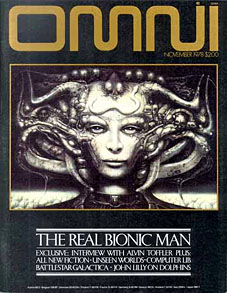
The (low-res) digitisation of the past continues apace on this site which is accumulating cover scans from a host of American sf and fantasy magazines. Oddly enough, I’d been looking for a place with pictures of the early Omni covers just recently, but this site didn’t come up on Google, or if it did, I missed it. I bought most of the first year’s run of Omni so it’s interesting seeing which covers I remember and which I’d forgotten about. Now, where is there a site with a complete run of New Worlds covers? Link via Strange Attractor.
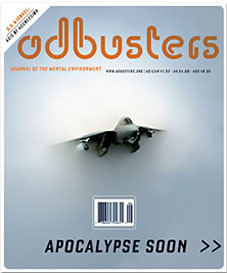
And an item of contemporary magazine news:
Jonathan Barnbrook designs the latest issue of Adbusters.
Previously on { feuilleton }
• A few thousand science fiction covers
• Vintage magazine art II
• Neville Brody and Fetish Records
• View: The Modern Magazine
• Vintage magazine art
• Oz magazine, 1967–73
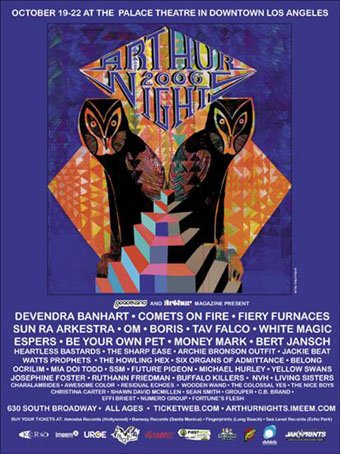
Arthur Nights in LA this weekend—wish I was there. Last year’s Arthur Fest was one of the best music events I’ve been to.