Needful Things

needful1.jpg

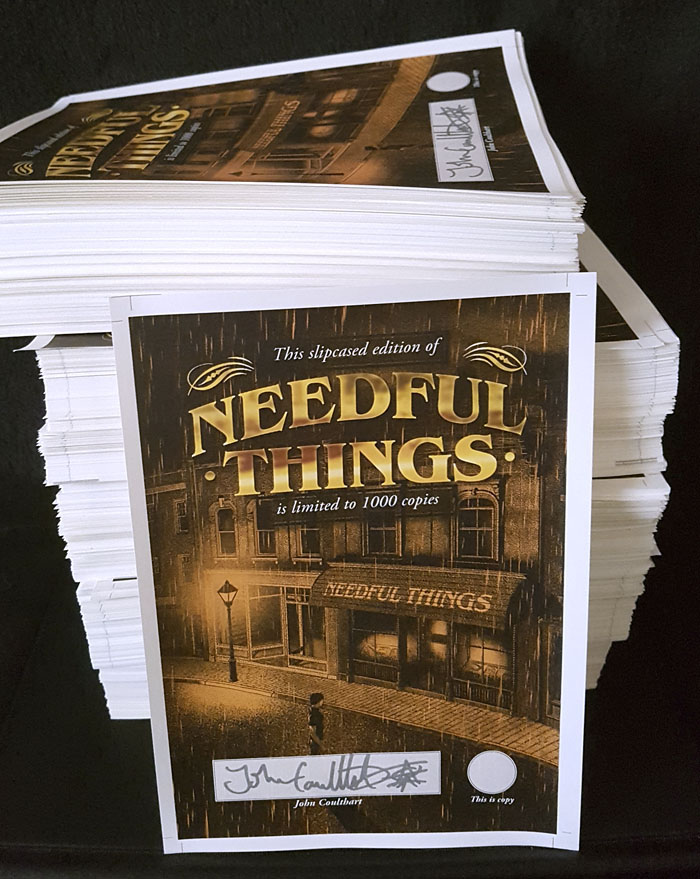
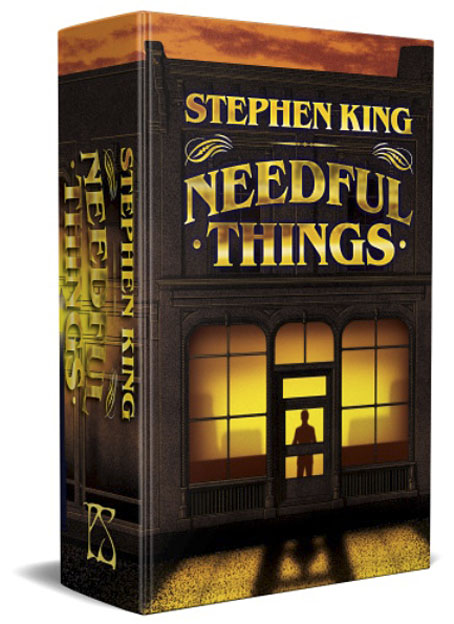
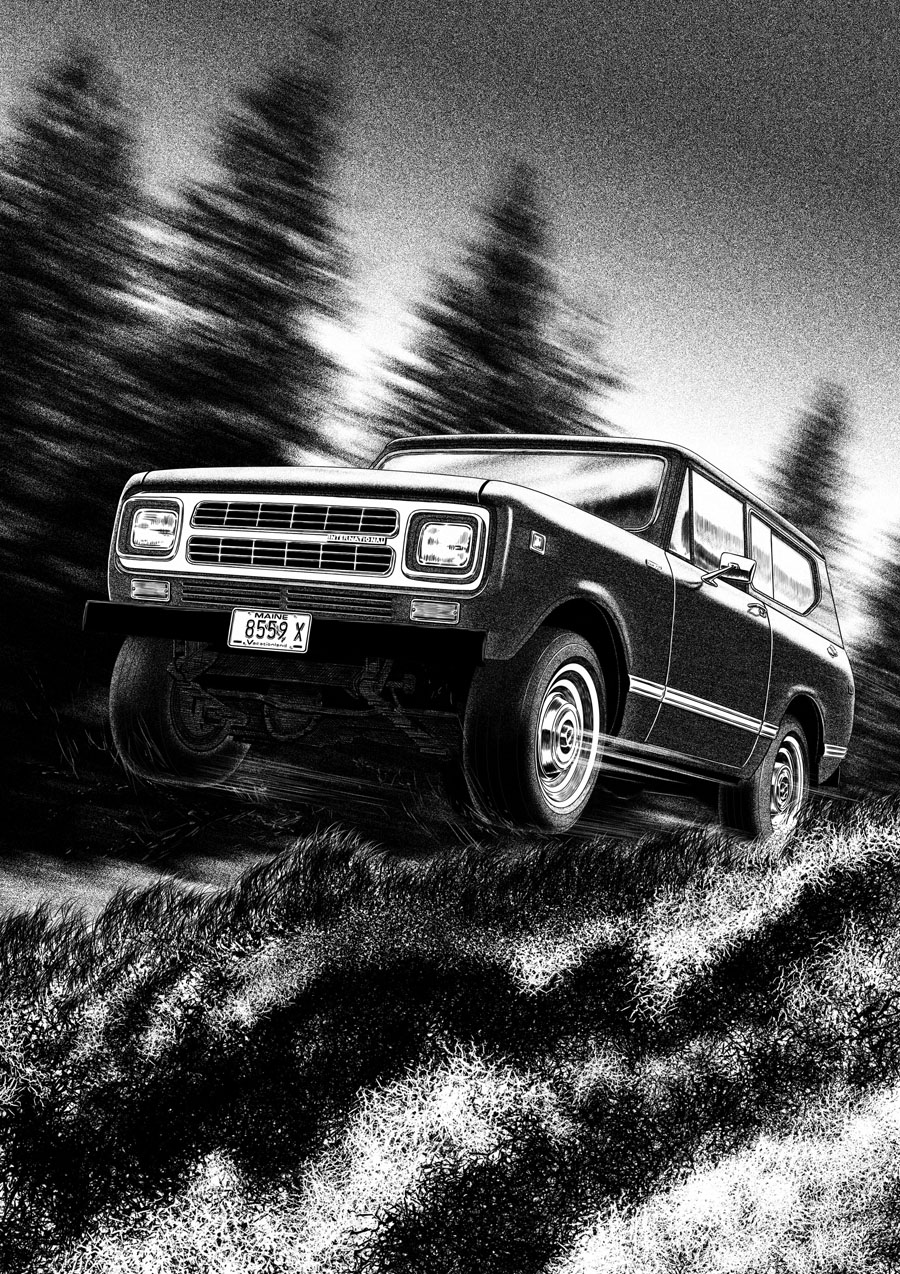
This is the first time I’ve mentioned this doorstop volume but it won’t be the last. I’ll be writing at greater length about last year’s heavy-duty illustration project once the book is in print. Needful Things is the latest in an ongoing series of reprints of Stephen King books from PS Publishing, each volume being limited to 1000 cased, hardback copies. Each book showcases the work of a different illustrator who also signs a tipped-in bookplate. There’s a thriving international market for deluxe reprints of King’s books so these things always sell out fast. This post serves as an alert to let interested purchasers know that the pre-ordering queue will open on the publisher’s website this Friday.

needful2.jpg

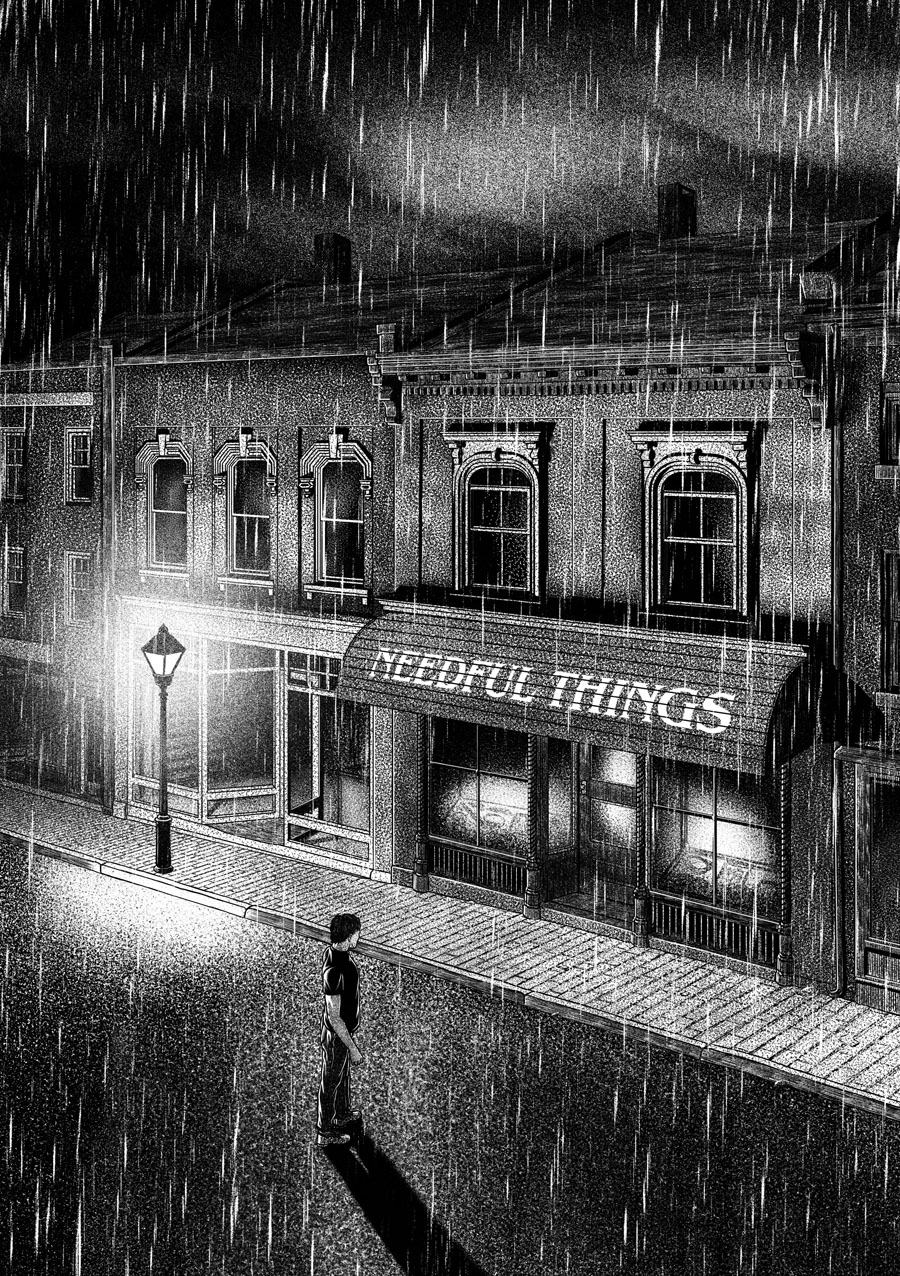
It was just over a year ago when PS asked if I’d like to illustrate Needful Things. I agreed with some trepidation, having already started work on another major illustration/design project (still in progress). The request from PS was for a cover design and 30 full-page interior illustrations; that’s only a little more than the amount of work I had to do when illustrating Dracula a couple of years ago, but those illustrations were mostly digital collages which took two or three days each to complete. A full-page drawing with this level of accuracy and detail takes me the best part of a week so I could see nine months of frantic plate-spinning ahead. Everything worked out, anyway, and I’m very pleased with the end results. So is Stephen King, which is good to know.

needful3.jpg

I’m afraid I don’t have price details for this one but the PS edition of Cujo was priced at £90. Anyone wanting to join the pre-order stampede is advised to first join the publisher’s mailing list. The most recent PS mail has some additional information about the ordering process. I’ll write a little more about the illustrations once the dust has settled.

Previously on { feuilleton }
Long Live the New Flesh: The Films of David Cronenberg
Berni Wrightson in The Mist

Pavonine pattern play

pattern1.jpg

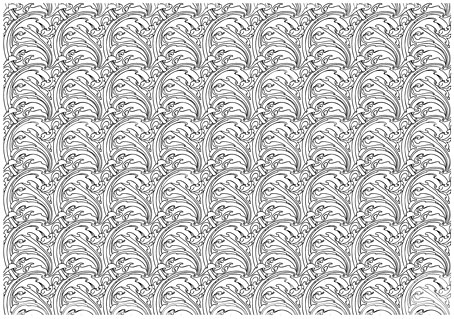
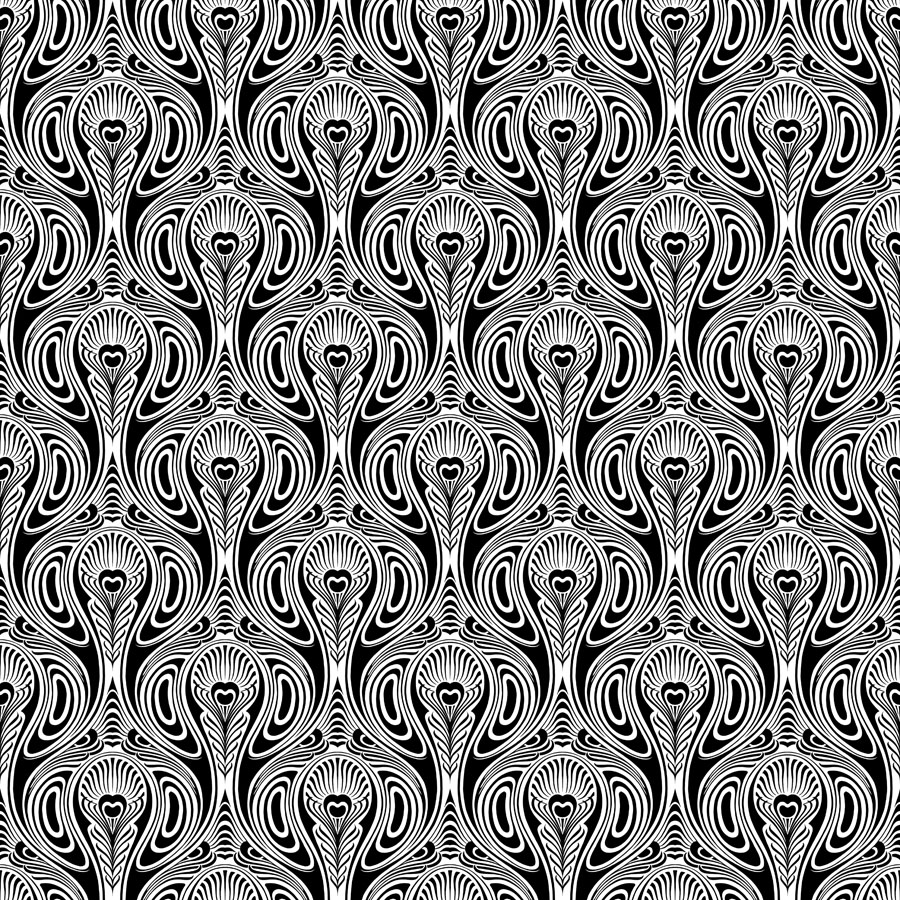
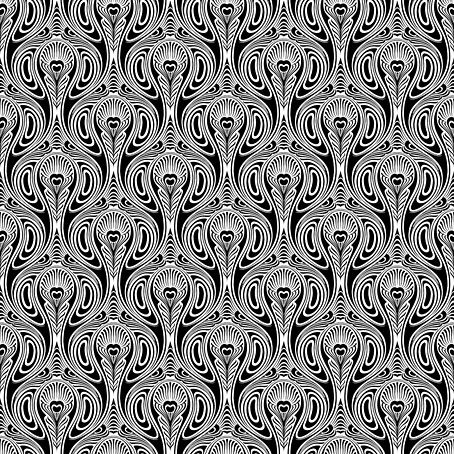
One of the projects I’ve been working on recently contains a large quantity of Art Nouveau design. I can’t discuss this any further for the usual embargo reasons, but I can show off this pattern which has been generated as a by-product of the main work. This is one of those fin-de-siècle designs that looks like it might have originated in the 1960s, a decade which saw a revival of interest in Art Nouveau graphics. Those sinuous lines would work well on a psychedelic poster, and there’s even a touch of Op art in the melting ovals that separate the peacock feathers.
pattern7.jpg

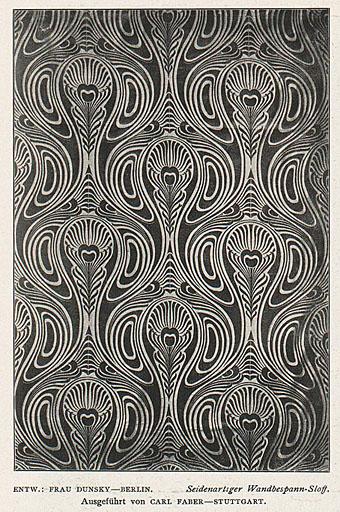
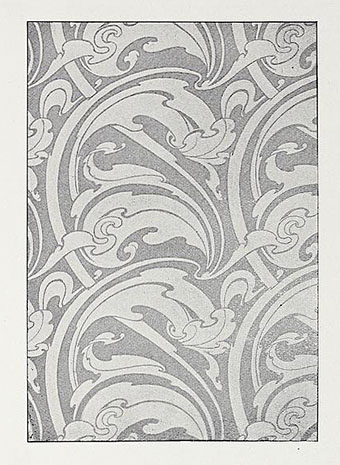
But this isn’t a design from 1970, it actually dates from 1900, the source being a small wallpaper sample that I spotted some years ago in issue 7 of Deutsche Kunst und Dekoration. “Frau Dunsky, Berlin” is named as the designer although there’s no further information about her design in the text. After seeing this I thought I’d have a go at copying the pattern in order to create a digital version but I soon gave up when it became apparent that too much work was required to convert the indistinct image into a sharp outline. I didn’t have a graphics tablet at the time, and my printer had broken down, so the only way to draw an outline was the hard way, using a mouse pointer.
pattern2.jpg

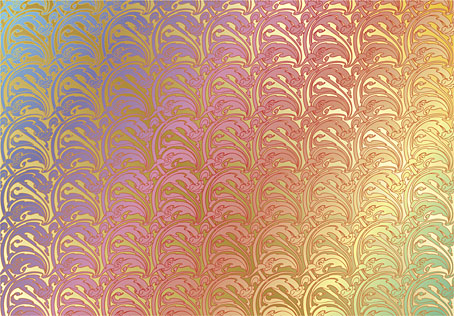
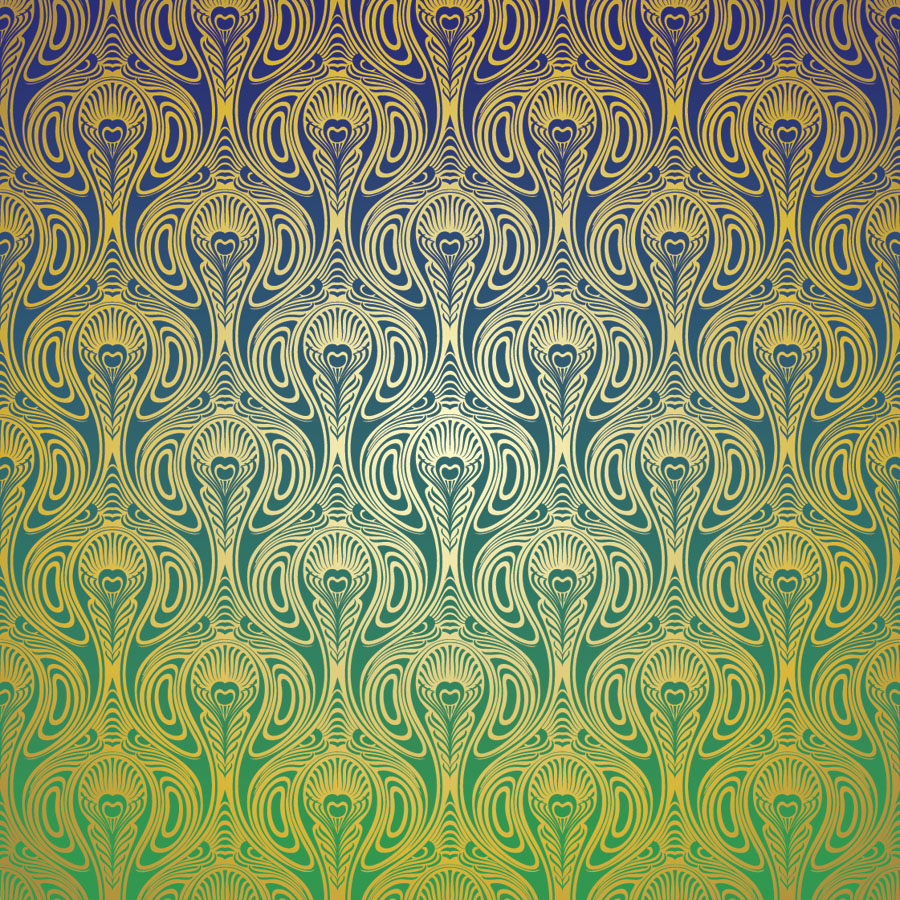
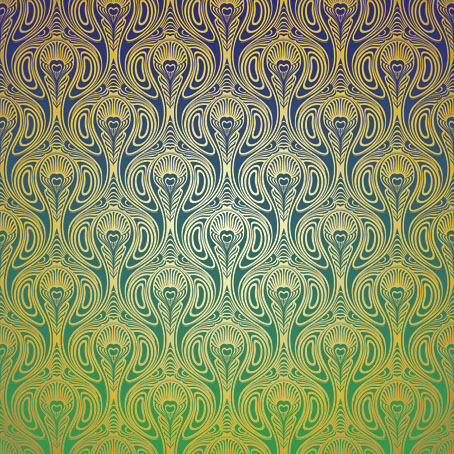
Vectorised and coloured.

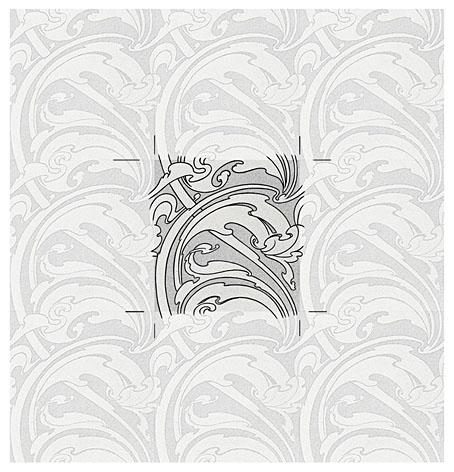
A few days ago I pulled out the copy I’d been working on and, since I now have a graphics tablet, decided to try again. Even though creating the outline was easier this time I still wasn’t sure whether a repeatable pattern would be possible. The magazine sample is slightly warped, and the repeated elements don’t match exactly when overlaid, but I was able to compensate for the flaws with some stretching and redrawing in Photoshop. It’s very satisfying getting something like this to work, even more so when it’s a 120-year-old design that you’ve managed to resurrect. I also feel a little familial continuity with this kind of pattern making. My mother worked as a textile designer for a few years in the 1950s, although she never worked on anything like this, the designs produced by her studio were generally chintz-like floral patterns.
pattern3.jpg

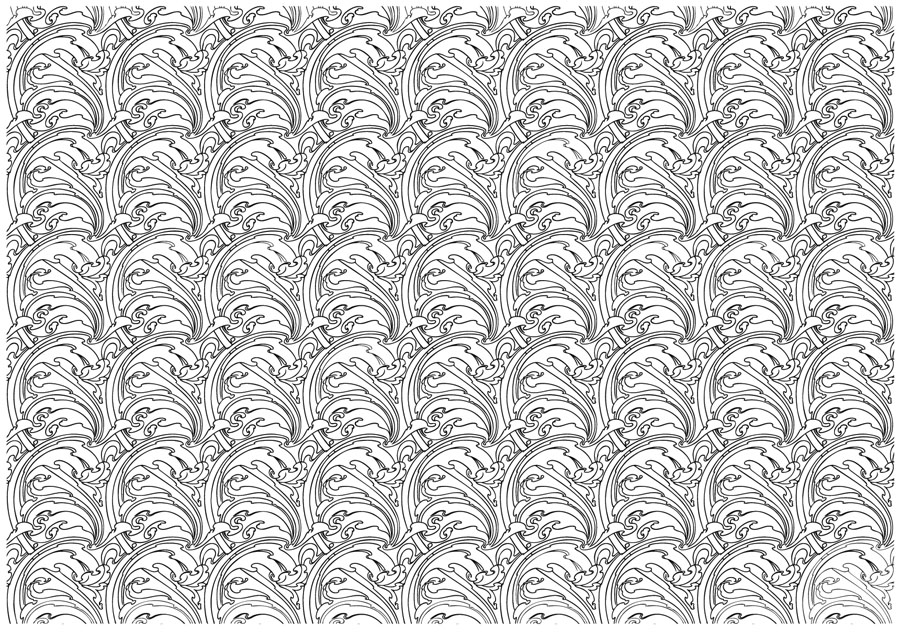
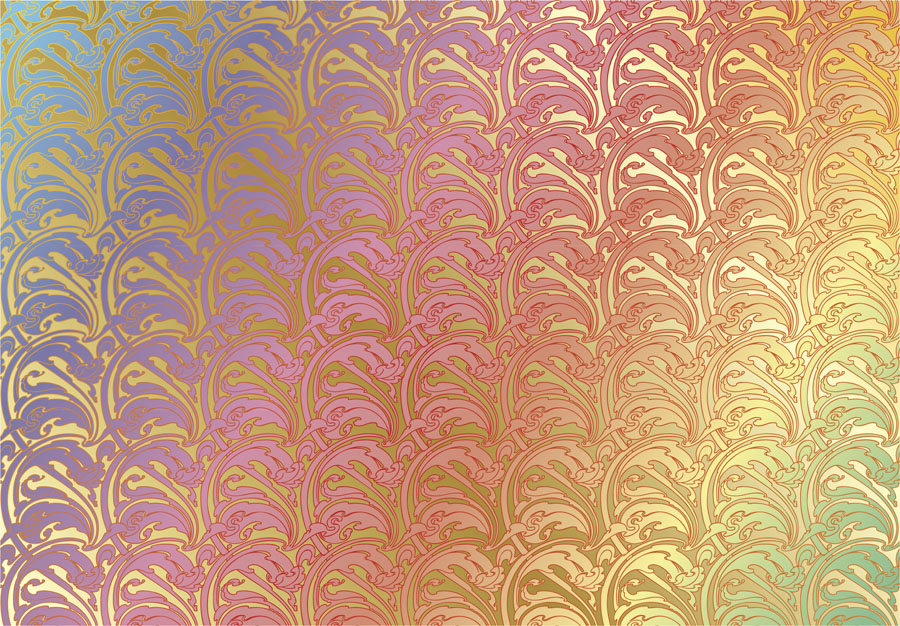
Prior to redrawing the peacock design I’d resurrected another wallpaper design from the same period. This is one of several examples by a French designer, André Morisset, that appeared in issue 15 of L’Art Decoratif. Monsieur Morisset’s design was easier to work into a digital version, being a better reproduction, while the design itself is a square that tiles vertically and horizontally so it’s easier to build into a pattern.
pattern4.jpg

Drawing the outline.

pattern5.jpg

A tessellated tiff.

pattern6.jpg

A coloured vector version.

I’ll be doing a few more things like this when I get the chance. I’m not sure yet whether they’ll find a place in the things I’m working on, but once you have a satisfactory vector outline you can file the art away until you need it later.

Previously on { feuilleton }
Louis Rhead’s peacocks
Peacocks
Rene Beauclair
Whistler’s Peacock Room
Beardsley’s Salomé

Splendid Suns

suns.jpg

I answered a few interview questions recently for Shunga Gallery, a site concerned with the erotic side of Japanese prints, and with contemporary practitioners who work in a similar areas. (All NSFW, needless to say.) I’m not really an erotic artist but Marijn has selected a few examples of my artwork that contain prominent erections, going back to the badly-proportioned drawing of the Great God Pan that I did in 1986 for my late friend, Ed, when he was part of a Dutch music & performance group, Abrahadabra. The drawing appeared in the zine of the same name, and later provoked mild disapproval from the organisers of a video festival in Den Haag where Ed and friends were using it as a flyer to promote their activities. Also at Shunga Gallery are a few pages from the rebarbative Reverbstorm, a book that’s the darkest and nastiest thing I’ll ever do. Some of that artwork provoked a rather more serious form of disapproval, as I explain in the interview.

Continue reading “Splendid Suns”

Old Marvel versus Sherlock Holmes

oldmarvel4.jpg

Arriving in the post this week, one of the books whose covers I was creating late last year. Work-wise, the past year has been busier than usual which means I’ve fallen behind with the logging of recent commissions. In the past few months I’ve created several album designs, more book covers, an entire book design (cover plus interior), and also been working on two bigger projects at the same time. Things have calmed down a little now so updates will be forthcoming.

oldmarvel1.jpg

Old Marvel: The Scientific Detective is another design for Mark Williams’ Dark Lantern Tales imprint which once again resurrects a forgotten detective from pulp obscurity, and in a larger format than before. The new volume is significant for presenting a Sherlock Holmes-like character—credited to the pseudonymous “Grip”—who predates Holmes’ first appearance by three years, thereby suggesting a possible inspiration for Arthur Conan Doyle. Holmes collector Joe Rainone provides the details of publication and sets out the available evidence in an informative foreword. The Old Marvel character not only pre-empts Holmes by using his scientific knowledge to solve mysteries but he also pre-empts subsequent generations of spies and investigators with the various gadgets he uses, including what may be the first fictional deployment of an Edison voice recorder. My brief for the cover was to combine the illustration of the character with a vignette showing a shipping disaster from the story plus some of the contents of the detective’s tool kit.

oldmarvel2.jpg

The book is actually two stories in one volume, with the second half being a reprint of the very first Sherlock Holmes novel, A Study in Scarlet. Both stories are presented as semi-facsimiles of their original US printings, together with reproductions of title pages and so on. The Holmes story is reproduced from its appearance in The Illustrated Home Guest in 1892, and includes rare illustrations one of which appears on the cover. Doyle’s first Holmes novel is the most controversial of all his stories—at least if you’re a Mormon—since this is the one where the inhabitants of Salt Lake City are depicted as a murderous religious cult. I filled out the cover with panels showing the two main story locations: a view of London via Ludgate Circus and a canyon in Utah. Finding a period engraving of St Paul’s Cathedral that remained visually interesting when narrowed down in this way took some time.

oldmarvel3.jpg

Previously on { feuilleton }
More detectives
The Joe Phenix Detective Series
Illustrating Sherlock Holmes

Das Letzte Ritual

letzte.jpg

Arriving in the post this week, the German edition of The Last Ritual by SA Sidor, a novel with one of the Art Deco-styled cover designs that I’ve been producing recently for Aconyte Books. This isn’t the first example of my artwork being published in Germany—the Magic: The Gathering cards I was painting in the 1990s were sold in many different countries with translated captions and credits—but I think it’s my first German book cover. If that statement sounds unnecessarily vague it’s because things can sometimes be published or reprinted in other countries without anyone telling you about them, especially if a large company is behind the production.

Anyway, my congratulations to Mr Sidor on having his book translated by Cross Cult. There’s also an audio version of this one available. Meanwhile, I’ve just finished another cover for the Arkham Horror series but I can’t show it yet until the title has been announced. More on that later.

Previously on { feuilleton }
The Devourer Below
Litany of Dreams
The Last Ritual