Jack of Jumps

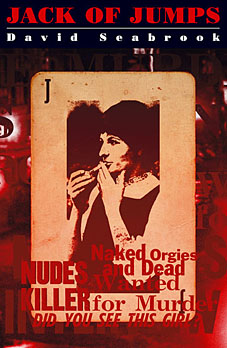
jack.jpgDavid Seabrook’s fascinating true crime investigation was published in May by Granta sporting a cover design by yours truly. The Guardian finally managed to review the book this weekend.

Tart visions
Chris Petit shadows David Seabrook as he trails a serial killer through the streets of sixties London in Jack of Jumps

Chris Petit
Saturday August 26, 2006
The Guardian

Jack of Jumps
by David Seabrook
370pp, Granta, £18.99
Between 1959 and 1965 eight prostitutes were murdered in London by a killer who became known as Jack the Stripper because of his habit of dumping the victims’ bodies naked. The murderer was never found. David Seabrook picks up the story in a manic, exhaustive trawl, via old police files, through a fragmented underworld defined by drink, soliciting, unwanted children and bad dentistry. He sifts his evidence with the zeal of a demented anthropologist, taking us back into a pre-decimal world where he notes a weekly disability pension of £2 8s 8d, against a cost of thirty bob for full sexual intercourse (three quid down in Curzon Street). It was a world caught on the cusp between postwar recession, stasis and a dying moral code, and the colour, mobility and licence of the 60s.

The case remains unsolved, despite Seabrook’s best efforts, but that hardly matters when his real subject is metropolitan jetsam and the kind of desperate lives that usually go unnoticed for want of a chronicler. While his category is true crime, his implicit references are to fiction and film, to an imaginative landscape variously represented by the drinking culture of Patrick Hamilton’s lowlife novels and the Notting Hill of the film Performance. Seabrook transforms the stale material of hundreds of “as-told-to” accounts into an act of epic retrieval, full of arcane cross-referencing. Implicit in his argument is a city haunted as much by a lost popular culture as by its missing souls.

Seabrook’s previous book, All the Devils Are Here, contained a memorable cameo of Freddie Mills, who resurfaces in Jack of Jumps. The former boxer ran a Chinese restaurant in Soho and in the early days of television was a popular light entertainer, distinguished by a dopey grin, amiable mugging and a dubious line in knitwear. In 1965 he apparently shot himself in his car in an alley off the Charing Cross Road. Seabrook fails to find anything to support the most scandalous rumour surrounding Mills’s death, that he was the murderer of those prostitutes and had topped himself in a fit of remorse, upon which the murders stopped.

Other theories remain equally elusive: that the victims, all of short stature, were choked during fellatio; that a copper was the killer because the locations where the bodies were dumped suggested someone who knew police divisional boundaries; that the killer had attended the Earl’s Court Motor Show. With greater car ownership, private vehicles played an increasing role in soliciting. Seabrook taps away at the darker recesses of the metropolitan mind, relishing the fact that his subject is so heroically unglamorous. Jack of Jumps is contemporaneous with the Profumo affair, but there are no good-time girls in this account, just lives of hard grind. At its most optimistic, it is a story of coming affluence: as the manhunt intensifies, the police earn a fortune in overtime, something that would have been inconceivable only a few years before.

Seabrook is a tart observer and knows that his obsession borders on the pointless: gumshoe as mug, retreading a worn-down past, chasing ghosts through a litany of pubs and their vanished clienteles, searching for the forgotten, luminous detail (“On this occasion she bought a bottle of Lovibond’s Vat 30 whisky”). Seabrook’s crazed A-Z of the city turns him into a low-life Borges, charting the impenetrable riddles of human behaviour, in a London that feels as foreign and surreal and as remote as Buenos Aires.

Previously on { feuilleton }
New work out this month
Borges in Performance

Web updates

I thought it was about time I made a new section for the site detailing some of my published (and unpublished) writings to date. The new section, { lexiphania }, lists non-fiction for the most part (Printer’s Evil is the exception), some of which has been added to the Writings section of { feuilleton }.

Hail, horrors! hail, infernal world!

horror.jpg

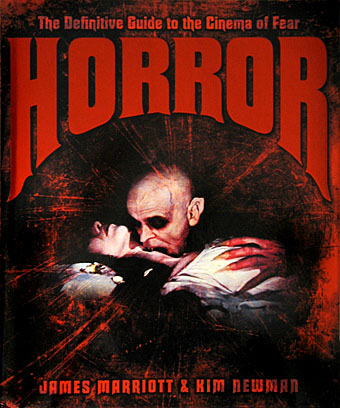
This marvellously lurid 250pp tome turned up in the post today, something I was looking forward to seeing as I wrote 30 of the reviews within, as well as some longer essays on Dracula, Lovecraft and a brief history of occult cinema. Nice layout, lots of colour and some great photos, many of which I haven’t seen elsewhere which isn’t always the case with books like this; I’ll enjoy reading the rest of it. Not sure when it’s due for publication just yet as Andre Deutsch/Carlton Books’ web presence is sketchy to say the least.

Update: The book was published on October 2nd, 2006.

Previously on { feuilleton }
The music of The Wicker Man
Nosferatu
David Rudkin on Carl Dreyer’s Vampyr

New things for August

kabbalah.jpg

A couple of updates to the site this month. Firstly there’s another interview with Eroom Nala focussing on life, art and (inevitably) my forthcoming Haunter of the Dark book.

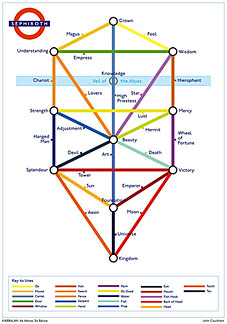
And I’ve finally got round to expanding the line of CafePress products (T-shirts and a larger poster print) for my Kabbalah poster which seems to be my most popular work judging by sales there. This surprises me seeing as it was done on a whim in 2000 after a visit to London. Alan Moore later used it in an issue of Promethea but I don’t know whether the people interested in it are Promethea fans or some of the new breed of Kabbalists.

I’ll be adding more products for other lines, and some new things, as time permits over the next few weeks.

Update: CafePress have decided that my artwork may need “copyright clearance”. So don’t bother trying to buy anything just yet.

Update 2: CafePress tell me that “Transport for London provided us with a notice stating that the use of the London Underground Roundel infringes upon their intellectual property rights”. I presume this means now I’ll have to amend the artwork to remove the offending article. Copyright hell: it’s the wave of the future. Get used to it. See this Boing Boing post for a good example of London Transport’s dead hand.

Update 3: Products reworked with slightly amended artwork although for some reason the page is still showing the old items.

Le horreur cosmique

hpllibrio.jpgI’ll be in Paris this week so some French-related postings are in order.

Michel Houellebecq’s HP Lovecraft: Against the World, Against Life (which I still haven’t read) has been in the news again recently, with a number of reviews appearing in UK newspapers and magazines, most of which present the by-now rather tired spectacle of reviewers who normally wouldn’t give any of this nasty pulp stuff a second thought having to take Lovecraft seriously because Houellebecq is a serious author. (“He’s a bad writer!” they bleat. And Lou Reed is a bad singer; you’re missing the point, you fools.) The Observer last week had one of the better ones. Last year the Guardian published an extract from Houellebecq’s book.

Curious how often it requires the French to make the Anglophone world look anew at marginalised elements of its own culture; Baudelaire championed Edgar Allan Poe, it was French film critics who gave us the term “film noir” when they identified a new strain of American cinema and the Nouvelle Vague writers and filmmakers were the first to treat Hitchcock as anything other than a superior entertainer. The French have always liked Lovecraft so it was no surprise to me at least when Houellebecq’s book appeared.

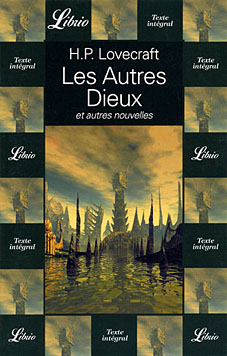
Oddly enough, the only association I’ve had so far with French publishing is the use of my 1999 picture of Cthulhu’s city, R’lyeh, on the cover of a reprint of HPL stories from Houellebecq’s publishing house (above). Something I’ll be looking for in Paris if I have the time will be more of Philippe Druillet‘s Lovecraft-inflected work. Druillet has been working with the imagery of cosmic horror since the late 60s and even illustrated the work of William Hope Hodgson, one of HPL’s influences and an English writer the broadsheet critics have yet to hear about. Take a look at these pictures for stories written before the First World War then go and look at some stills from the latest Pirates of the Caribbean movie. What was once the preserve of Weird Tales and other pulp magazines is now mainstream culture.

Previously on { feuilleton }
Davy Jones
Charles Méryon’s Paris