Art on film: The Beast

beast1.jpg

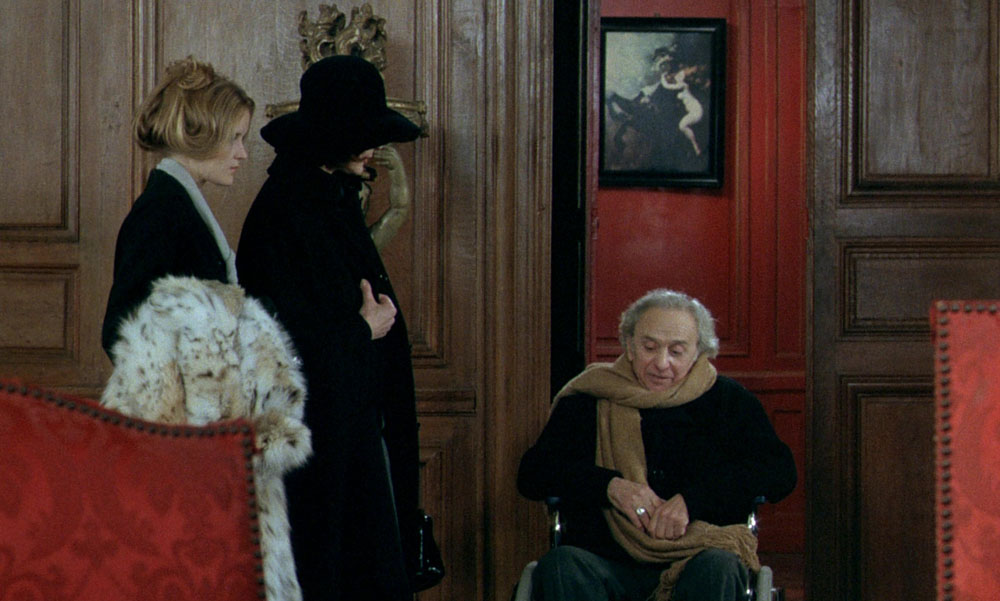
The Beast: Lisbeth Hummel, Elisabeth Kaza and Marcel Dalio.

In which Polish director Walerian Borowczyk places a little-known Symbolist painting in the background of The Beast, his strange sex film (or should that be strange-sex film?) from 1975. I’ve spent the past week or so working my way through Arrow’s box of Borowczyk films, of which The Beast is the last in the collection. It’s also the one film by the director that many people may be aware of even if they’ve never seen it, thanks to a historical reverie in which an 18th-century woman has a very graphic sexual encounter with the beast of the title, a bear-like creature with a fully-functioning phallus. This episode is framed by a somewhat farcical modern-day story set in a French chateau, with the bestiality flashback being the culmination of a parade of sexual antics that include equally graphic scenes of horse-breeding, female masturbation, and thwarted attempts by the daughter of the house to have sex with one of the servants.

frenzy.jpg

Frenzy aka Frenzy of Exultations (1893).

And this is the painting that Borowczyk shows. I said that it’s little-known but it happens to be the most visible of all the paintings by Polish artist Władysław Podkowiński (1866–1895), with a popularity in Poland that extends to reproduction on postcards and jigsaw puzzles. (That huge area of shadow must cause puzzle-solvers some headaches.) I only recognised the picture because Michael Gibson includes it in his wide-ranging study of Symbolist art, although he doesn’t have much to say about it apart from its having caused a minor scandal when it was first exhibited. This isn’t too surprising; prior to the 20th century there were few Western artworks that were so overt in their depiction of erotic delirium without tipping into outright pornography. Given this you’d expect Borowczyk to make more of the reference but he keeps the picture in the background, a reward for the small percentage of the audience who can identify the thing at a distance.

Frenzy is dramatically different to Podkowiński’s other paintings, most of which are Impressionist studies, and is further distinguished by having been attacked by its creator when the artist slashed the canvas with a knife while it was still being exhibited. Paintings and sculptures have been subject to attacks by members of the public for many years but this is the first I’ve heard of an artist attacking their own work while it was on display. The scandalous history suits the film as much as the salacious subject matter; The Beast was almost subject to an obscenity prosecution when an uncensored print was shown in London in the 1970s. For a long time it was one of those troublesome features that you’d be more likely to read about than to see.
Continue reading “Art on film: The Beast”

The art of John Duncan, 1866–1945

duncan09.jpg

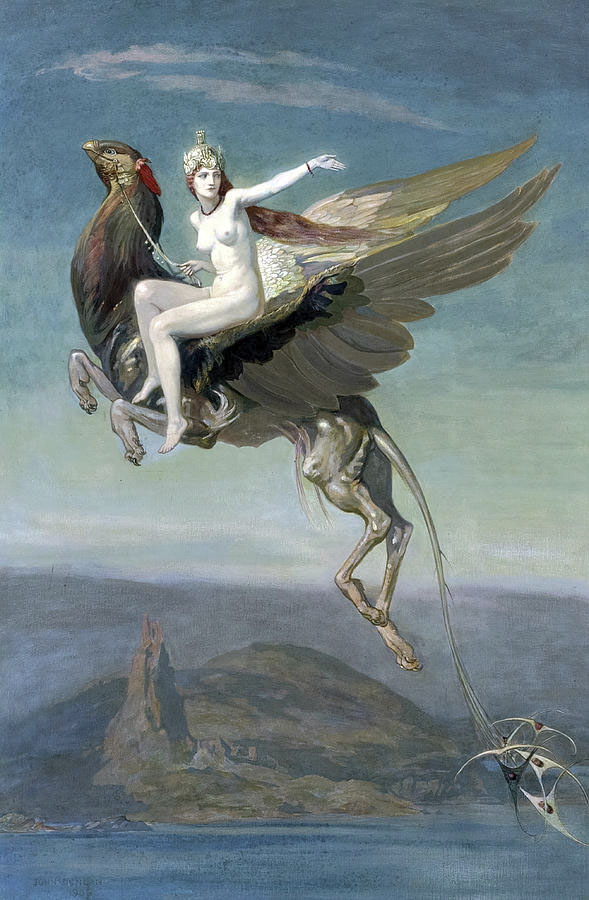
Heptu Bidding Farewell to the City of Obb (1909). Another of those paintings that provide a link between 19th-century art and 20th-century fantasy illustration.

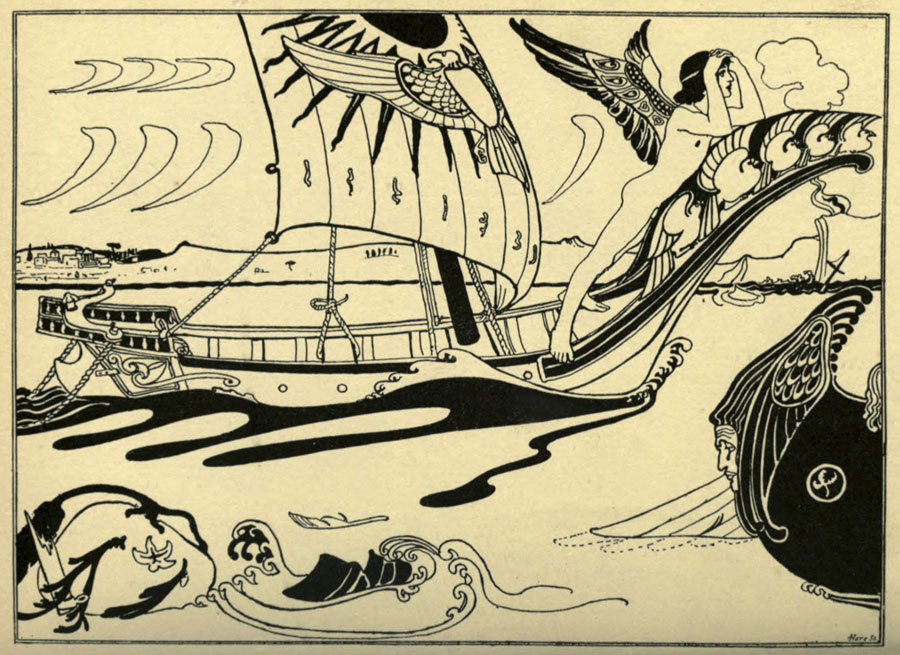
Scotland isn’t a nation commonly associated with Symbolist painting, or with what The Studio magazine called “mystic subjects” when writing about John Duncan’s painting of Heptu on her hippogriff. There were a handful of Scottish artists in the late 1800s whose work suits the description, mostly the members of the Glasgow School, although some of these would be considered marginal cases compared to their Continental contemporaries. In the Anglophone countries Symbolist art is so thin on the ground that Michael Gibson in Symbolism (1995) puts Great Britain and the United States into a single chapter, and even there many of the artists he highlights—people such as Thomas Cole and the Pre-Raphaelites—are more like precursors, being too early to be considered an active part of a movement that only established itself in the 1880s.

duncan08.jpg

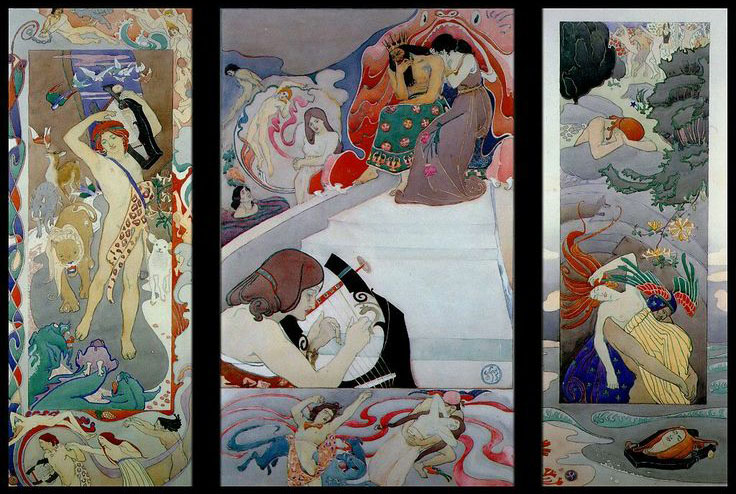
The Legend of Orpheus (1895).

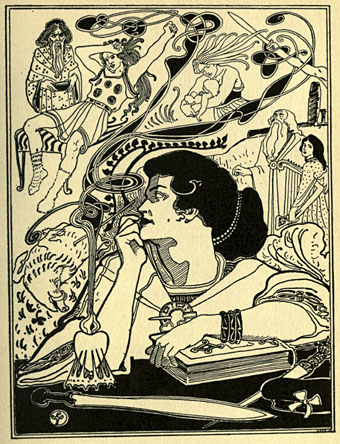
John Duncan does fit the bill, however, more so than I would have expected until I started looking at his paintings. Duncan’s career oscillated between Dundee and Edinburgh so he avoided the Arts and Crafts tendencies of the Glasgow School. His work is closer to French artists like Alexandre Séon, especially in the sculptural treatment of his figures. Familiar subjects and motifs abound: the riddle of the Sphinx, peacocks, Wagner, sorcery, and a variety of myths and legends, from Scotland to ancient Greece. The ink drawings here are from The Evergreen, A Northern Seasonal, a small art and literature magazine published in Edinburgh that managed four issues from 1895 to 1896. In Duncan’s later work he avoided the upheavals of Modernism by keeping to safe religious subjects. If the date is accurate for that Sphinx it must have seemed very old-fashioned in 1934.

duncan11.jpg

Out-Faring (1895).

duncan12.jpg

Anima Celtica (1895).

duncan04.jpg

A Sorceress (1898).

Continue reading “The art of John Duncan, 1866–1945”

Félicien Rops et Son Oeuvre

rops01.jpg

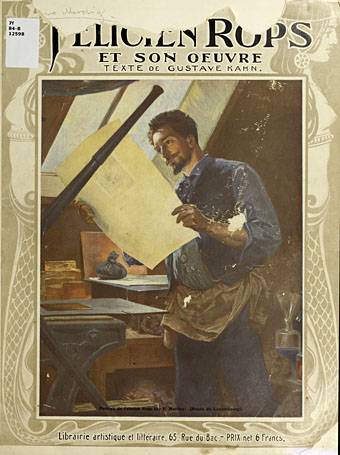
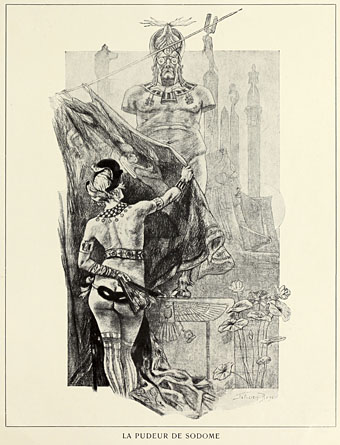
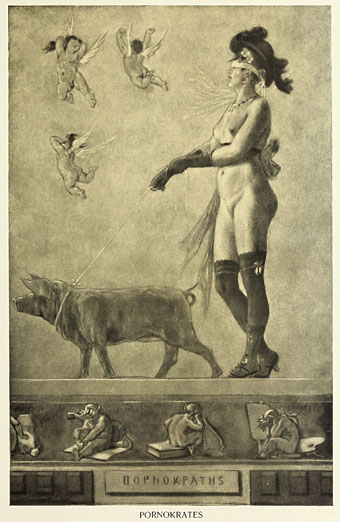
More Belgian Symbolism of a kind, although it’s debatable the degree to which Félicien Rops should be regarded as a Symbolist even though his work is generally listed as such. Decadent, certainly, and he did touch on popular Symbolist themes such as the temptation of St. Anthony, but only as part of his persistent obsession with that very fin-de-siècle icon, the Bad Woman. In Rops’ work this manifests as a succession of hollow-eyed femmes damnées—erotomanes, seducers and addicts—all of whom resemble each other.

rops02.jpg

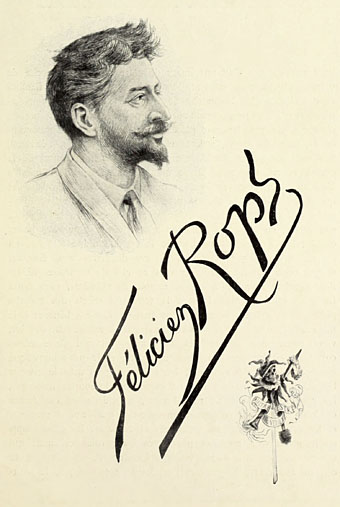
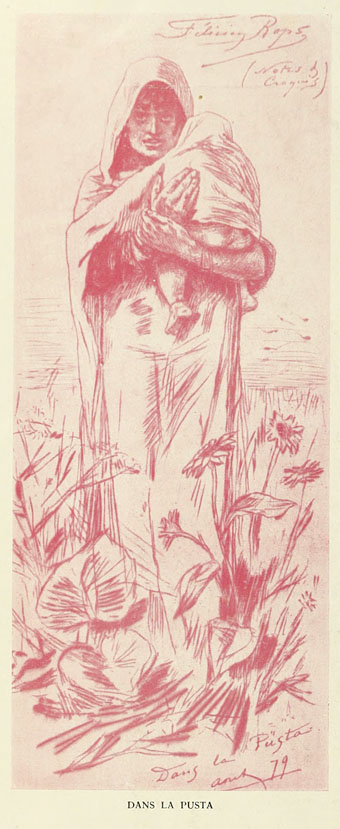
Félicien Rops et Son Oeuvre (1900) is a short monograph by Gustave Kahn which is is mostly of interest for the self-portraits and minor pieces, those drawings and prints that you’d only find now in a comprehensive examination of the artist’s career. In 1900 Rops’ overtly erotic drawings wouldn’t have been available outside private publications whereas today, in a reversal of fortune that might have surprised the artist, these are the works of his that everyone likes to see. The Internet Archive has a later study by Gustave Kahn which includes some of the more erotic pieces seen here, none of which are too explicit but there’s enough that his book might have encountered legal disapproval if anyone had tried to sell a copy in England.

rops05.jpg

rops03.jpg

rops04.jpg

Continue reading “Félicien Rops et Son Oeuvre”

Bruges-la-Morte, 1978

blm1.jpg

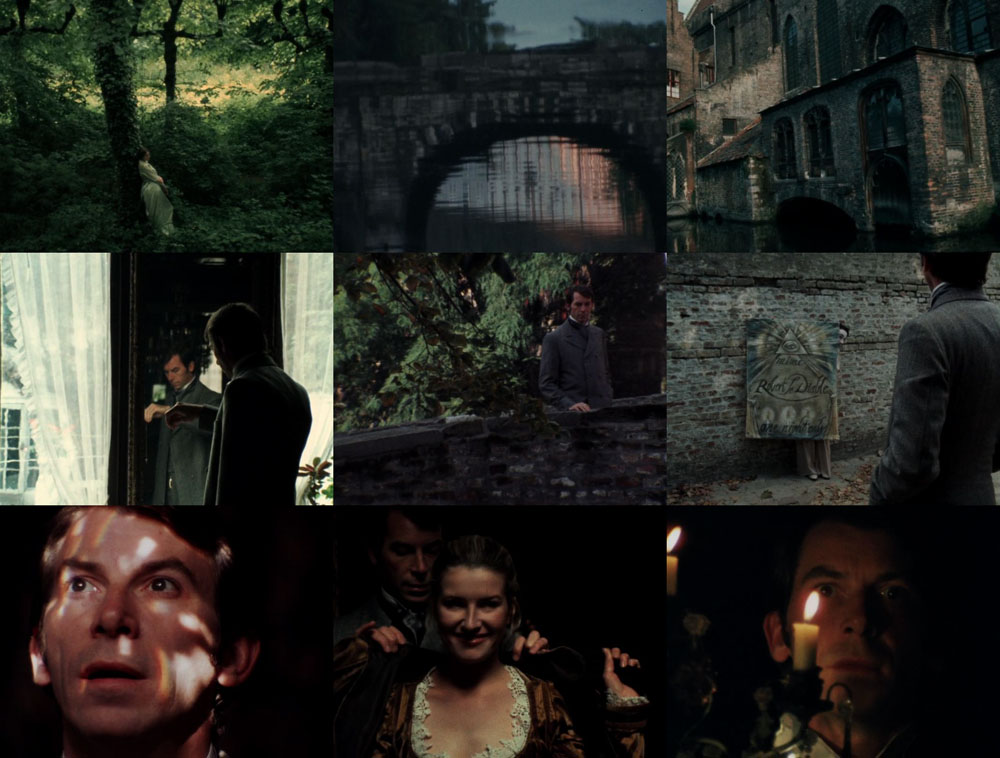
What we have here is a very creditable 67-minute film adaptation of the Symbolist novel by Georges Rodenbach. Ronald Chase directed, co-wrote the screenplay with Pier Luigi Farri, and also photographed the production with a small company of English actors in the city of Bruges. The film has recently been given a high-definition restoration and made available on the director’s Vimeo page. Chase describes his adaptation as a low-budget affair, the footage being originally intended for screening during performances of Die Tode Stadt by Eric Korngold, but it doesn’t come across as cheap or amateurish thanks to a professional cast and authentic locations. Rodenbach’s novel is distinguished by its early use of photographic illustrations, most of which are views of the canals of Bruges. Here we get to see the church steeples and crow-step gables from the viewpoint of a camera drifting along the same swan-filled waterways.

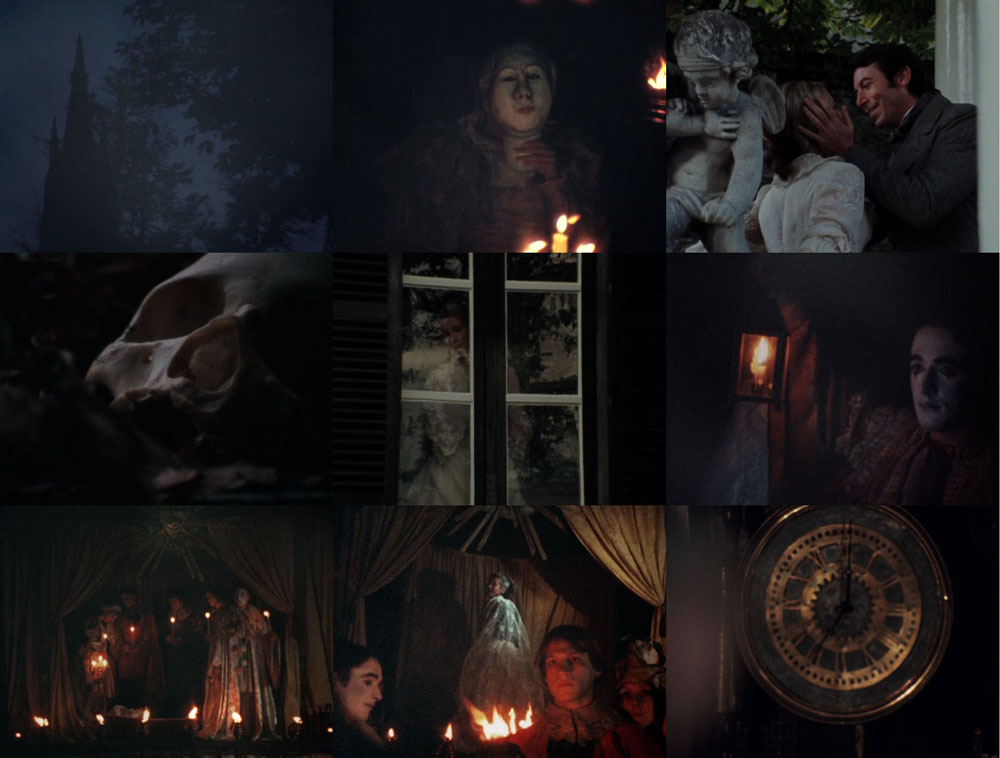
It’s a long time since I read Rodenbach’s novel so I can’t judge this version in any detail although my memories are of a dreamier narrative than the one the film delivers. Chase credits the story as being “suggested” by the novel but the broad outline follows Rodenbach, with a grieving widower (Richard Easton, whose character is unnamed in the film) meeting a dancer (Kristin Milward) who seems to be the double of his recently deceased wife. The dancer works with a troupe of performers who stage a nocturnal masque for the tormented man, an event which fails to alleviate his confusion or his anguish.

blm2.jpg

Chase’s film resembles one of the literary adaptations the BBC used to make throughout 1970s and 80s, modest and serious, and certainly of a quality that it could have been broadcast as a part of the Omnibus arts strand or in a late slot on BBC 2. Among the performers are a Pierrot character played by Anthony Daniels, an actor most people will know for his role as a gold robot in a space opera, and Nickolas Grace, who appeared as Oscar Wilde a decade later in Ken Russell’s Salomé’s Last Dance. There’s a touch of the diabolical Russell (and James Ensor) in the later masque scenes when the performers don papier-mâché masks, and a nun gets chased around a church. The mask-making is credited–very surprisingly–to Winston Tong, an artist and musician best known for his association with Tuxedomoon. I was hoping we might see more of the gloomy canals and equally gloomy architecture but the buildings and bridges that we do see look just as they would have done in Rodenbach’s day. If you want more there’s always the paintings and drawings of Fernand Khopff and Lucien Lévy-Dhurmer, or the photographs in the novel itself.

Previously on { feuilleton }
Bruges in photochrom
Bruges panoramas
Bruges-la-Morte

The art of Pinckney Marcius-Simons, 1867–1909

marcius-simons13.jpg

Vision of the Demon.

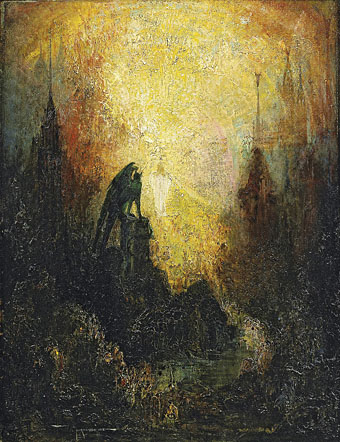
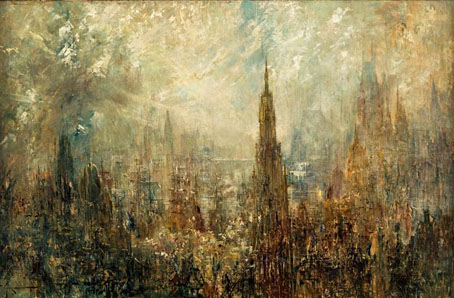
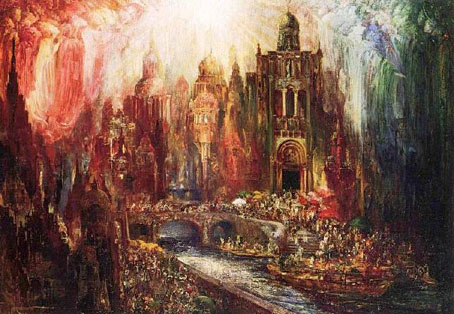
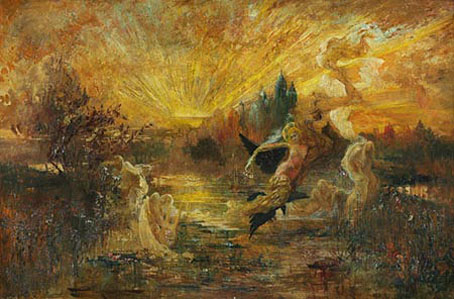
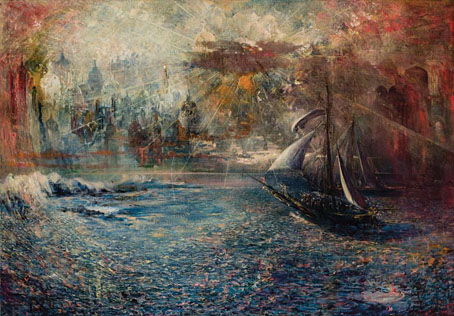
The Symbolist movement in painting never really took hold in America the way it did in Europe so it’s a surprise to find a new name to add to the very small list of American Symbolists. Pinckney Marcius-Simons painted his share of 19th-century genre pictures but these give way in his later career to canvases that show a distinct Gustave Moreau influence, or perhaps Turner in those nebulous volumes of illuminated vapour. Marcius-Simons was born in New York but lived in Europe for most of his life; he studied in Paris so he would have been able to see Moreau’s work first-hand. A few of his later pictures are rather vague fantasies but his real obsession was with Wagner’s operas, and he spent the last few years of his life working as a set designer at Bayreuth while also creating a series of paintings intended to illustrate the entire run of Wagner’s Ring Cycle. His most remarkable creation isn’t a canvas, however, but a French edition of A Midsummer Night’s Dream which he painted over entirely, even decorating the binding. I’m surprised again that such a unique work isn’t more widely known. Happily the entire book is available online at the Folger Shakespeare Library.

All the usual caveats apply here with regard to the accuracy of titles and dates. There’s even some dispute about the artist’s birth year which is occasionally given as 1865. Most of these pictures have been found on auction sites where larger reproductions may be seen.

marcius-simons03.jpg

Port City.

marcius-simons04.jpg

marcius-simons05.jpg

Sunrise.

marcius-simons12.jpg

The City of Dreams.

Continue reading “The art of Pinckney Marcius-Simons, 1867–1909”