Bird Gods

birdgods01.jpg

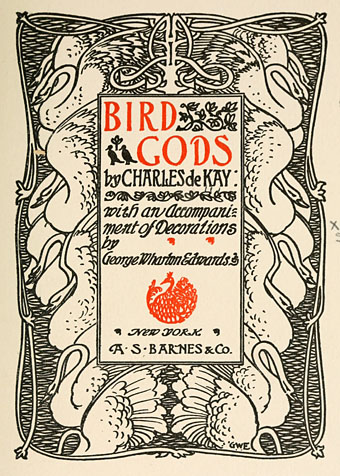
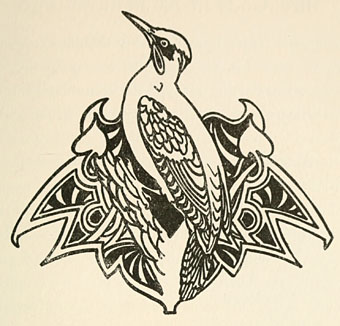
Why, I asked myself, should certain birds have been allotted to certain gods and goddesses in the Greek and Roman mythology? Why should the eagle go with Zeus, the peacock with Hera, the dove with Venus, the swan with Apollo, the woodpecker with Ares, the owl with Pallas Athene? It could not be mere chance that so many gods and goddesses had each their attendant bird; the attribution was too regular; it was done too much on a system. What was the original meaning of it all?

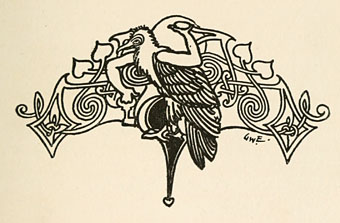
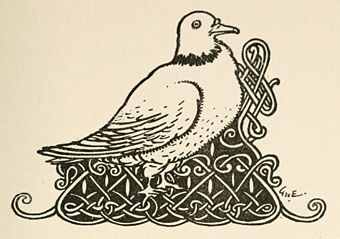
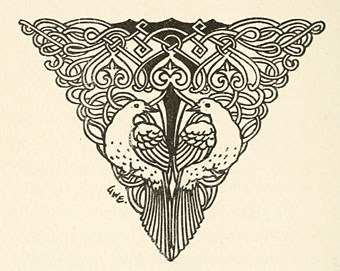
Charles de Kay attempts to answer his question in Bird Gods (1898), a study of the mythological and religious import of birds through the ages. Illustrator George Wharton Edwards was an American artist who worked in the Impressionist style when painting but here deliveries a range of bird portraits embellished with bits of imitation Celtic knotwork. The interlacings of Celtic art underwent a resurgence of interest with the development of Art Nouveau. Edwards’ illustrations aren’t the best examples of this (Mucha’s Hamlet poster is much better) but they give an idea of the trend. Browse the rest of De Kay’s book here or download it here.

birdgods02.jpg

birdgods03.jpg

birdgods04.jpg

birdgods05.jpg

Continue reading “Bird Gods”

The Modern Antiquarian

modern1.jpg

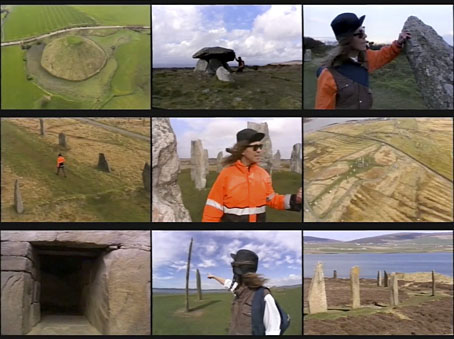
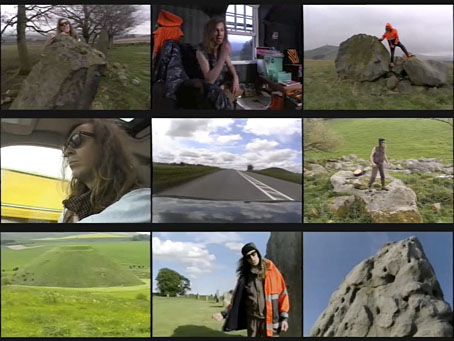
The stones of Callanish are explored again, this time by an energetic and erudite Julian Cope. The Modern Antiquarian was a 55-minute TV documentary produced by the BBC in 2000 as a spin-off from Cope’s book-length study of the ancient past of the British Isles, The Modern Antiquarian: A Pre-Millennial Odyssey Through Megalithic Britain (1998). Cope has always been a great enthusiast, blessed with a talent for communicating that enthusiasm in his own inimitable manner. Needless to say this film, which follows him while he visits some of his favourite neolithic sites, is nothing like the standard television approach to archaeology. Cope isn’t an academic (thank Odin) yet his book is 448-pages of deep investigation which involved visiting every one of the sites he was writing about; he’s also not that other television standby, the shallow audience proxy, he’s too well-informed for that. It would have been good if this one-off film had developed into a series but for its original screening it was shunted into a late-night slot where few people would have seen it. Cope then, as now, is probably too intense for a general audience.

The Modern Antiquarian: part 1 | part 2 | part 3 | part 4 | part 5 | part 6

modern2.jpg

Previously on { feuilleton }
Callanish panoramas
Japrocksampler

Callanish panoramas

callanish1.jpg

Photo by Serge (SEB) Bogdanov.

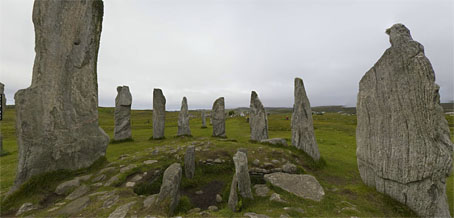
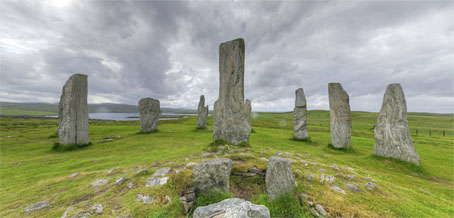
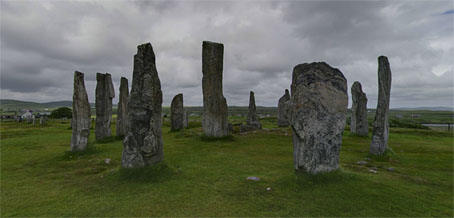
A post for the Summer Solstice. I’ve linked to panoramas of the Callanish standing stones before but these are more recent photos at 360Cities where the full-screen views are more immersive, especially if you have a large monitor. The stones are situated on the Isle of Lewis in north-west Scotland, and still tend to be overshadowed by the reputation of their more visible relations in the south of England. Stonehenge and Avebury may be more famous but they’re ruined cathedrals next to the Callanish stones which have survived four thousand years of harsh Atlantic weather very much intact by virtue of being so remote. In that respect they retain some of their original aura: anyone planning a visit has to really want to see these things, you can’t simply drive past them on the way to somewhere else.

callanish2.jpg

Photo by Alan McLean.

callanish3.jpg

Photo by Alan McLean.

Elsewhere on { feuilleton }
The panoramas archive

Meetings with Remarkable Men

meetings1.jpg

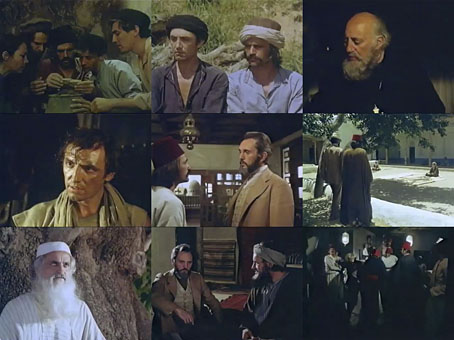
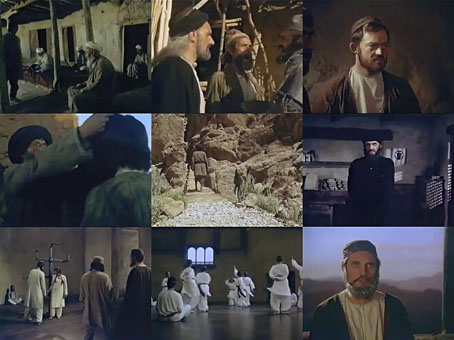
Another Peter Brook film, and a very strange one it is, not for its content but more for the way you wonder how the director managed to get anyone to pay for it, and what kind of audience it was supposed to be aimed at. Meetings with Remarkable Men is a book by GI Gurdjieff which is supposedly an account of the mystic’s early life and youthful questing for truth, although there’s always been debate about how much of it was intended as straight autobiography and how much as symbolic instruction. I’ve known about Brook’s film since it was first released in 1979 but its resolutely uncommercial nature means it never had a wide cinema release, and I’ve never seen it listed for TV screening either.
meetings2.jpg

I’ve not read Gurdjieff’s book but know enough about the man’s life and general philosophies to at least appreciate Brook’s film. Many other viewers would have considerable problems when Brook and screenwriter Jeanne Salzmann make no attempt to elaborate on the details of Gurdjieff’s quest. From youthful worries about life and death, to a search for a secret brotherhood who may have preserved ancient philosophies, the film illustrates scenes in the sketchiest manner: old volumes are bought then discarded; a map is sought then forgotten; gurus are pursued only to be found unsatisfying. For a film about enlightenment it’s surprising to be left so unenlightened. Much of the film was shot on location in Afghanistan shortly before the Soviet invasion, and at times the film seems like a chase from one dusty location to another with little reason or purpose.

The most bizarre feature of all is the cast: Gurdjieff is portrayed by a Serbian actor, Dragan Maksimovic, but many of the other roles provide cameos for an array of British talent, not least Terence Stamp in between appearances as General Zod in the Superman films. Elsewhere there’s Warren Mitchell (!) playing Gurdjieff’s dad, Colin Blakely, Marius Goring, Ian Hogg (who was also in The Marat/Sade), and most surprising of all since I was watching him recently in Quatermass and the Pit, Andrew Keir as the head of the mysterious Sarmoung Monastery. The cast alone helps maintain some interest although at times it’s like one of those all-star features such as Around the World in Eighty Days where you’re wondering who’s going to turn up next. For those whose curiosity is piqued, the entire film is on YouTube.

Previously on { feuilleton }
The Marat/Sade

Ezio Anichini postcards

anichini2.jpg

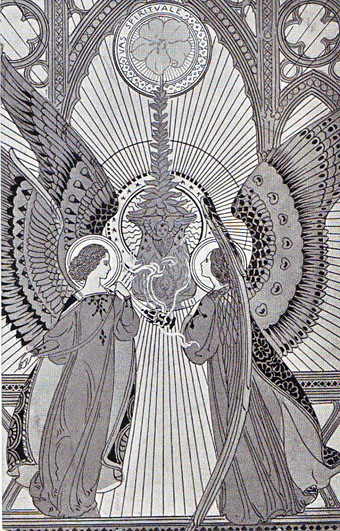
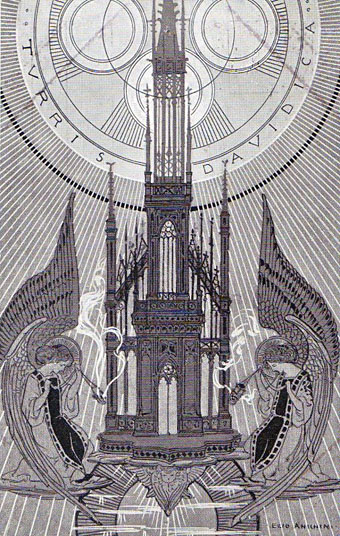
More from Ezio Anichini (1886–1948), the Italian artist responsible for yesterday’s Salomé, these are part of a series of postcards on the theme of sacred music dated from between 1915 to 1920. The precision of these drawings is remarkable. See the (complete?) set here.

anichini3.jpg

Elsewhere on { feuilleton }
The illustrators archive

Previously on { feuilleton }
Ezio Anichini’s Salomé