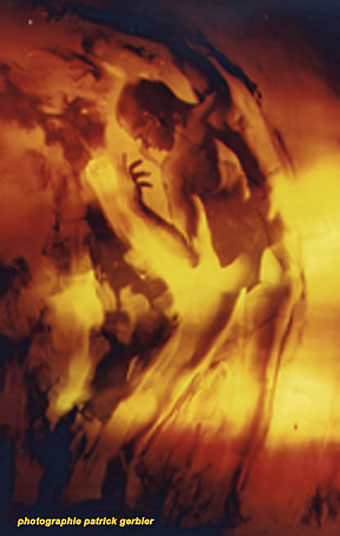
Corps & Graphiques 2 (2004).
Ecstatic homoerotica by Patrick Gerbier.
Elsewhere on { feuilleton }
• The gay artists archive
A journal by artist and designer John Coulthart.

Photography
Corps & Graphiques 2 (2004).
Ecstatic homoerotica by Patrick Gerbier.
Elsewhere on { feuilleton }
• The gay artists archive

Haven’t had one of these for a while. Artist and photographer Diego Lago has this version of the Flandrin pose on his Flickr pages. He also seems to have used it as a model for this painting.
Elsewhere on { feuilleton }
• The recurrent pose archive
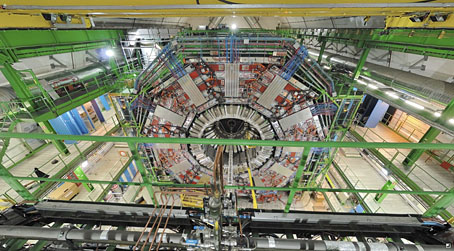
With sound effects, yet, so it’s like you’re there. 360º views by Peter McReady.
Via New Scientist.
Elsewhere on { feuilleton }
• The panoramas archive
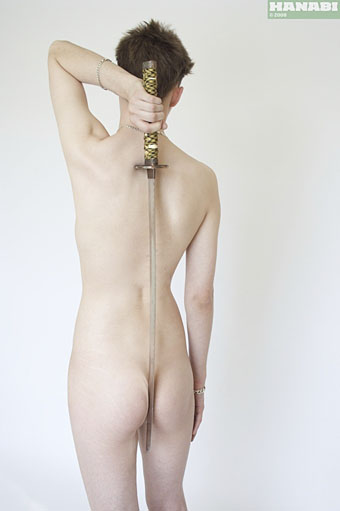
Don’t try this at home… Model Clark photographed by Neil Bradley as part of a deviantART set.
Elsewhere on { feuilleton }
• The men with swords archive
Previously on { feuilleton }
• Secret Lives of the Samurai
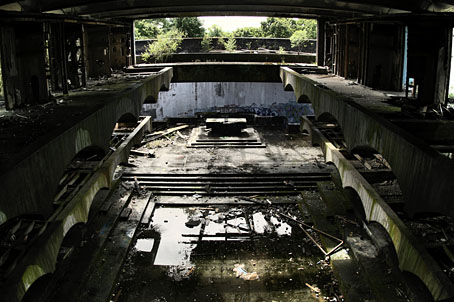
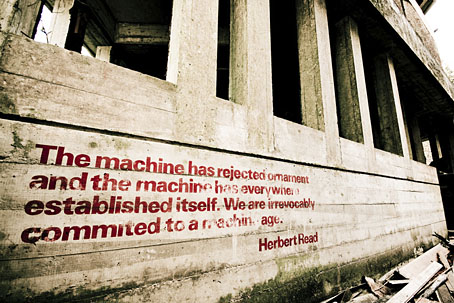
“Soon to be picturesque ruins” was a slogan the Situationists used to enjoy posting on Parisian buildings but their rebuke to architectural hubris can be applied anywhere. St Peter’s College seminary building at Cardross near Glasgow was an example of post-Le Corbusier concrete construction which drew praise for its clean modernity in the 1960s. Today it brings only photographers and graffiti kids to its dereliction. Brian Dillon notes that the seminary
resembles nothing so much as the desolate and sentient “zone” in Andrei Tarkovsky’s 1979 film Stalker: a place where snow falls slowly upon vacant altars, where stagnant pools are so full of rot that they look horribly alive even at the edge of winter, where a startlingly tame robin will perch on your head as you step delicately over the rubble. (More.)
Yes indeed, and Flickr is full of striking examples like these. Someone ought to take advantage of what Dillon calls the seminary’s “futuristic rot” and use the place as a film set before the decay becomes too hazardous or the building is demolished altogether.
Previously on { feuilleton }
• The ruins of Detroit
• Ephemeral architecture
• The temples of Angkor
• St Pancras in Spheroview
• The Stalker meme