Battersea Power Station

battersea.jpg

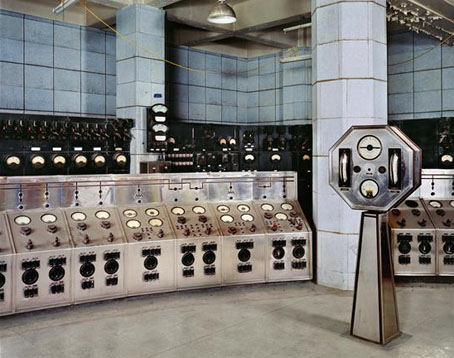
A photograph of the control room of Battersea Power Station, London, by Michael Collins, one of a series which will shortly be on display at the Royal Institute of British Architects.

The images show Battersea Power Station as what Collins describes as a “twentieth century ruined castle” – a building that was built to last, with a high quality structure and interior, including Art Deco walls and ceilings.

Giles Gilbert Scott’s enormous temple of heavy industry continues to sit decaying on the banks of the Thames while property developers come and go. The latest of these, Real Estate Opportunities, has fallen into debt which means proposals to develop the site are once again on hold. A part of me likes the idea of the building sitting there unused and purposeless year after year, like some vast Steampunk Stonehenge; Giles Gilbert Scott’s other Thames-side power station, Bankside, was successfully transformed as Tate Modern, but we know from various proposals that the fate of Battersea, whether as theme park or shopping centre, is likely to be a lot less edifying.
quark1.jpg

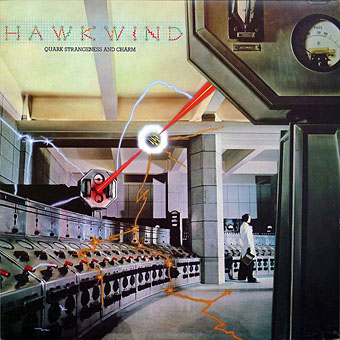
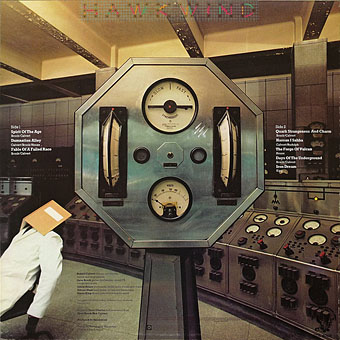
It took redevelopment to transform Bankside from temple of industry to temple of culture but Battersea’s unmistakable presence has a powerful cultural history of its own. Everyone knows the Hipgnosis sleeve design for Pink Floyd’s Animals (1977); less familiar is the photos of the control room which Hipgnosis used for Hawkwind’s Quark, Strangeness and Charm the same year. I tend to prefer the back cover of this sleeve to the front; that octagonal readout device is more interesting than the rather unconvincing sparks and exchanges of energy. And speaking of energy, my former employers are still active, unlike the rancorous Floyd.
quark2.jpg

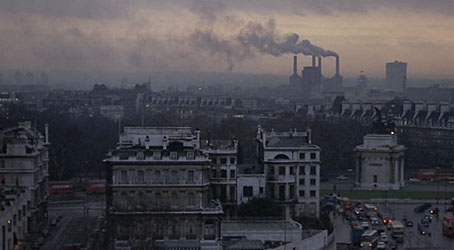
There’s a page here listing other uses of the power station, including its many film appearances which date back to the 1930s. That list mentions the control room’s use as a background for the “Find the Fish” sequence in Monty Python’s The Meaning of Life (1983) but they omit an earlier Monty Python appearance when you briefly see the building in operation during And Now for Something Completely Different (1971). It was closed down a few years later. So here it is, then, belching fumes over west London on a profoundly gloomy winter afternoon.
battersea2.jpg

Elsewhere on { feuilleton }
The album covers archive

Previously on { feuilleton }
The Sonic Assassins
The Bradbury Building: Looking Backward from the Future
David Trautimas

trautimas.jpg

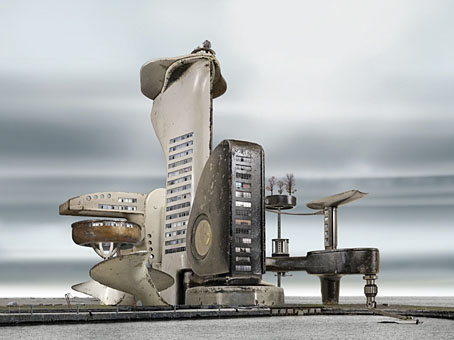
The Fishing Complex (2008).

Canadian artist David Trautimas re-purposes household and other objects into fantasy buildings by exaggerating their scale then montaging them into landscapes. This example is from his Habitat Machines series; there’s also an Industrial Parkland series. Many of the former group are pleasantly convincing, and their weathered appearance adds to the impression of having discovered the works of a lost Modernist architect. Some of these are like digital equivalents of paintings by Arnau Alemy.

Via Things Magazine.

Previously on { feuilleton }
The art of Arnau Alemany

On the Moon

ba1.jpg

Two Apollo 11 pictures from NASA’s endlessly fascinating collection of high-res photos. Both these are of Buzz Aldrin taken with Neil Armstrong’s suit-mounted Hasselblad. The one above is the most famous of the lot, of course, reproduced endlessly (I even copied it once as part of a drawing), but you hardly ever see it in its original tilted state like this; picture editors prefer to balance the horizon. The one below I hadn’t seen before in such detail. The lunar lander here looks remarkably small and fragile.

ba2.jpg

Previously on { feuilleton }
Memories of the Space Age
Apollo liftoff
Earthrise
East of Paracelsus

Apollo liftoff

apollo1.jpg

Forty years ago I was seven years old and this sight, dear reader, was the most thrilling thing in the whole world. Even now, seeing again the classic fisheye moment of Apollo 11’s launch sparks a buried flare of childhood excitement, resurrecting a deep obsession with astronauts, Saturn V rockets, command modules and lunar landing craft. In 1969 all I could do was gape in awe at our tiny black-and-white TV screen as it showed men going to the Moon right this minute!

Now I’m the same age as the astronauts of the Apollo missions I look at these photographs and feel at different kind of awe, at the courage required to sit at the top of a metal tower as tall as St Paul’s Cathedral filled with highly-combustible rocket fuel. And that’s before you get to the liftoff itself with its punishing g-forces, followed by navigating a vacuum for several days in a tin can controlled by less computer power than you’d find now in the average mobile phone. None of this occurred to me when I was seven, all that mattered was the fact that men were going to the Moon right this minute!

apollo2.jpg

I’ll return to those childhood obsessions later (no, you don’t escape that easily). Meanwhile the fortieth anniversary of the Apollo 11 mission is naturally generating a fair amount of web attention. NASA has a new site, We Choose the Moon, which augments their older archives. And New Scientist tells us Why the moon still matters. On the same site there’s also Brian Eno discussing the Moon missions and his 1983 soundtrack album, Apollo, which I’m listening to right this minute!

Apollo 11 at the Big Picture
Weaving the way to the Moon | The beatnik and the little old ladies

Previously on { feuilleton }
Earthrise
East of Paracelsus