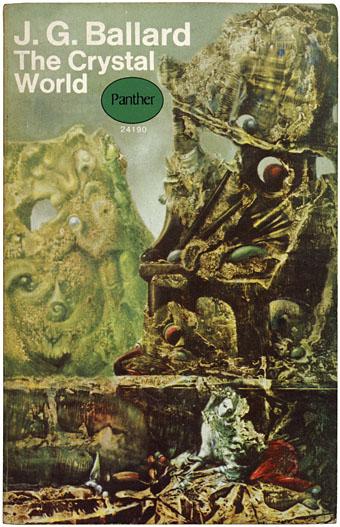
Panther Books paperback edition, 1968; cover painting: The Eye of Silence by Max Ernst.
If I can’t remember when I first encountered JG Ballard’s work, it’s not because I was reading him at a very early age, more that a childhood enthusiasm for science fiction made his books as omnipresent in my early life as any other writer on the sf, fantasy and horror shelves. I know that when I started to read the New Wave sf writers his work immediately stood out, not only for its originality but also for the numerous references to Surrealist painting which litter his early fiction, references which meant a great deal to this Surrealism-obsessed youth. Ballard was a lifelong and unrepentant enthusiast for the Surrealists, with repaintings by Brigid Marlin of two lost Paul Delvaux pictures prominent in one of his rooms (often featured in photo portraits). I always admired the way he never felt the need to apologise for Salvador Dalí’s excesses, unlike the majority of art critics who dismiss Dalí after he went to America. The paintings of Dalí, Delvaux, Tanguy and Max Ernst became stage sets which Ballard could populate with his affectless characters.
Once I’d encountered the New Worlds writers—Ballard, Michael Moorcock, M John Harrison, Brian Aldiss and company—and their American counterparts, especially Harlan Ellison, Samuel Delany and Norman Spinrad, there was no returning to the meagre thrills of hard sf with its techno-nerdery and bad writing. Ballard and Moorcock were the gateway drug to William Burroughs, Jorge Luis Borges and countless others, and I thought enough of his work in 1984 to attempt a series of unsuccessful illustrations based on The Atrocity Exhibition. It’s been an axiom during the twenty years I’ve worked at Savoy Books that Ballard, Moorcock and Harrison were (to borrow a phrase from Julian Cope) the Crucial Three of British letters, not Rushdie, Amis and McEwan. One of the books I designed for Savoy, The Exploits of Engelbrecht by Maurice Richardson, was a Ballard and Moorcock favourite, and included appreciations of Richardson by both writers. I wish Ballard could have seen the new (and still delayed) edition of Engelbrecht but he got a copy of the earlier book. Sometimes once in a lifetime is more than enough.
• Ballardian.com
• Pages of obits and MM comment at Moorock’s Miscellany
• Ballard interview by V Vale at Arthur with an special intro by Moorcock
• Jeff VanderMeer at Omnivoracious
• Guardian | Times | Independent | Telegraph
Previously on { feuilleton }
• Ballard in Barcelona
• 1st Ballardian Festival of Home Movies
• Revenant volumes: Bob Haberfield, New Worlds and others
• JG Ballard book covers