Angels 6: Paradise stands in the shadow of swords

stuck_angel.jpg

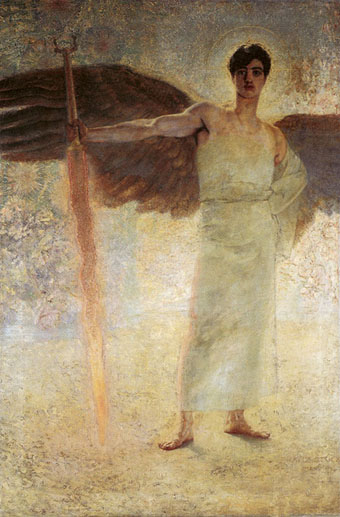
The Guardian of Paradise by Franz Stuck (1889).

We’ll let Coil have the final word on the angel theme, the post title being taken from their Cathedral In Flames. Those words recognise—as does the painting above—that the Christian concept of Heaven is of a gated community guarded by warriors to keep the undesirable at bay.

Symbolist painter Franz Stuck was (as far as we know) robustly heterosexual but his angel isn’t far removed from the work of contemporary photographers like Anthony Gayton who specialise in teasing out the erotic undercurrents in this kind of imagery. Which brings us full circle, seeing as we started with Caravaggio and his distinct brand of religious subversion. The irony is that some of the more vocal elements of Christianity can’t help subverting themselves or their own messages, as John Patterson notes in his Guardian piece today, alluding not only to the Ted Haggard debacle but also to Haggard’s favourite artist, Thomas Blackshear, both of whom were discussed here in November. Patterson writes that the recent brand of bigoted fervour that’s swept America seems to have abated, or at least retreated, after threatening to become a mainstream force. Europe often seems a haven of healthy heathen sanity by comparison, a part of the undesirable world being kept outside the American Paradise. St. Peter now demands retinal scans, fingerprints and a biometric passport. Continual rumbles from Pope Maledict and his closeted cardinals are an increasing irrelevance, the background static of a dying regime. Paradise may be guarded by attractive angels but we can only look and never touch. As Patterson says, the devil has all the best tunes. And the best books and movies and games. And sex and fun. I know which side of the fence I’d rather be on.

Elsewhere on { feuilleton }
The gay artists archive
The men with swords archive

Previously on { feuilleton }
Gay for God

Angels 3: A diversion

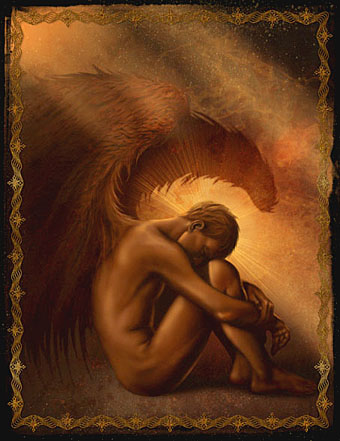
On Monday Eroom Nala mentioned my Fallen Angel picture in one of the comments for the first angel posting. Here’s the picture in question (from 2004).

fallen_angel.jpg

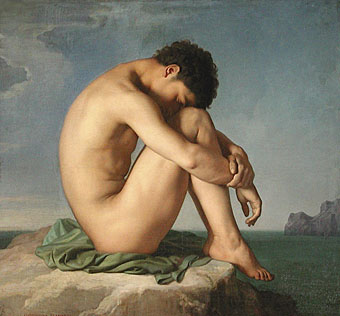
As I mentioned earlier, this was based on Jeune homme assis au bord de la mer (Young Man Sitting by the Seashore, 1836), the most well-known painting by Jean Hippolyte Flandrin (1809–1864). In a posting back in February I wrote about how this painting has become something of a gay icon over 170 years, with increasing numbers of artists and photographers working their own variations on the pose. As far as I was aware, I was the only person to have tried adding wings to the figure.

flandrin.jpg

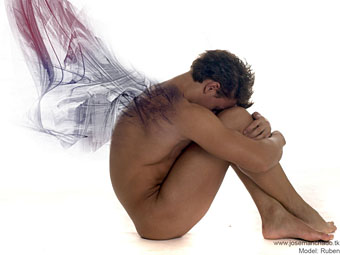
Now today I run across a great gallery of photographs by Jose Manchado who has his rather gorgeous model, Reuben, adopt the same pose then gives him a set of abstract wings.

manchado.jpg

Manchado’s other photographs are well worth a look. He also adds more realistic wings to a female model but since we’re concerning ourselves with male angels this week I’ll leave you to look for her.

Elsewhere on { feuilleton }
The gay artists archive
The recurrent pose archive

Angels 1: The Angel of History and sensual metaphysics

angelus_novus.jpg

Angelus Novus by Paul Klee (1920?).

The Catholic church failed to work its medieval magic on me beyond inspiring a fondness for ecclesiastic architecture and men with wings. But in keeping with the season it’s Angel Week here on { feuilleton } although some of the angels featured may not be quite Vatican-approved.

Above is the Paul Klee painting that prompted Walter Benjamin’s celebrated piece from ‘Theses on the Philosophy of History’ (1940) in Illuminations:

A Klee painting named Angelus Novus shows an angel looking as though he is about to move away from something he is fixedly contemplating. His eyes are staring, his mouth is open, his wings are spread. This is how one perceives the angel of history. His face is towards the past. Where we perceive a chain of events, he sees one catastrophe, which keeps piling wreckage upon wreckage and hurls it in front of his feet. The angel would like to stay, awaken the dead, and make whole what has been smashed. But a storm is blowing from Paradise; it has got caught in his wings with such violence that the angel can no longer close them. This storm irresistibly propels him into the future to which his back is turned, while the pile of debris before him grows skyward. This storm is what we call progress.

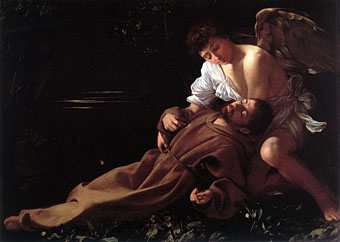
A world away from Benjamin’s wreckage, Caravaggio paints a typically luscious boy who just happens to have a pair of wings stuck to his back cradling a swooning saint in St Francis in Ecstasy. Ecstasy as a theme isn’t unknown in religious art, of course, but Renaissance painters usually showed St Theresa doing the fainting. Caravaggio was following a different muse.

st_francis.jpg

St Francis in Ecstasy by Caravaggio (1595).

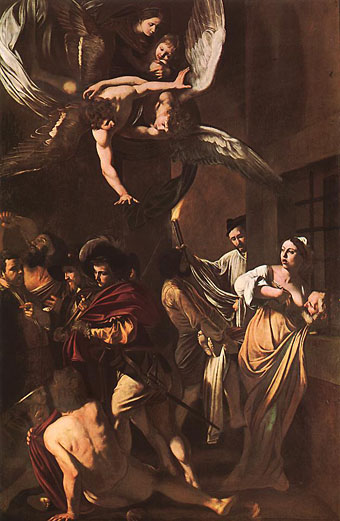
The pair of embracing angels tumbling into the marvellous Seven Acts of Mercy (below) are slightly more robust, a lot more so than the creature posing in Rest on the Flight to Egypt (1597), a picture whose precise religious content seems tenuous at best. And there are still those who believe Caravaggio’s interest in male flesh was solely artistic…

seven_acts.jpg

Seven Acts of Mercy by Caravaggio (1607).

More angels tomorrow.

Elsewhere on { feuilleton }
The gay artists archive

The art of Hubert Stowitts, 1892–1953

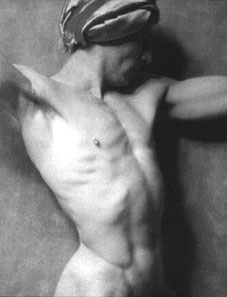
stowitts1.jpg

Left: Stowitts photgraphed by Nickolas Muray, 1922.

Hubert Julian Stowitts had a number of careers, including dancer, film actor, painter, designer and metaphysician. As a dancer he worked with Anna Pavlova, who discovered him in California in 1915 and took him on tour around the world. His statuesque figure was used by Rex Ingram for the infernal scenes in The Magician (1926), an adaptation of Somerset Maugham’s rather limp roman-à-clef based on the exploits of Aleister Crowley. The scene with Stowitts as a satyr owed nothing to the book, however, being more inspired by the director’s fondness for the tales of Arthur Machen. Most photos that turn up from this film show Stowitts rather than Paul Wegener who played the sinister alchemist of the title.

Stowitt’s painting developed in the 1930s and included a series of 55 paintings of nude (male) athletes for the 1936 Olympics (see Ewoud Broeksma’s contemporary equivalents at originalolympics.com). Other paintings depicted dance scenes, costume designs, people encountered during travels in the Far East and, in the 1950s, a series of ten Theosophist pictures entitled The Atomic Age Suite.

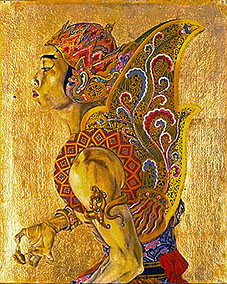
stowitts3.jpg

Prince Suwarno in Mahabarata role (1928).

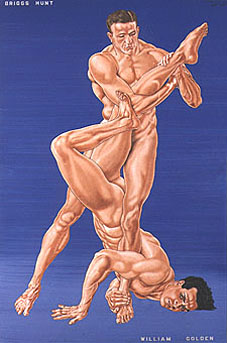
stowitts2.jpg

Briggs Hunt and William Golden (1936).

stowitts4.jpg

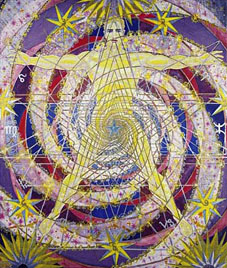
The Crucifixion in Space (1950).

The Stowitts Museum and Library
Stowitts at the Queer Arts Resource

Elsewhere on { feuilleton }
The gay artists archive

Previously on { feuilleton }
The art of Nicholas Kalmakoff, 1873–1955