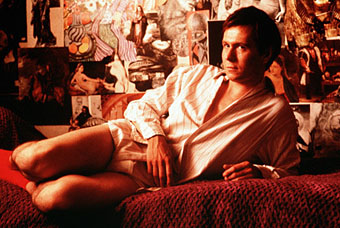
Gary Oldman as Joe Orton in Prick Up Your Ears (1987).
Ken: At least you can say you’ve sat in the same chair as TS Eliot.
Joe: Yes, I’m never going to wipe my bum again.
Gay playwright Joe Orton receives a welcome renewal of attention this month with a showing of films at the ICA in London and the 20th anniversary re-release of Prick Up Your Ears, the great Orton biopic by Alan Bennett and Stephen Frears. Gary Oldman is marvellously sexy (and funny) as Orton in Frears’ film, Alfred Molina is equally good as his increasingly neurotic lover, Kenneth Halliwell (who eventually murdered Orton before killing himself), and there’s decent casting throughout, with Vanessa Redgrave playing Peggy Ramsay and Julie Walters hilarious as Orton’s mother.
Prick Up Your Ears was originally Halliwell’s title for a script Orton was writing for the Beatles (“…much too good a title to waste on a film,” said Orton.) That film idea, variously titled Up Against It and 8 Arms To Hold You, was deemed “too gay” by McCartney and co., not least because Orton had all four Beatles sleeping in the same bed. He also wrote that “…the boys, in my script, have been caught in flagrante, become involved in dubious political activity, dressed as women, committed murder, been put in prison and committed adultery. And the script isn’t finished yet.” Now you know why the third Beatles film was an animated one.
A feature in The Guardian examining Orton’s legacy, as well as the film, has this to say of Prick Up Your Ears:
it was the first mainstream British film to depict the gay underworld of West End toilets and sign language that existed in an age when homosexuality was still illegal.
And much of it was filmed on location in Orton’s haunts. Every time I’ve been through Islington tube station I think of the scene where Gary Oldman picks up a guy he’s been eying in the lift.
Orton had the misfortune to die in 1967, the year homosexuality was decriminalised in Britain. Well… decriminalised so long as you were both 21, not members of the Armed Forces and there was no one else in the room with you; Orton could have made a play out of such farcical restrictions. But the film makes it clear that the existence of a stupid law—which caused the downfall of another playwright, Oscar Wilde—did nothing to prevent him enjoying himself. The Guardian has another quote from him:
[The police] interfere far too much with private morals—whether people are having it off in the backs of cars or smoking marijuana, or doing the interesting little things one does.
They still do, Joe.
The web doesn’t serve Orton’s memory very well; the links below are some of the more interesting finds.
• An interview from June, 1967
• Joe Orton at the BBC Sound Archive
• Joe Orton at GLBTQ
• The Disappearing Gentlemens’ Lavatories of Old London
(A hymn to the public convenience by Dudley Sutton, dedicated to Joe Orton.)
Previously on { feuilleton }
• Passion play
• The Poet and the Pope
• Please Mr. Postman
• All you need is…
• Queer Noises