Soundsuits by Nick Cave

cave1.jpg

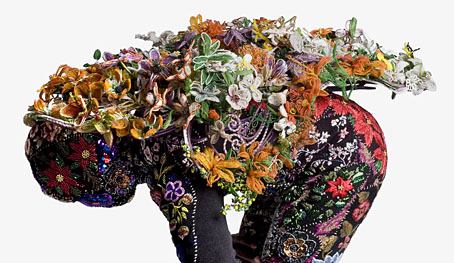
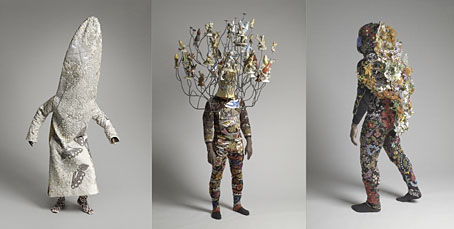
No, not the Australian singer. Soundsuits are wearable artworks by an American artist, dancer and fashion designer. Bigger pictures here while the Jack Shainman gallery has details of a recent exhibition.

Metal armatures adorned with a range of objects including painted ceramic birds, flowers, brass ornaments, and strands of beads, top the figures and serve as headdresses that activate the sculpture and provide a visual and textural contrast to the soft bodysuit. Soundsuits, named for the sounds made when the sculptures are worn, are as reminiscent of African and religious ceremonial costumes as they are of haute couture. A multitude of references bring to mind not only disparate cultural traditions but they also highlight Cave’s diverse background and artistic training. Cave studied and danced with Alvin Ailey and created his own clothing line which he featured in a shop he opened and ran for ten years. He is as interested in fashion and cultural, ritualistic and ceremonial concepts as he is in politics, a domain that has always been part of his work as demonstrated by acts of collecting and reconfiguring elements and concealing the identity, race, and gender, of those who wear his suits.
cave2.jpg

Xiphophilia

koronkiewicz.jpg

How else to name this obsession? (Which, it should be noted, is more a mild preoccupation than a full-on fetish.) Xiphoid isn’t a word one hears very often:

\Xiph”oid\ (?; 277), a. [Gr. ? sword-shaped; xi`fos a sword + ? form, shape: cf. F. xiphoide.] (Anat.)
(a) Like a sword; ensiform.
(b) Of or pertaining to the xiphoid process; xiphoidian.

Ensiform is less of a challenge but doesn’t lend itself to a suffix while foinery is a term which only refers to combat with foils. Xiphophilia will have to suffice.

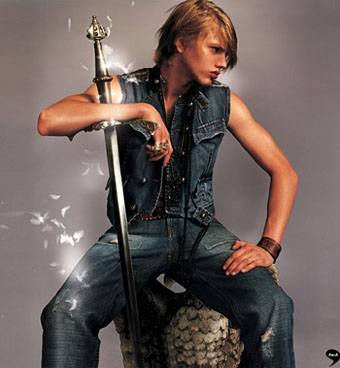
swordboy

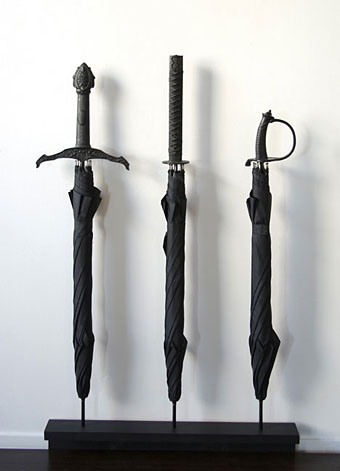
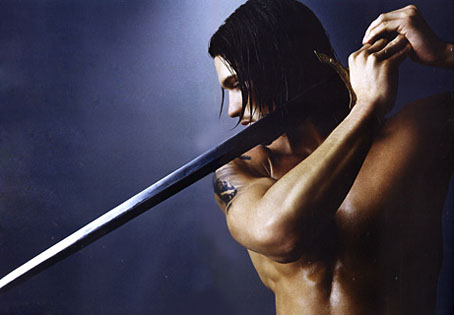
The Aragorn type at the top of the post is a Polish model, Jared Koronkiewicz, and his uncredited photo is via Queerty. The identity of the pouting sword boy is a mystery but this picture and another look like scans from a fashion mag. Thanks to Callum for the tip. Finally, the umbrella swords are a design concept from Materious. While these might be useful for keeping commuters at bay, in the current climate of security theatre they’d probably only lead to your arrest or worse. But they look good. Via Core77.

umbrellas.jpg

Elsewhere on { feuilleton }
The men with swords archive

Butterfly women

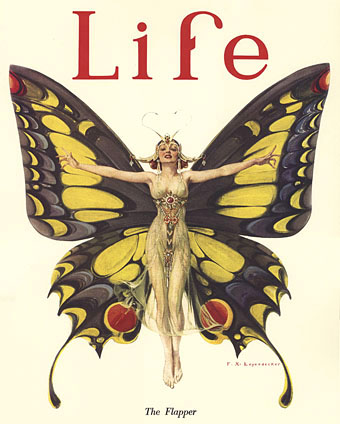
The Flapper by Frank X Leyendecker, Life magazine (1922).

When I posted this splendid cover last July I said that I ought to make a post of Butterfly Women, so here is one. Don’t expect this to be at all comprehensive, women with butterfly wings are as legion as mermaids, these are merely a couple of favourites.

moser_fuller.jpg

Loïe Fuller by Koloman Moser (1901).

The ultimate butterfly woman must be Loïe Fuller (1862–1928) whose Serpentine Dance inspired a host of fin de siècle paintings and sculptures and was also filmed by the Lumière brothers in 1896. The Internet Archive has a tinted copy of the latter while Europa Film Treasures has an Italian short from 1907, Farfale (Butterflies) with a troupe of dancers (also hand-tinted) imitating the Fuller style.

life_benda.jpg

Life magazine cover by Wladyslaw Benda (1923).

These two pictures were discovered via the wonderful Golden Age Comic Book Stories who always has the best scans of vintage art. The Life covers are from the humour periodical which expired in 1936, not the later photojournalism magazine. For more Life covers, look here.

vargas_dragonfly.jpg

Dragonfly by Alberto Vargas (1922).

Okay, so it’s called Dragonfly but those look more like butterfly wings to me. A delicate piece of Vargas cheesecake which echoes the flapper theme of the Leyendecker picture. This Flickr user has a whole set of butterfly girl cigarette cards but we don’t get to see them properly without paying. If anyone has seen them elsewhere, please leave a comment.

Elsewhere on { feuilleton }
The illustrators archive

Previously on { feuilleton }
Mermaids
Wladyslaw Benda
Vintage magazine art II
Vintage magazine art

Eonism and Eonnagata

deon.jpg

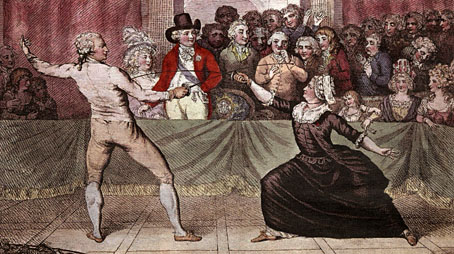
The Chevalier d’Eon wins a fencing bout.

I’ve known of the cross-dressing Charles-Geneviève-Louis-Auguste-André-Thimothée d’Eon de Beaumont—or the Chevalier d’Eon (1728–1810) to give him his title—for some time thanks to a typically witty and informative entry by Philip Core in Camp: The Lie that Tells the Truth (1984). The nobleman rubs shoulders there with the equally flamboyant Henry Paget (1875–1905), Fifth Marquess of Anglesey, known as “the Dancing Marquess”, and Romain de Tirtoff, better known as illustrator and designer, Erté, who we see in a photo dressed as “Claire de Lune”. Aside from his status as a historical curio, and a failed attempt by Havelock Ellis to borrow his name to describe transvestism—Eonism, the Chevalier seems less celebrated than he might be. So it’s a pleasure to hear that theatre director Robert Lepage has created a new stage production, Eonnagatta, based on the Chevalier’s colourful life:

For a long time now, the actor and experimental theatre director Robert Lepage has been fascinated by the life of the Chevalier d’Eon, an 18th-century French soldier who had a flamboyant career as a diplomat and secret agent for Louis XV, and spent much of his adult life dressed as a woman. Officially, the Chevalier’s skirts were worn as a professional disguise: his exceptionally fine features allowed him to pass easily for a woman, and thus move around undetected as a spy. But the Chevalier didn’t just do it for the job. He was a genuine cross-dresser, an 18th-century transvestite.

Lepage’s fascination has now led to Eonnagata, a daring collaboration inspired by the life of the Chevalier that gets its British premiere next week. The work has been put together by four very different, and internationally acclaimed, artists: there’s Lepage, the choreographer Russell Maliphant, the dancer Sylvie Guillem and the fashion designer Alexander McQueen. That’s quite a team – and the result is a unique hybrid of their art forms. How would they describe it? Maliphant gives it a go: “It’s not pure dance: it doesn’t have Sylvie doing splits or amazing falls. But it’s not pure theatre, either.” (More.)

deon2.jpg

Eonnagata.

Continue reading “Eonism and Eonnagata”

Colin Corbett’s decorated jockstraps

corbett1.jpg

I missed posting something about Strapped: The Art of the Decorated Jockstrap while the exhibition was running last month at the London College of Communications but better late than never with this. Designer Colin Corbett’s playful additions to the humble jockstrap hit so many spots of obsession it’s like he read my mind: black clothes, swords, peacocks, jockstraps… You can see more of them here and he talks about some of the designs here.

corbett2.jpg

Dennis Covey, meanwhile, turns jockstraps into art by making unique torso casts of their wearers. He also has a fine collection of other homoerotic work, most of which is for sale.

Elsewhere on { feuilleton }
The gay artists archive

Previously on { feuilleton }
Game boy