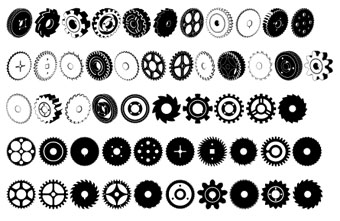
A font by Lewis Tsalis for T.26.
A journal by artist and designer John Coulthart.

Design
A font by Lewis Tsalis for T.26.
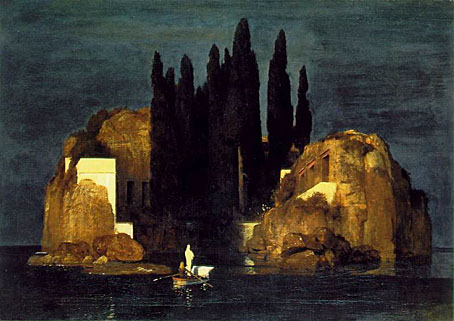
Another favourite painting for many years and Böcklin’s most well-known work.
Arnold Böcklin (1827–1901) produced several different versions of the painting. All versions depict an oarsman and a standing white-clad figure in a small boat crossing an expanse of dark water towards a rocky island. In the boat is an object usually taken to be a coffin. The white-clad figure is often taken to be Charon, and the water analogous to the Acheron. Böcklin himself provided neither public explanation as to the meaning of the painting nor the title, which was conferred upon it by the art dealer Fritz Gurlitt in 1883. The first version of the painting, which is currently at the Metropolitan Museum in New York City, was created in 1880 on a request by Marie Berna, whose husband had recently died.
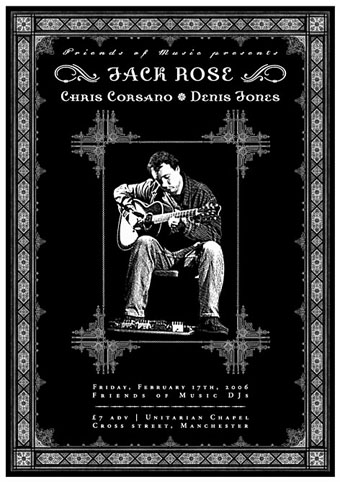
The great post-Fahey guitarist Jack Rose plays the Unitarian Chapel tomorrow with support by incredible improv drummer Chris Corsano. I designed the posters and flyers for the event.
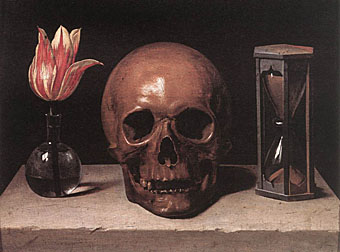
Still-life with a skull (vanitas) by Philippe de Champaigne.
vanitas
think of the scene from shakespeare’s hamlet where the prince holds a skull of yorick, a former servant, bemoaning the pointlessness and temporary nature of worldly matters. certain themes characteristic of a specific philosophy have been commonly represented during an era, and an iconography has been developed to express them. an example is the still life vanitas vanitatum of the middle ages, a reminder of the transitory quality of earthly pleasure symbolized by a skull. pictorial arrangements are dealing with the vanity of the intellectual world (globe, books), and of the ‘vita voluptaria’ (musical instruments, smoking implements). often painters continued the old tradition of including appropriate captions or texts on their pictures. the favourite was the admonition from ecclesiastes I: ‘vanity of vanities; all is vanity’. the transience of human existence is often brought out also by other symbols like the candle and the hourglass.