
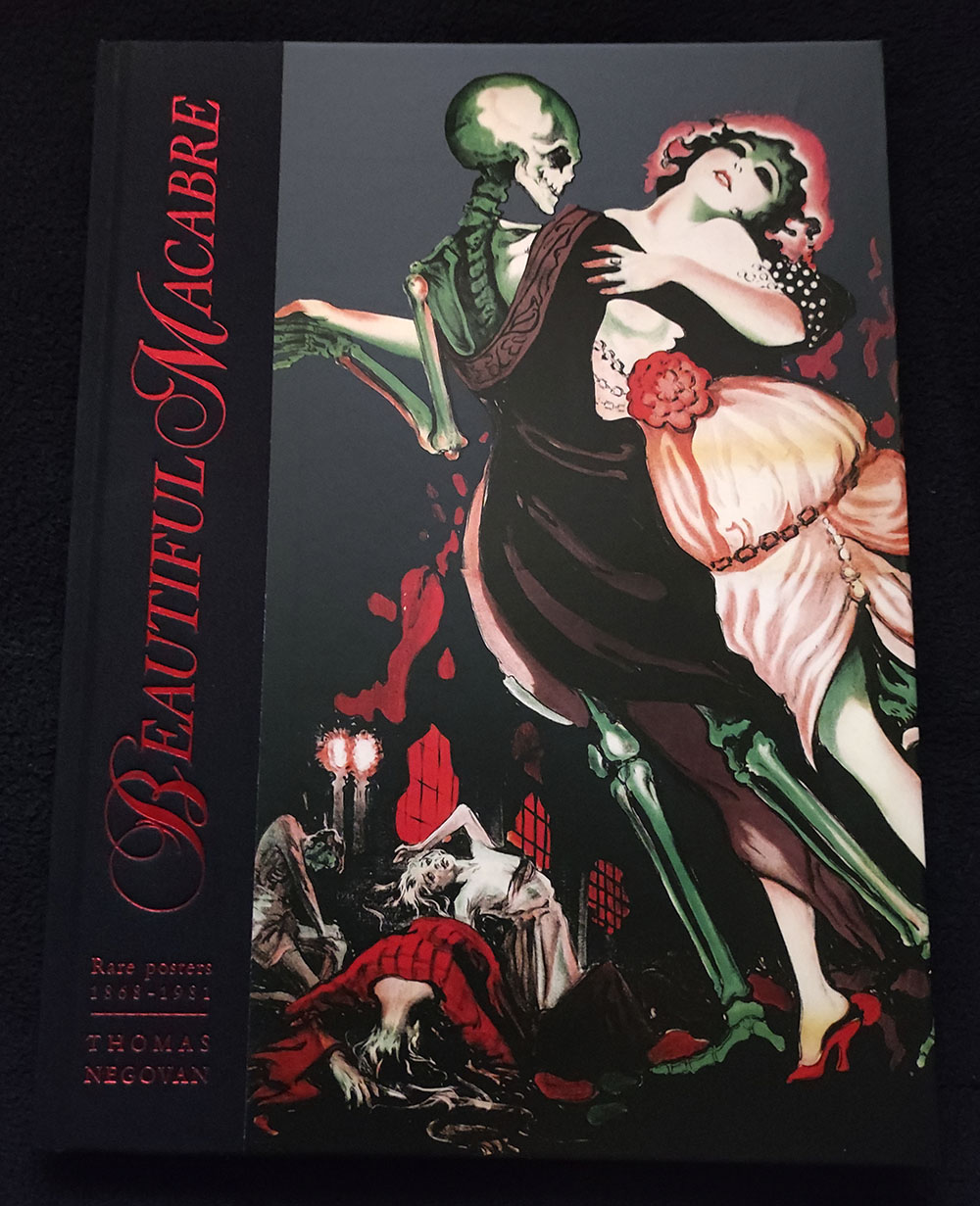
Beautiful and macabre: two books from Century Guild

posters.jpg

Arriving in the mail last week, a pair of beautifully-produced volumes which Thomas Negovan very generously sent to me. Negovan’s Century Guild publishes the kind of art I’ve been writing about here for the past twenty years: Symbolist painting, Art Nouveau graphics, Decadent illustration and more. There’s some intersection between the publisher’s backlist and earlier titles from Dover Publications, but where Dover have mostly concentrated on mass-produced paperbacks Century Guild deploy the full range of finishings available to a publisher of high-quality art books: foil embossing, faux leather finishes, spot-varnished boards, edges sprayed in metallic ink, and ribbon place-markers. Beautiful Macabre is Negovan’s own selection of rare poster art from 1868 to 1981, rare enough for most of the material to be new to me: theatre posters, Expressionist film posters, exhibition posters, etc, with an emphasis on Decadence through the ages. This is another of those books that show how the morbid preoccupations of the 1890s became codified in the 20th century into generic horror.
seder.jpg

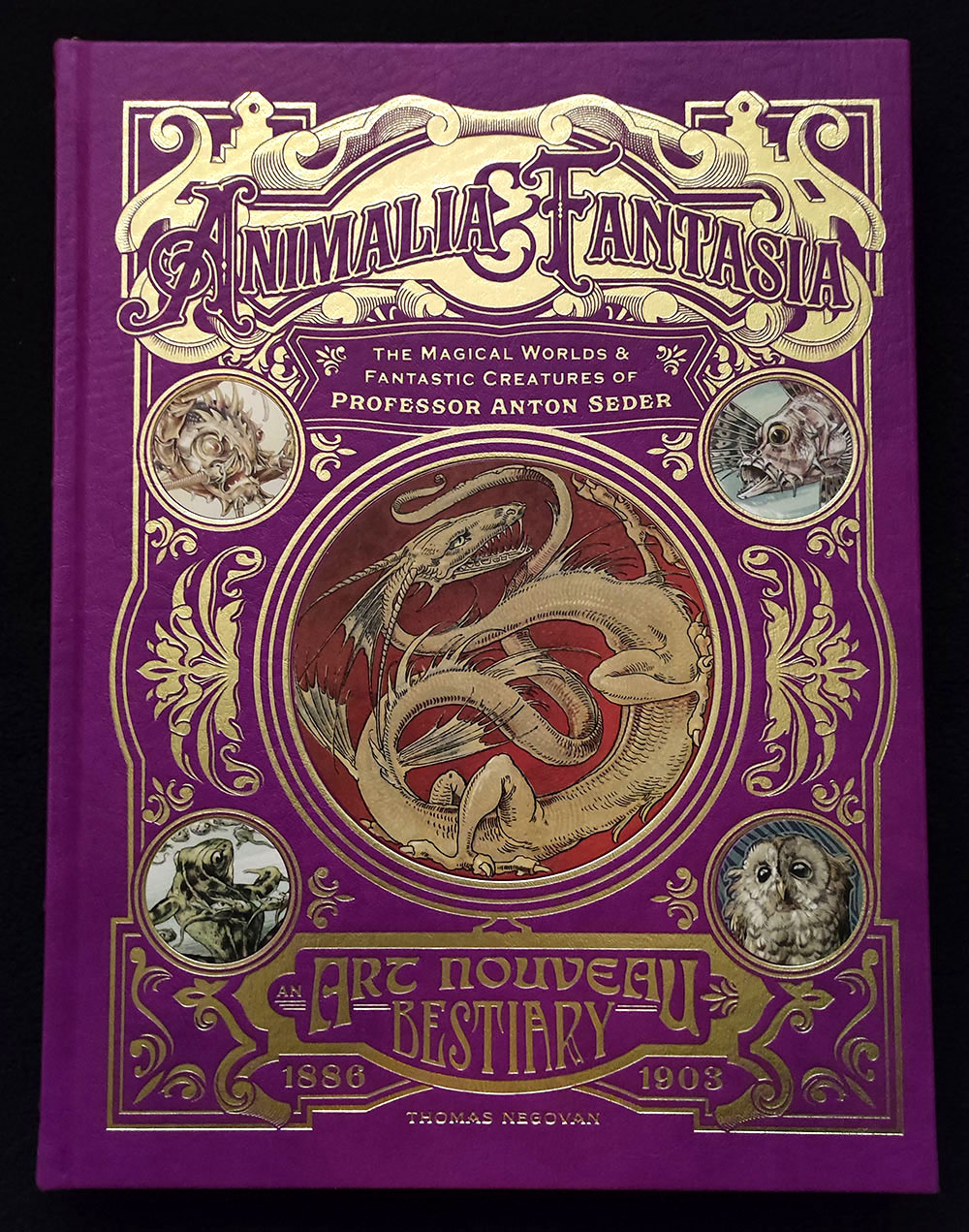
Cover design by Jack Hargreaves.

The Anton Seder book is a more singular study, reprinting the intricate plates from Das Thier in der Decorativen Kunst (The Animal in Decorative Art) and Moderne Malereien, a collection of Seder’s interior designs in the Art Nouveau style. Seder’s book of animal designs has its own Dover reprint (which may explain how Murray Tinkelman was able to incorporate some of the creatures into his Lovecraftian cover art) but the Century Guild collection includes much more than this, with biographical notes, and pages that place Seder’s books in the context of previous guides and templates for use by artists and craftspeople. This type of book was a common thing around 1900 (Alphonse Mucha produced three of them), while similar examples abound in previous centuries. The fragmentation of art and craft in the 20th century, and the turn against exuberant decoration, put an end to a form whose spirit survives today in reprints such as this. And it happens to have arrived at a time when its contents will be very useful reference for my current commission. Thanks, Thomas!

Previously on { feuilleton }
Eldritch Art Nouveau: Lovecraft at Ballantine
Moderne Malereien, 1903
Das Thier in der Decorativen Kunst

Documents Décoratifs by Alphonse Mucha

mucha11.jpg

I’ve had a copy of the Dover edition of these plates for some time, but it’s good to find a digital copy at last, especially now I can see that Dover bleached all the subtle background tones to a solid white. The artwork looks much better in its original state. It was also a little surprising to discover that Documents Décoratifs was originally a collection of loose sheets in a portfolio, not a book as I always thought.

mucha01.jpg

The plates were Alphonse Mucha’s contribution to that small collection of publications intended to assist other designers and craftspeople in their decorative work. Mucha’s drawings break down his style into a series of isolated motifs and design elements: panels, borders, figures, flowers, lettering and other details, together with a few pages of more complete designs. He also offers several pages of suggestions for applying his Art Nouveau flourishes to jewellery, furniture and other household objects. I’ve used parts of these designs a few times in my own work, most recently in the Bumper Book of Magic. Even if you don’t have a practical use for the plates they’re all very beautiful pieces in themselves, especially the pencil drawings.

mucha03.jpg

mucha04.jpg

mucha05.jpg

Continue reading “Documents Décoratifs by Alphonse Mucha”

A Book of Studies in Plant Form

plants01.jpg

A recent arrival at the Internet Archive, A Book of Studies in Plant Form (1896) by Albert Lilley and W. Midgley is a guide to using the shapes of flowers and plants in various types of design. Plants were the common currency of Art Nouveau, and this book is very oriented towards the latest design trend, showing a variety of design suggestions that would fit easily into the pages of The Studio magazine. Despite their age, books like this (and similar volumes by Maurice Verneuil and others) are still useful today in showing how to convert the untamed actuality of a living plant into a harmonious repeatable design. Lilley and Midgley’s book contains many fine illustrations, also a number of photographs. Browse it here or download it here.

plants02.jpg

plants03.jpg

plants04.jpg

plants05.jpg

Continue reading “A Book of Studies in Plant Form”

Documents d’atelier: Art décoratif moderne

documents01.jpg

These collections would have been useful when I was mining my Art Nouveau reference books while working on the Bumper Book of Magic. Documents d’atelier is a two-volume overview of the Nouveau idiom as it manifested throughout the worlds of art and design, from architecture and housing interiors, to jewellery, ceramics and so on. The books were compiled in 1899 by Victor Champier, and no doubt draw on the resources of Revue des arts décoratifs, the magazine that Champier edited from 1880 to 1902. The Nouveau era didn’t last very long but it generated many guides of this kind, not all of which are useful if you’re looking for something to work from. Documents d’atelier is better than most in presenting actual works rather than speculative designs, and with more variety than you find in other guides. The colouring is also an attractive feature: black-and-white photos have been tinted in pastel shades to match the colour reproductions. The creators of each design are credited on the pages so you don’t have to go hunting through an index.

documents02.jpg

Both these volumes are hosted at Gallica where the web interface remains as inefficent as ever. If you want to see more pages I recommend downloading the PDFs rather than trying to leaf through the things online.

Volume 1 | Volume 2

documents03.jpg

documents04.jpg

documents05.jpg

Continue reading “Documents d’atelier: Art décoratif moderne”

Lettres et Enseignes Art Nouveau

mulier1.jpg

These lettering designs were posted at Wikimedia Commons in the summer but I’ve only just noticed them this week. I’d been searching for Étienne Mulier’s designs while working on the six-part story about Miss Adeline Carr, aka “The Soul”, in the Bumper Book of Magic, the idea being to have each chapter open with the character’s name in a different Art Nouveau lettering style. If you look at enough bookselling sites you can eventually find one or two large photos of Mulier’s pages which is what I used when creating the heading for the second chapter of the story; but I still would have preferred to have had access to the whole collection. As it happens, most of the Wikimedia plates have also come from bookselling sites but they’re a slightly better collection than the ones I found.

soul.jpg

Mulier’s plates were published in 1901, presented not in book form but as a collection of loose lithographs in a card portfolio; the “Enseignes” in the title are suggestions for shop signs. Mulier also throws in a couple of less practical designs showing alphabets created by posing flamingos. The loose-leaf format is a useful one for something intended to be consulted by artists and craftspeople. Books could be awkward things in the days before digital scanning and photography if you wanted to trace something from a page which wouldn’t lie flat. The Mulier design I used for The Soul isn’t a perfect alphabet—the letters K and M could do with improving—but it’s a good example of the French approach to Art Nouveau lettering (and Art Nouveau design in general) which tends to be more loose and plant-like than equivalents from Germany or the Netherlands. The organic appearance of the letterforms suited the chapter I was illustrating which opens with a hunt for magic mushrooms.

mulier2.jpg

Mulier’s plates don’t appear to have been turned into printable fonts until the 1960s when the revival of interest in Art Nouveau prompted the creation of filmtype adaptations. Fontsinuse shows a rare print example on the cover of an album by Scottish prog band Beggar’s Opera, a version of the typeface which filled in the bi-chromatic letters and slightly altered their forms. “One of the ugliest typefaces ever created,” says Mr Hardwig. I can think of worse. More recently we have the inevitable digitisations, with Art Nouveau Caps being the closest to Mulier’s original. I was tempted to use a digitised version for the story but I find that many amateur (or semi-professional) digitisations of old typefaces are often crude things compared to the originals. I also liked the bi-chromatic effect so I ended up drawing my own copies of the letters I needed.

Previously on { feuilleton }
Bergling’s Art Alphabets
Typefaces of the occult revival