
The name’s d’Eon. Chevalier d’Eon | “He was an 18th-century spy who loved to cross-dress and swordfight.”
Category: {dance}
Dance
Ruth St Denis
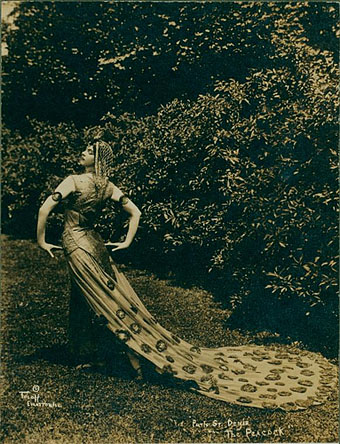
The Peacock (no date).
Dancer Ruth St Denis (1879–1968) strikes Art Nouveau poses in the New York Public Library’s Denishawn Collection, now at Flickr.
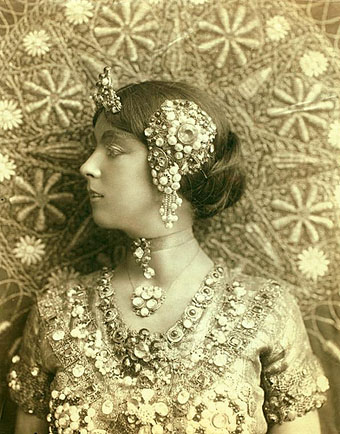
Radha (1904).
Previously on { feuilleton }
• Peacocks
• Rene Beauclair
• Elizabetes Iela 10b, Riga
• The Maison Lavirotte
• Whistler’s Peacock Room
• Beardsley’s Salomé
• The art of Hernan Gimenez
• Images of Nijinsky
Matthew Bourne’s Dorian Gray

Dorian (Richard Winsor) photographed by Bill Cooper.
Matthew Bourne‘s new dance version of Dorian Gray opens today at the Sadler’s Wells Theatre, London, and I’d have been interested in this production even without visions like the ones above and below; the eye candy merely adds an additional frisson and, let’s face it, there’s always been an erotic component to dance and ballet however high-minded the intention. Bourne famously gave the world the a Swan Lake with male swans and in Dorian Gray updates Wilde in a very contemporary manner (following Will Self’s Dorian: An Imitation and Duncan Roy’s recent film adaptation) with the gay subtext made an overt text.
Set in the image-obsessed world of contemporary art and politics, Matthew Bourne’s ‘black fairy tale’ tells the story of an exceptionally alluring young man who makes a pact with the devil. Amongst London’s beautiful people, Dorian Gray is the ‘It Boy’ – an icon of beauty and truth in an increasingly ugly world.
The destructive power of beauty, the blind pursuit of pleasure and the darkness and corruption that lie beneath the charming façade; the themes behind Oscar Wilde’s cautionary tale have never been more timely.
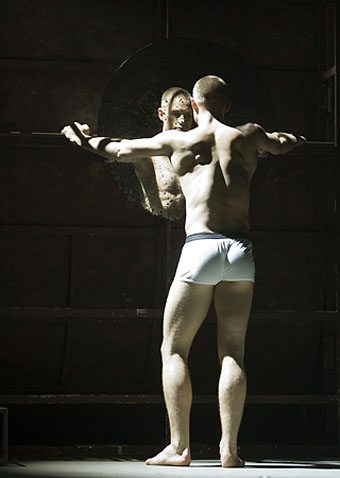
Richard Winsor again, photographed by Murdo Macleod.
Dorian Gray continues the gender-reversals with Lord Henry becoming Lady H, while Sybil Vane is transmuted to Cyril. I like the stage design detail where the customary nightclub glitterball becomes a version of Damien Hirst’s diamond-encrusted human skull, the expensive artworld bauble finding its own level at last as a piece of decoration. Updating stories in this way often provokes a feeling of ambivalence—removing the subtext can have the effect of diluting the tension which lies at the heart of the work—but the continual refashioning of Wilde’s fable has confirmed its status as a contemporary myth, something I’m sure he’d be very pleased about. In that respect, it gives the creator the immortality through art which his creation, in the closing pages of the story, is denied.
• Because Wilde’s worth it | Matthew Bourne discusses the production
• Review in The Independent
• Bill Cooper’s production photos
• Wilde at heart: Matthew Bourne’s Dorian Gray | Another photo gallery
Elsewhere on { feuilleton }
• The Oscar Wilde archive
John Osborne’s Dorian Gray
I wrote recently about John Selwyn Gilbert’s television play, Aubrey, an hour-long drama concerning the artist Aubrey Beardsley. The play was only screened once in 1982 and, like most one-off studio works of the period, is unavailable on DVD. John Osborne’s 1976 adaptation of The Picture of Dorian Gray is a welcome exception to this neglect and can be acquired in a box set along with three BBC productions of Wilde’s plays and a more recent Wilde documentary.
The stage plays are decent enough although the cast in the 1952 film version of The Importance of Being Earnest takes some beating. Dorian Gray is for me the essential work in the collection, even if its 100-minute running time cuts the story to the bone. The principal attraction in an entirely studio-bound work with few actors is the leads, and for this we have two great performances from John Gielgud as Lord Henry and Jeremy Brett as artist Basil Hallward. The tragic Dorian is played by Peter Firth who has difficulty keeping up with these heavyweights, especially in the later scenes when the story concentrates more fully on his predicament. Matters aren’t helped by his Yorkshire accent which frequently rises to the surface in a manner that would surely raise eyebrows in Mayfair drawing rooms.
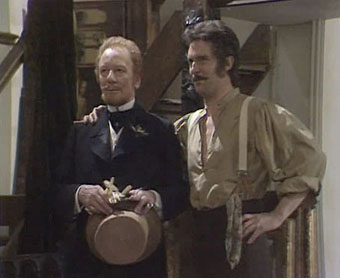
Lord Henry & Basil Hallward admire the portrait.
Because Wilde’s worth it
Because Wilde’s worth it
| Matthew Bourne makes Dorian gay.