Weekend links 702

miller.jpg

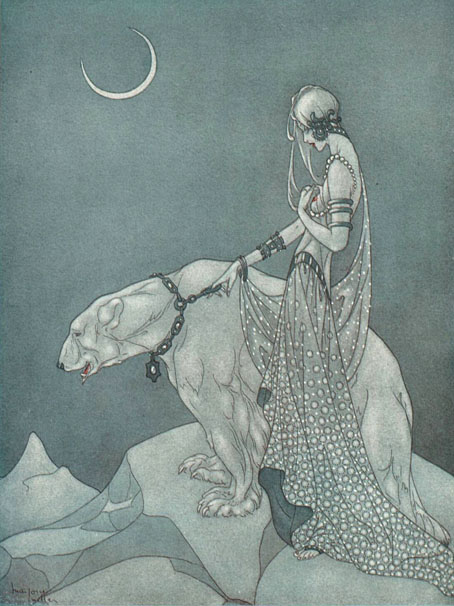
The Great Bear (1933) by Marjorie Miller.

• New music: “Lo-fi no-fi post-fi fragments of disparate SCATTERBRAIN thoughts scrapbooked together using industrial glue discretely purloined from building site tea-break opportunities to fully form the definitive SEPIA PUNK AMBIENT (?) statement of assiduous apathy intent ~ hextracted from SEPIA CAT CITY (GEpH017LP) available via moonwiringclub.com areet now TA.” Nobody writes product descriptions like Moon Wiring Club.

• “Both the Harry Smith and the Sun Ra books were hard sells, because they were virtual unknowns who had pretty much given their life for art. In each case only about two publishers were interested in either one of them. The editors said either that they hadn’t heard of him, or else they had heard of him and didn’t want to hear any more.” John Szwed talking to Raymond Foye about the mercurial Harry Smith, and the problems of writing biography.

• At Public Domain Review: Max Beerbohm’s A Christmas Garland (1912), a collection of seasonal parodies of well-known writers of the day. As with any such work, the success of each piece depends upon familiarity with the author being parodied, but Beerbohm’s prose is always a delight.

Mirrorshades (1986), the cyberpunk story anthology edited by Bruce Sterling, is currently available for reading or e-text download at Rudy Rucker’s website. The book is still in copyright but I’m guessing this has been done with the agreement of the contributors.

• “…the richness of terrestrial creatures which at points are capable of sounding utterly extra-terrestrial.” Daryl Worthington explores the history of birdsong and its influence on human music.

• At Smithsonian Magazine: Listen to the centre of the Milky Way translated into sound or look at yet more photos of the aurora borealis. (Or do both at the same time.)

• At Wormwoodiana: Through the Golden Valley to the Dark Tower. Mark Valentine and friends go on a book-buying expedition.

14 x 14, a collection of Oulipo poems by Ian Monk, translated by Monk and Philip Terry, with collage cover art by Allan Kausch.

• “I am fascinated by electromagnetic waves.” Carsten Nicolai (aka Alva Noto) discussing art and creativity with Max Dax.

Secret Satan, 2023, the essential end-of-year book list from Strange Flowers.

Spice Islands Sea Birds (1957) by Les Baxter | Trippin’ With The Birds (1997) by Stereolab + Nurse With Wound | Strange Birds (1999) by Coil
One Hundred Views of Mount Fuji

hokusai01.jpg

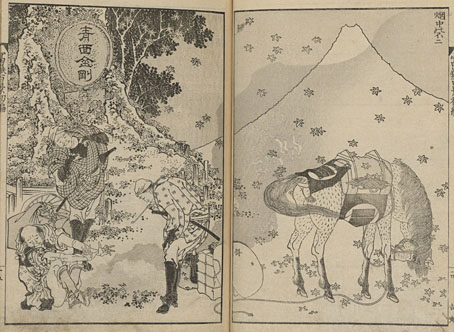
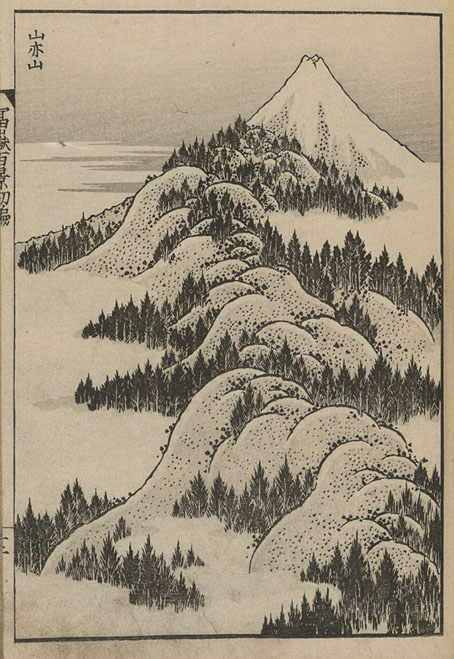
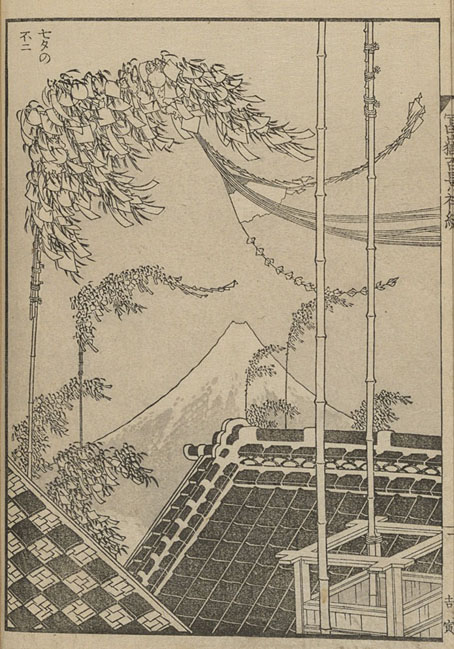
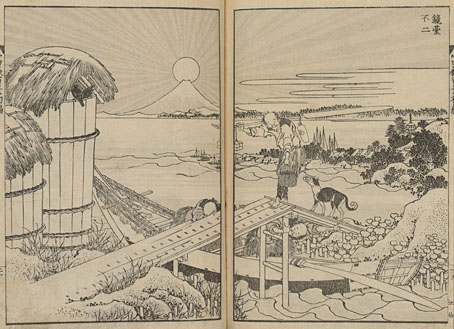
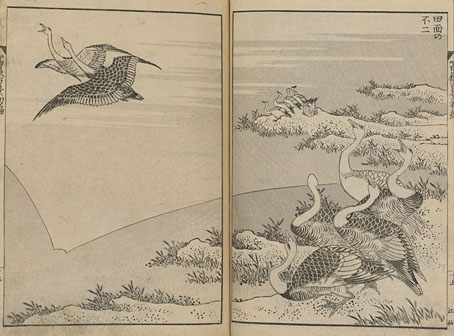
You won’t get all one hundred views here, of course, but all may be seen in their original three-volume printing courtesy of the Smithsonian Library’s Hokusai archive. (See below for the individual book links.) I linked to this cache some time ago but it’s taken me until now to have a proper look at the Hundred Views, rather a shameful admission considering how good they are. In mitigation, this is partly the fault of the Smithsonian Library who insist on labelling all the books with their Japanese titles and no other information. To find the Fuji books you either have to already know the Japanese title (Fugaku Hyakkei), or else look through 82 different uploads to see what they contain.

hokusai02.jpg

Hokusai’s books differ substantially from his colour prints, even though they use the same woodblock print process, and there’s often an overlap in subject matter, as with the Mount Fuji volumes. Many of the prints are monochrome, using combinations of black lines or dots with grey tones. A few of them also use a second colour, usually a flesh tone, while a handful are fully coloured. The books show greater artistic variety than in Hokusai’s ukiyo-e prints which, being intended for display, were subject to different aesthetic demands. One of the books is dedicated to the artist’s designs for painted combs, for example, while others—the manga series—are sketchbooks that show Hokusai’s invention, his sense of humour and his powers of observation. (The use of manga here shouldn’t be confused with the contemporary term for Japanese comics.)

hokusai03.jpg

The Hundred views of Mount Fuji are more playful than the famous colour prints of the mountain, being inventions rather than drawings from life. The series is a virtuoso exercise in portraying the sacred volcano in as many ways as possible—silhouette, distant outline, reflection in water—at all times of the year and in all weathers. The views are populated by a wide range of Japanese humanity, from the upper classes to the lowest labourers, as well as a variety of animals: cranes and smaller birds, deer, horses, bats, a dragon, even a spider that seems to catch the mountain in its web. The perspectives also shift from drawing to drawing. There’s no question that Hokusai knew perfectly well how to represent perspectival depth yet his view of a group of astronomers looking at the mountain dispenses with the Western approach to perspective. The three Fuji books were created in the 1830s, at a time when there was no analogue for this type of pictorial experimentation in Western art. I love the formal invention in these drawings, all the ones that show columns of people where every face is obscured by a large hat. I could enthuse at length about so many other details but you should really just go and look at them yourself.

hokusai04.jpg

The Smithsonian collection has a couple of sets of Fugaku Hyakkei. The set I’ve chosen has lighter paper which provides better contrast for the printing, especially the grey tones which are often applied with great subtlety.

Fugaku Hyakkei: Book One | Book Two | Book Three

hokusai05.jpg

Continue reading “One Hundred Views of Mount Fuji”

Weekend links 701

kawase.jpg

Frosty Morning in Nagaoka, Izu (1939) by Hasui Kawase.

• “A few years ago, retired professor of religious studies Chris Bache wrote a book called LSD and the Mind of the Universe. His book is the story of 73 high-dose LSD experiences he had over a period of 20 years, from 1979 to 1999, and how they changed his understanding of the very nature of reality. Bache believes psychedelics represent a ‘true revolution in Western thought,’ and his life has been lived around that premise. But after his long psychedelic journey, Chris ends up in a really interesting place. He wonders, ‘Can you have too much transcendence?'” Steve Paulson talks to Chris Bache about mega-dosing LSD.

• “Operating in the margins and intersections of folklore, experimental electronics, dreams and nightmares…” Or Hauntology, German-style. Louis Pattison at Bandcamp looks at some of the artists featured on Gespensterland, a compilation album released by Bureau B. The latest news reports about Bandcamp haven’t been encouraging. Download those digital purchases.

• “Cassel favored botanically inspired lines, distilled geometries, and a crepuscular-or-witching hour palette to capture the strange wind and cold light of a particular metaphysical space.” Johanna Fateman reviews Anna Cassel: The Saga of the Rose, a book about the occult artist edited by Kurt Almqvist and Daniel Birnbaum.

• At Dennis Cooper’s: 10 filmmakers, 20 short films, 2 each: Joyce Wieland, Vivienne Dick, Eileen Maxson, Sue de Beer, Amy Greenfield, Chiaki Watanabe, Coleen Fitzgibbon, Germaine Dulac, Lori Felker, Barbara Hammer.

• Rambalac took his roaming camera to the slopes of Mount Fuji. More drone shots, please.

• New music: A Field Guide To Phantasmic Birds by Kate Carr, and Inland Delta by Biosphere.

Winners and finalists for the 2023 Ocean Photographer of the Year.

• At Wyrd Daze: the latest Disco Rd zine and related podcast.

Transcendental Express (1975) by Can | Transcendence (1977) by Alice Coltrane | Transcendental Moonshine (1991) by Steroid Maximus

The Corset and the Jellyfish

bantock.jpg

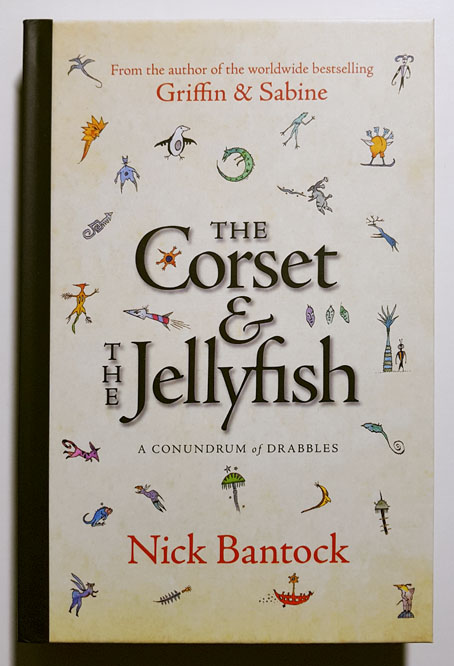
Cover design by Brian DeVoot and Elizabeth Story.

In the post this week, the latest book from Tachyon, a collection of Oulipo-inflected Surrealism from Nick Bantock:

Little is known of the fascinating manuscript that Nick Bantock has come to possess. It was discovered in an attic in North London, stuffed into a battered cardboard box, and unceremoniously delivered directly to Nick’s doorstep. Inside the package lay one hundred evocatively absurd stories, one hundred humorous drawings of strangely familiar, quirkish glyphs, plus a cryptically poetic note signed only as “HH.” (Possibly the well-known, eccentric billionaire, Hamilton Hasp?)

In these stories—each consisting of precisely 100 words—strange creatures slip through alleyways, and eerie streets swallow people whole. Taken altogether, they may constitute a puzzle that no one has been able to solve thus far. Could there even be one missing story?

I didn’t design this one but I was happy to see a preview copy which I described as “A tapestry of exquisite miniatures”. Each of Bantock’s illustrations is printed in colour, which I think is a first for the publisher. Given the time of year, The Corset and the Jellyfish is an ideal gift for any visitors to Calvino’s invisible cities.

Alastair’s Manon Lescaut

alastair01.jpg

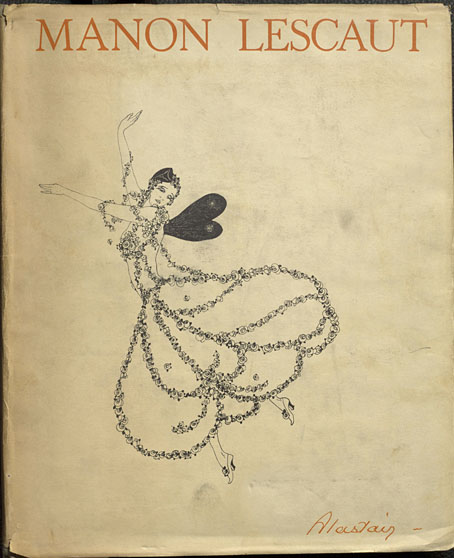
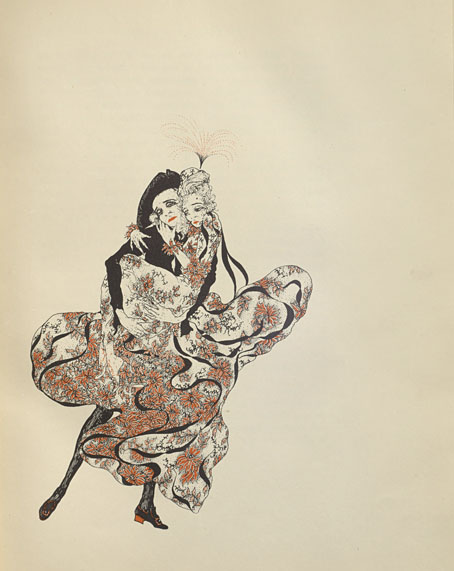
The illustrated works of Alastair aren’t always easy to find, not when Hans Henning Voigt (as the artist was known to his German parents) chose a nom de l’art shared by a large portion of Scottish manhood, past and present. This 1928 edition of Manon Lescaut by the Abbé Prévost is a recent arrival at the Internet Archive. The publisher, John Lane, specialised in illustrated editions, and their Manon Lescaut gives an idea of what we might have seen from Aubrey Beardsley had he survived into the 20th century. John Lane had published collections of Beardsley’s drawings together with related works like Robert Ross’s memories of the artist. It was in their interest to continue the posthumous association, hence the pairing of Alastair with a novel that Beardsley himself might have illustrated. Alastair not only positioned himself as an inheritor of Beardsley’s filigreed drawing style but in photographs appears to be adopting the persona of one of Beardsley’s etiolated characters.

alastair02.jpg

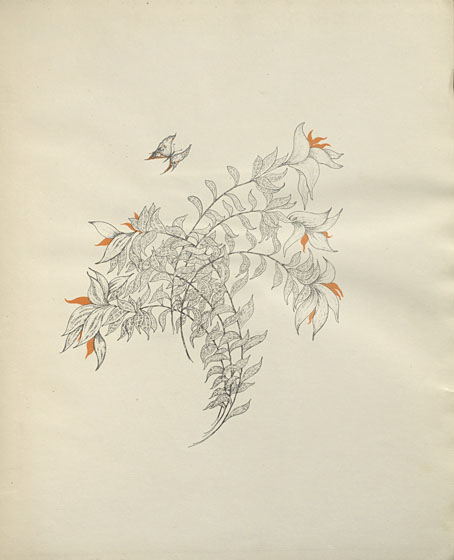
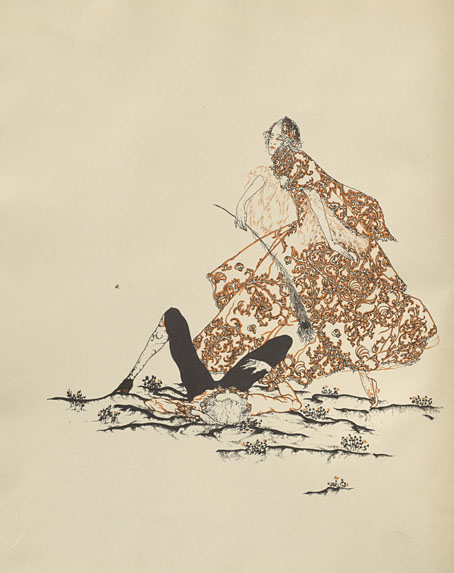
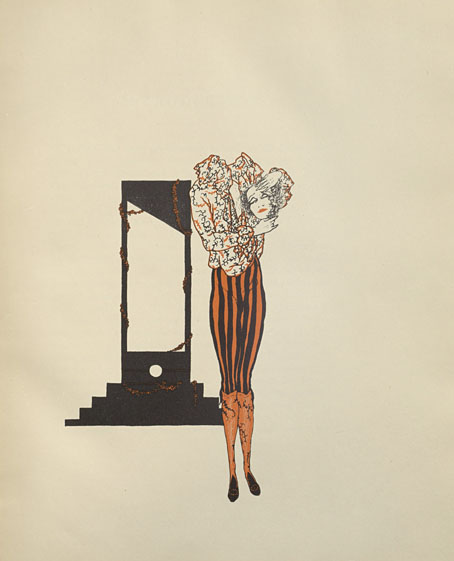
This edition of the novel is an English translation by DC Moylan, with an introduction by Arthur Symons, Beardsley’s friend and collaborator when the pair were teamed as editor and art editor of the short-lived Savoy magazine. Symons was an astute critic, his essays are always worth reading; he remembers his friend here while stepping lightly around Alastair’s imitation of Beardsley’s decorations. As for Alastair himself, he did a good job with the illustrations. The figure-drawing isn’t as uncertain as in some of his earlier works, and each piece is printed in two colours (“the colour of fire and night” as Symons describes it), a process he favoured elsewhere. The leading study of Alastair’s art, Alastair: Illustrator of Decadence (1979) by Victor Arwas, reproduces five of the fourteen drawings, only one of which is shown in colour.

alastair03.jpg

alastair04.jpg

alastair05.jpg

Continue reading “Alastair’s Manon Lescaut”