
Day of the Dead
| Robert Hughes excoriates Damien Hirst.
Category: {sculpture}
Sculpture
Planet by Marc Quinn
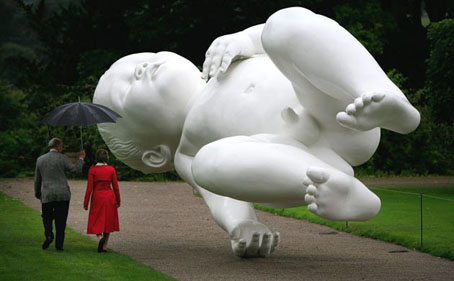
Planet by Marc Quinn. Photo by Christopher Furlong.
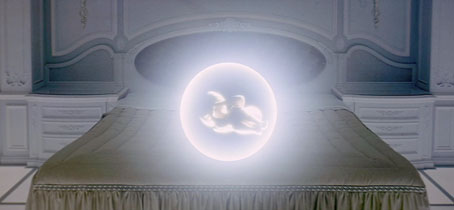
Marc Quinn’s remarkable sculpture is one of several pieces by different artists (including Salvador Dalí) being displayed in the gardens of Chatsworth House until November 2, 2008. I much prefer this to Quinn’s recent works which have gained attention almost solely for having Kate Moss as their model. A floating baby with a stellar name can’t help but remind me of another weightless infant with a cosmic genesis.
Previously on { feuilleton }
• Giant Skeleton and the Chocolate Jesus
• 2001: A Space Odyssey program
Roger Hiorns’ crystal world
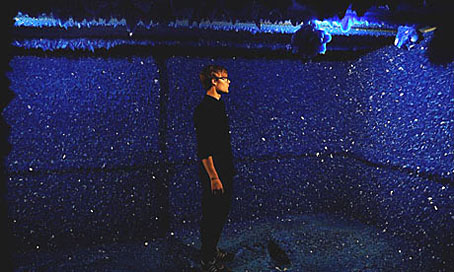
A visitor examining Seizure. Photograph by Sarah Lee.
I’d love to see this installation work which opened on Wednesday at 157 Harper Road, Southwark, London. British artist Roger Hiorns has transformed a flat awaiting demolition by growing thick mats of copper sulphate crystals on all the interior surfaces, a work he calls Seizure. Copper sulphate always brings back memories of chemistry lessons at school and childhood chemistry sets. I recall growing the crystals in a test tube but such meagre attempts at efflorescence give little indication of how beautiful these things are at a larger scale. Happily Flickr has further documentation of Hiorns’ work while Adrian Searle reviews it for The Guardian, fittingly referencing JG Ballard’s The Crystal World. “Seizure is a sort of sci-fi nightmare in Southwark, and that this happens in a council flat makes it all the more uncanny and disturbing,” he says. A shame, then, that it wasn’t situated in an empty high-rise block for maximum Ballard overload.
Seizure runs until 2 November, 2008. Artangel has location details and opening times.
Previously on { feuilleton }
• JG Ballard book covers
Wood that Works by David C Roy
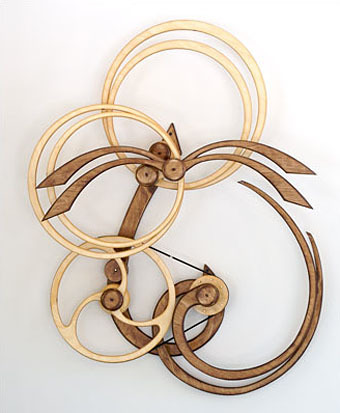
Falcon (2007).
David C Roy‘s wooden sculptures are fine enough when viewed like this but really need to be seen in motion since these are all kinetic pieces. Roy’s website has a choice of animations for each work, from Flash diagrams to YouTube videos, all of which are fascinating to look at. Each piece is spring-driven and runs for several hours. The movements aren’t as predictable as you’d imagine either, many of them create an evolving range of patterns depending on the speed or arrangement of the components.
Previously on { feuilleton }
• Glass engines and marble machines
• Peter Eudenbach’s Eiffel Ferris wheel
IKO stained glass
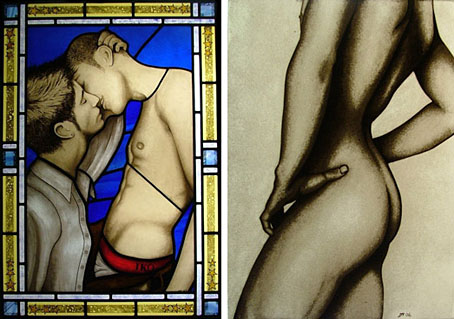
left: The Kiss; right: Male nude.
Stained glass by IKO, aka Italian artist Diego Tolomelli.
Elsewhere on { feuilleton }
• The gay artists archive
Previously on { feuilleton }
• The art of Lucio Bubacco