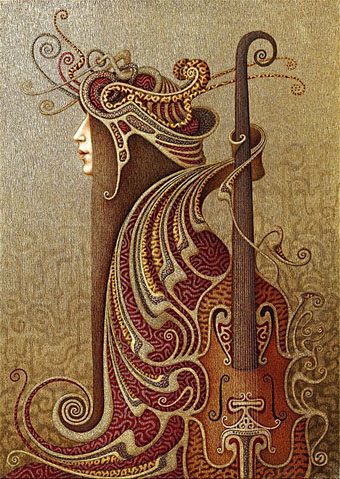
The art of Maxwell Armfield, 1881–1972

armfield1.jpg

De Profundis.

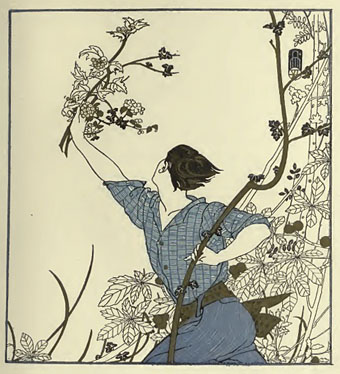
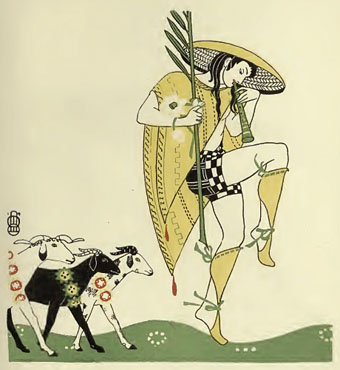
I’ve known Maxwell Armfield’s work in the past mainly for the appearance of his paintings in books of late Victorian or even Pre-Raphaelite art. His depiction of Faustine (1904), which illustrates a Swinburne poem, is probably the most popular of these, with a subject resembling Rossetti’s portraits of Jane Morris. So it’s a surprise to find his illustration work using a very different, more open style based on Ancient Greek art and (possibly) Classical enthusiasts such as John Flaxman. Among the online examples, the redoubtable Internet Archive has a few book downloads available including a volume of Armfield’s rather tepid poetry, The Hanging Garden, and other verse (1914), which nonetheless includes the fine illustrations shown here. In addition there’s a curious fable by Vernon Lee, The Ballet of the Nations; a Present-day Morality (1915) in which Death stages a ballet (aka another war) to decimate humanity, and a short book Rhythmic Shape; A Text-book of Design (1920), Armfield’s guide to art and design theory.
armfield2,jpg

“Out of the East he came.”

Elsewhere on { feuilleton }
The illustrators archive

Magnifying the Prado

prado1.jpg

Albrecht Dürer’s Self-portrait of 1498 as revealed by a new collaboration between Madrid’s Prado Museum and Google Earth. Google has photographed a number of the Prado’s paintings in ultra-high resolution, allowing users of their atlas application to examine the pictures to a degree which the artists themselves wouldn’t have experienced without the use of a magnifying lens. This must be the first time it’s been possible to scrutinise the actual brushstrokes of an online reproduction; screen grabs below show a zoom into Dürer’s right eye. So far only 14 paintings have been given this treatment but among them is the Garden of Earthly Delights triptych by Hieronymus Bosch. It’s worth downloading Google Earth simply for the opportunity to lose yourself in that work’s fantastic tableaux.

prado2.jpg

Bruges panoramas

bruges1.jpg

Do you detect a theme here? The 360º Cities site which I linked to yesterday won’t be news to some since its panorama views are now incorporated into Google Earth. I hadn’t fully investigated it before, however, so I wasted some time today wandering the streets of Bruges almost as you would in a computer game thanks to the way the different panoramas are linked. Clicking the arrows or the thumbnail views means you’re immediately transported to the next location. (Needless to say this works best using the full screen option on a large monitor.) The photographs in this instance are by Robin de Baere.

bruges2.jpg

Bruges is another of those waterlogged places with cobbled streets which so beguile me, hence the choice of a Belgian town over more obvious European locations. The light skies in the night shots—a result of long exposures—lend the empty streets some of the same mysterious atmosphere captured by René Magritte in his Empire of Light series. Magritte was Belgian, of course, so it’s rather fitting, as was Paul Delvaux, another painter of noctural mystery.

empire.jpg

Empire of Light by René Magritte (1953–54).

Elsewhere on { feuilleton }
The panoramas archive

Previously on { feuilleton }
Bruges-la-Morte
Taxandria, or Raoul Servais meets Paul Delvaux