The recurrent pose 30

fernandez.jpg

The previous post in this series showed Flandrin’s Jeune Homme Assis au Bord de la Mer (1836) being used as a book cover illustration and here it is again, confirming once again how easily the painting fits the world of homoerotica whatever the original intention of the artist. I hadn’t come across this book before but it looks like it may be worth buying despite the mixed reviews.

flandrin.jpg

And a recent posting from this Flickr user is another deliberate imitation of Flandrin’s pose.

Elsewhere on { feuilleton }
The recurrent pose archive

The art of Yannis Tsarouchis, 1910–1989

tsarouchis1.jpg

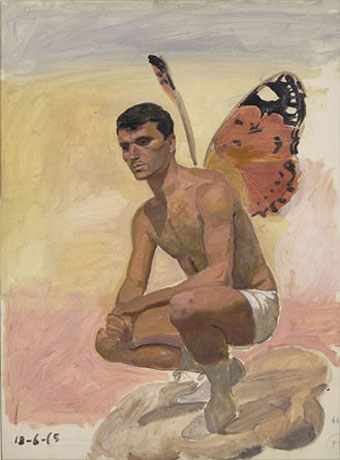
Man with butterfly wings sitting on his heels, study from life (1965).

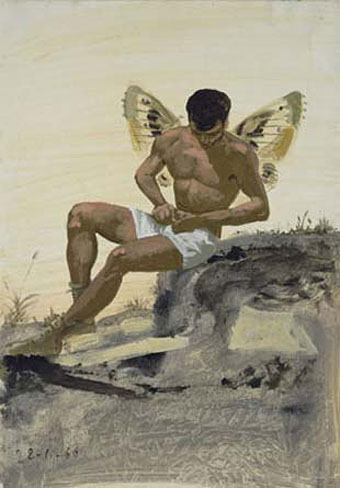
Two paintings by Greek artist Yannis Tsarouchis among whose homoerotic works can be found obsessively recurrent depictions of men with butterfly wings. Via Bajo el Signo de Libra.

tsarouchis2.jpg

Winged spirit buttoning his underpants (1966).

Elsewhere on { feuilleton }
The gay artists archive

Previously on { feuilleton }
Butterfly women

A profusion of Peake

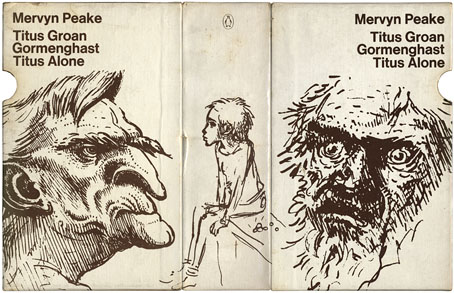
gormenghast_box.jpg

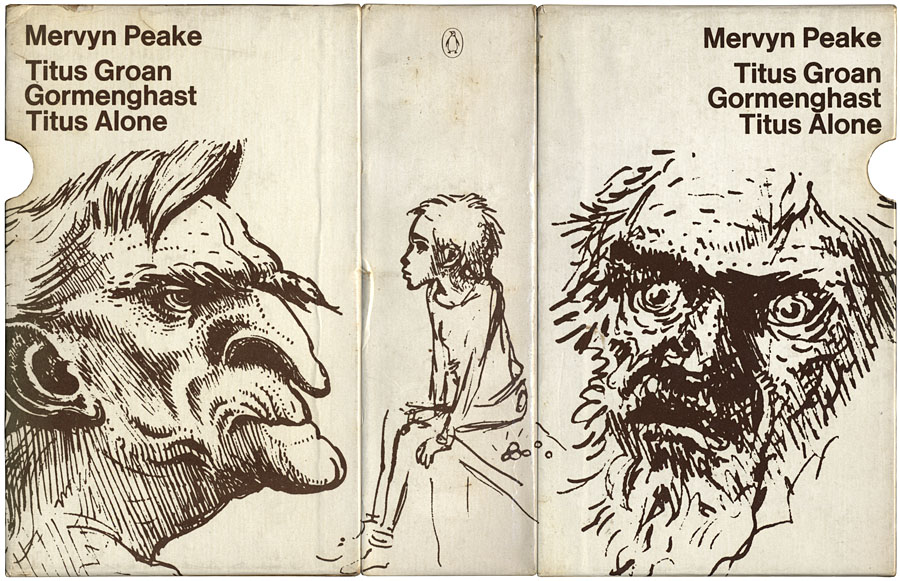
Bellgrove, young Titus and Barquentine by Mervyn Peake. Case designed by Robert Hollingsworth.

I’d thought about posting the covers of my boxed set of Gormenghast paperbacks a couple of years back when there was a flurry of blogospheric attention being given to Penguin cover designs…thought about it then never got round to it. The reason for doing so now is twofold: firstly I’ve been re-reading the books, and secondly some Gormenghast-related news emerged this week which gives this post an additional relevance.
gormenghast1.jpg

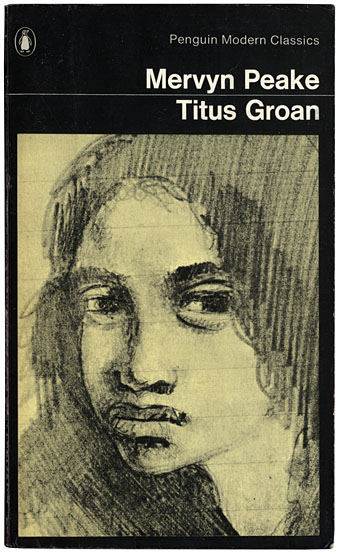
Fuchsia by Mervyn Peake.

The set of Peake paperbacks which Penguin published in 1968 (and their subsequent reprints) were the first editions of Peake’s trilogy which I encountered so I can’t help but regard them as the ones, the only copies I could countenance reading. That may change, however (see below). I’ve no idea how scarce the boxed edition is but the books are reprintings from 1970 so I presume Penguin put out a boxed gift set to make the most of Peake’s posthumous success. I always liked the presentation which is the standard Penguin Modern Classics format of the period, it leaves to you how much you want to regard the books as works of fantasy or simply novels of a rather grotesque and highly imaginative reality. Titus Groan‘s sketch of a glowering and thoroughly unglamorous Fuchsia was a daring choice for a cover intended to lure a newer, younger audience to Peake’s work. The drawing says a great deal about the author’s unsentimental attitude towards his creations; compared to the florid and often delicate covers of the fantasy books being published by Ballantine in the late Sixties (a series which included the Gormenghast trilogy), it seems shockingly unpleasant.

Continue reading “A profusion of Peake”
The Art of Fontana Modern Masters

fontana1.jpg

Design by John Constable, painting by Oliver Bevan (1971).

James Pardey was in touch again this week with news of his a book cover site which follows his earlier (and justly praised) Art of Penguin Science Fiction. The new site The Art of Fontana Modern Masters presents the abstract cover designs for Fontana’s collection of pocket-sized introductions to notable writers, philosophers and scientists. My own copy of the Joyce volume from the initial run of the series is shown above. A note on the back cover states that Oliver Bevan’s painting is part of a single work arranged across ten books which “can be rearranged to form a variety of patterns”. In a pitch to some presumed “collect-the-set” mentality among intellectuals, this idea was continued on later books in the series and James’s site gives an idea of how the covers might be arranged. Until I saw all these covers together I hadn’t realised how impressive the series looks. As with the Penguin site there’s copious information about the production and evolution of the designs.

fontana2.jpg

If that’s not enough, James has a short essay about the series at Eye magazine and HarperCollins (who bought out Fontana) are producing a fine art print of the entire run of covers as shown above. For more details about that, go here.

Elsewhere on { feuilleton }
The book covers archive

Previously on { feuilleton }
Penguin science fiction